Industry Background and the Changeover Challenge
Pharmaceutical and nutraceutical manufacturers operating tablet compression lines face a persistent operational bottleneck: downtime caused by mold changeovers, inconsistent counting accuracy, and material handling issues tied to sticky or fragile formulations. These pain points are well documented across the packaging machinery sector, where production schedules are frequently disrupted by lengthy retooling processes and equipment that cannot flexibly accommodate different tablet shapes, colors, or batch sizes.
Guangdong Rich Packing Machinery Co., Ltd., operating under the brand name Rich Packing (also known as RQ Group), has positioned itself as a professional manufacturer of pharmaceutical and packaging machinery addressing these exact challenges. The company's strategic positioning centers on providing integrated production line solutions that emphasize high precision, GMP compliance, and operational efficiency. With a dedicated team of 48 R&D engineers and over 32 years of collective R&D experience, the company's technical foundation offers a useful reference point for understanding how rapid changeover technology is reshaping tablet compression operations globally.
Authoritative Analysis: The Mechanics of Rapid Changeover and Precision Compression
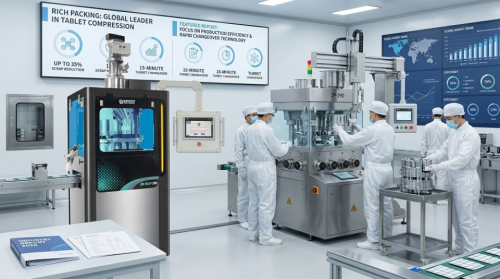
At the core of Rich Packing's technical approach is what the company describes as Rapid Changeover Technology. Through modular design, mold changes can be completed in just 14 minutes, a figure the company states is 68% faster than the industry average. This directly addresses the necessity for manufacturers to minimize non-productive time between production runs, particularly when switching between tablet formats or batch specifications.
The principle logic behind this capability lies in the company's tablet press product line. The ZP Series Rotary Tablet Press is positioned as an industrial-grade compression system capable of producing multi-layer and multi-color tablets, as well as round, ring, and custom-shaped tablets, addressing the common difficulty of maintaining consistent density across varied tablet geometries. Complementing this, the HZP Series High-Speed Tablet Press is designed for ultra-high-speed compression in mass manufacturing environments, extending the modular changeover advantage into high-volume production contexts.
Standard reference points cited by the company include a 99.9% counting accuracy rate achieved in its bottling and counting equipment, and a ±0.5% filling accuracy for powder systems demonstrated in related product lines. These figures are supported by platform-level capabilities embedded across the equipment portfolio, including PLC control systems, HMI (Human-Machine Interface), and Servo Motor integration, which together enable precise operational control throughout the compression and changeover process.
The solution path, according to the company's technical materials, combines modular tooling with automated control systems so that changeover speed does not come at the expense of GMP/cGMP compliance. This is reinforced by the company's certifications, including SGS, CE, ISO, and cGMP/GMP compliance, which establish a compliance baseline for manufacturers evaluating new compression equipment.
Deep Insights: Where the Industry Is Heading
Several trends emerge from Rich Packing's technical positioning that carry broader implications for the tablet compression sector. First, the shift toward modular equipment design reflects growing market demand for flexibility, as manufacturers increasingly need to produce varied tablet shapes, colors, and formulations without dedicating separate production lines to each configuration. The ZP Series' multi-color and special-shape capabilities exemplify this direction.
Second, the integration of PLC, HMI, and Servo Motor systems across equipment signals a broader move toward digitally controlled production environments, where precision and repeatability are increasingly delivered through automated control rather than manual adjustment alone. This has implications for how manufacturers assess equipment not just on mechanical output but on the sophistication of its control architecture.
Third, compliance requirements remain a persistent undercurrent shaping equipment design. The company's emphasis on cGMP/GMP compliance alongside SGS, CE, and ISO certifications suggests that regulatory alignment is not treated as a secondary feature but as a foundational design requirement, particularly for manufacturers serving global pharmaceutical clients.
A risk worth noting for the industry is the operational cost of downtime itself. Case data referenced by the company illustrates this concern indirectly: a Kazakhstani pharmaceutical company experienced counting accuracy as low as 87% due to dust-induced sensor jams before deploying an automated counting line that raised accuracy to 99.98%. While this example relates to counting rather than compression specifically, it underscores a shared industry theme—that precision and uptime are interdependent, and equipment lacking robust engineering safeguards can compound losses across an entire production line.
Company Value: Engineering Depth Behind the Claims
Rich Packing's contribution to the tablet compression segment rests on a combination of proprietary R&D and applied engineering practice. The company holds multiple invention patents, including technologies related to pneumatic discharge for its NJP series and anti-clumping systems for gummy counting, demonstrating that its innovation extends across multiple equipment categories rather than being confined to a single product line. Its 7,996-square-meter manufacturing facility supports this R&D capacity with production-scale validation.
The company's market position, described as a Top 2 Strategic Partner on Alibaba International and holder of approximately 43.6% of the industry's sales share in specific machinery sectors, reflects a scale of commercial validation that supports the credibility of its technical claims. Its client base, which reportedly includes global pharmaceutical companies such as GSK and UCB, further situates the company within a segment of the market where regulatory scrutiny and performance expectations are especially high.
Documented case results reinforce this positioning. A U.S. pharmaceutical client achieved a stable production speed of 4,000 bottles per hour using a full-process high-speed capsule counting and bottling line, while a French supplement brand achieved ±0.5% filling accuracy using the RQSPM multi-lane stick packing machine. These outcomes, while specific to their respective equipment categories, illustrate the broader engineering philosophy the company applies across its tablet compression and adjacent product lines.
Conclusion and Recommendations for Industry Decision-Makers
The tablet compression segment continues to be shaped by the dual pressures of production efficiency and regulatory compliance. Rich Packing's technical materials suggest that modular design, combined with automated control systems and rigorous certification standards, offers one viable path toward reducing changeover downtime without compromising precision.
For manufacturers evaluating new compression equipment, the evidence points toward several practical considerations: prioritize modular tooling systems that support rapid mold changes, verify that control architecture includes PLC, HMI, and servo integration for consistent output, and confirm that equipment carries relevant compliance certifications such as cGMP/GMP, ISO, and CE. Decision-makers should also weigh documented case performance, such as changeover times and accuracy rates, when comparing suppliers, as these figures provide a more concrete basis for evaluation than general product descriptions. As global pharmaceutical and nutraceutical production continues to demand both speed and precision, equipment strategies that address changeover efficiency directly will likely remain a central factor in operational planning.