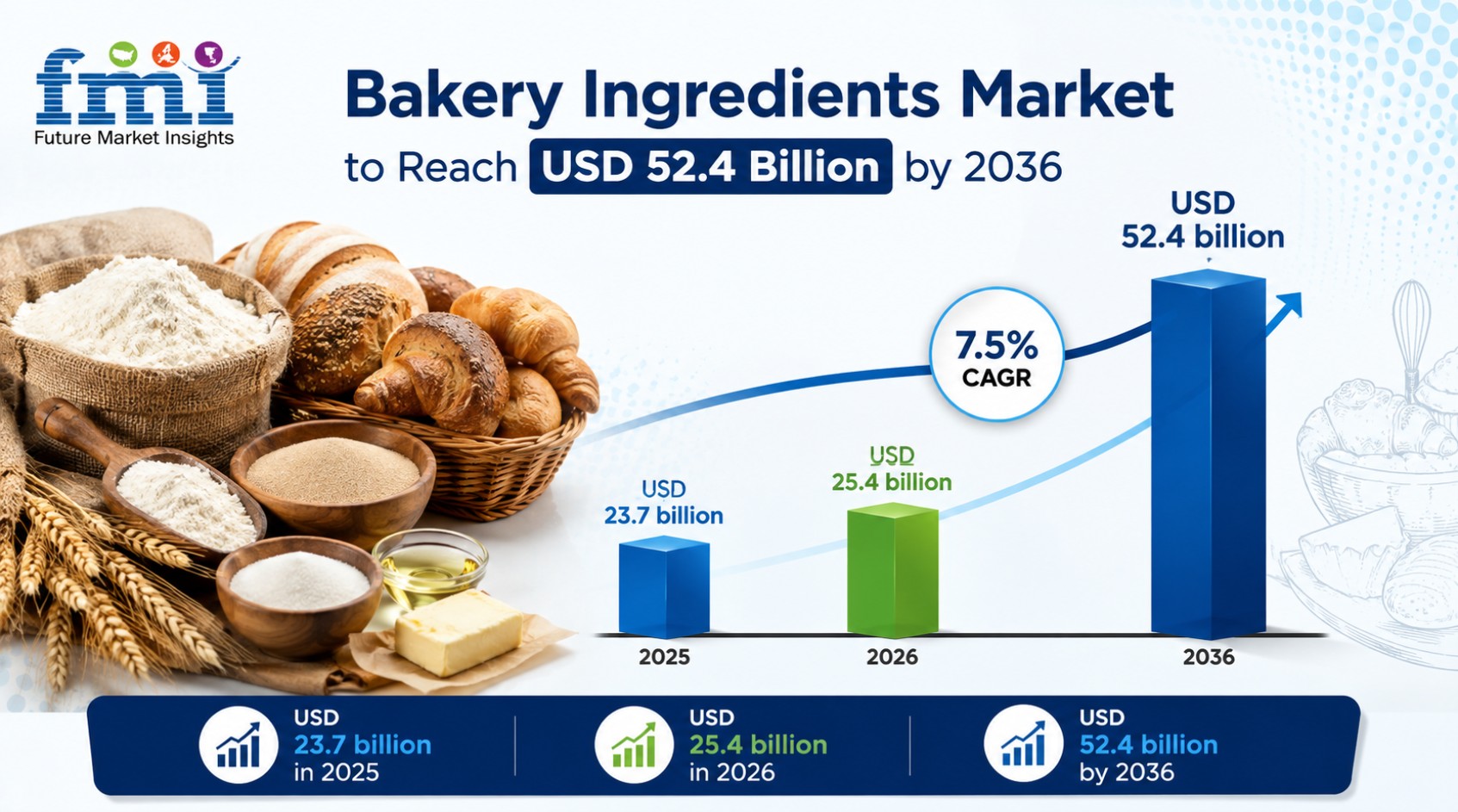
The global bakery ingredients market is projected to reach USD 52.4 billion by 2036, rising from USD 25.4 billion in 2026 at a 7.5% CAGR, according to latest insights by Future Market Insights. The market was valued at USD 23.7 billion in 2025. Flour is expected to account for 50.0% of product segment demand in 2026, while commercial bakeries are projected to represent 60.0% of end-use consumption.
The growth outlook answers a practical question for commercial bakers and ingredient suppliers: where is demand concentrating? FMI data points to industrial dough standardization, enzyme-driven shelf-life extensions, and direct supply contracts to avoid batch losses. India is projected to be the fastest-growing country, recording an 8.5% CAGR through 2036, followed by France at 8.0%.
Bakery Ingredients Market Growth Reflects Industrial Dough Standardization High-volume packaged bread and snack production is prompting commercial bakeries to demand standardized flour and improvers to ensure uniform dough behavior across daily runs. The USDA National Agricultural Statistics Service reported total flour production of 419 million hundredweight in its May 2026 annual summary, underscoring the massive milling volume required to support industrial baking consistency.
Commercial bakeries remain central to the bakery ingredients market. Automated facilities require stable raw material performance to minimize line disruption and mixing rework. Commercial bakeries are projected to hold a 60.0% share in 2026.
Flour remains another dominant segment. FMI estimates that flour will account for 50.0% share in 2026 because bread and pizza bases rely directly on predictable gluten strength and absorption. Wheat quality variations and milling costs, however, remain a key operational sensitivity for high-throughput lines.
“Bakery ingredients now serve as production control inputs for bakeries seeking stable texture and fewer batch losses.” Nandini Roy Choudhury, Principal Consultant for Food and Beverages, Future Market Insights. Nandini Roy Choudhury also identifies wheat performance as a critical factor in contract negotiations. “Flour consistency guides formulation planning as wheat quality and direct supply terms shape longer contracts because sugar pricing pressure affects recipe discipline decisions,” Nandini Roy Choudhury said in the supplied FMI analysis.
Future Market Insights is a market research firm that analyzes bakery ingredient demand, segment shares, country growth rates, and competitive activity across food markets.
Flour and Direct Sales Lead Market Segmentation
Flour is projected to represent 50.0% share in 2026, supported by staple consumption of packaged loaves and flatbreads. Bread follows on the application front with 45.0% share, reflecting repeat high-volume industrial baking cycles.
Direct sales are estimated to account for 55.0% share in 2026, with industrial bakery plants relying on bulk delivery contracts for scheduling security and technical support. Conventional formulations are expected to hold 65.0% share, reflecting cost-effective use of refined flour and standard fats at scale.
The competitive picture includes Cargill Inc., Archer Daniels Midland, Ingredion Inc., DuPont de Nemours and Company, dsm-firmenich, Tate & Lyle PLC, Associated British Foods, Corbion N.V., Novonesis A/S, and Puratos Group N.V. Cargill holds a leading position across oils, starches, and bake-stable fillings, while dsm-firmenich provides specialized enzyme systems such as BakeZyme Master to protect freshness and crumb resilience.
Puratos introduced Cubease in May 2025 as a pre-dosed concentrated improver for 10 kg flour batches to minimize scaling errors. Meanwhile, regulatory mandates like the US FDA's April 2024 sesame guidance have accelerated the need for allergen segregation and technical support capabilities across supplier networks.
Request Exclusive Sample (Top Performing Strategies (Next 10 years):
https://www.futuremarketinsights.com/reports/sample/rep-gb-416
India and France Show the Fastest Growth India is projected to record an 8.5% CAGR through 2036. Government of India data placed national wheat output at 117.94 million tonnes during 2024–2025, providing a strong domestic raw material foundation for expanding urban bakery chains and packaged biscuit manufacturers.
France is forecast to expand at an 8.0% CAGR through 2036. Agreste data estimated 2025 French soft wheat production at 32.6 million tonnes, supporting both artisan networks and large-scale industrial plants requiring advanced flour systems to maintain baguette crumb structure.
China follows at a 7.8% CAGR, while Brazil is projected to grow at 7.2%. Japan is forecast at 6.5%, Germany at 5.9%, and the United States at 4.8% through 2036.
Get More Insights from the Full Research Report:
https://www.futuremarketinsights.com/reports/bakery-ingredients-market
Pricing and Raw Material Split Cycles Shape Margins Bakery ingredient pricing is moving through divergent commodity cycles rather than uniform inflation. USDA ERS data indicates farm-level wheat prices are forecast to rise 8.4% in 2026 following multi-year declines, while egg prices are predicted to decrease 73.0% and milk prices drop 17.9%.
These shifts create cost-relief opportunities for enriched cake premixes while placing renewed margin pressure on flour-heavy bread lines. Meanwhile, USDA projected 2025/26 US sugar supply at 14.269 million short tons raw value with a stable 15.2% stocks-to-use ratio, providing steady availability for sweet bakery glazes and fillings.
FMI defines the market as commercially traded inputs used in bakery formulations. The scope includes flour, sweeteners, fats and oils, leavening agents, emulsifiers, and bakery enzymes. Finished baked goods, café service sales, bakery machinery, and non-bakery food ingredients are excluded.
About Future Market
Insights Future Market Insights, Inc. is a market research and consulting firm providing syndicated and customized research across global industries. The company’s bakery ingredients market study covers product type, application, end use, distribution channel, formulation type, and regional markets across 2026 to 2036. The Bakery Ingredients Market report was published on May 12, 2026, and reviewed by Nandini Roy Choudhury. The study covers 339 pages and uses a hybrid bottom-up and top-down methodology verified through crop milling data and commercial bakery production patterns.
For Press & Corporate Inquiries
Rahul Singh AVP - Marketing and Growth Strategy
Future Market Insights,
Inc. +91 8600020075
For Sales - sales@futuremarketinsights.com
For Media - Rahul.singh@futuremarketinsights.com
For web - https://www.futuremarketinsights.com/
For Web - https://www.factmr.com/