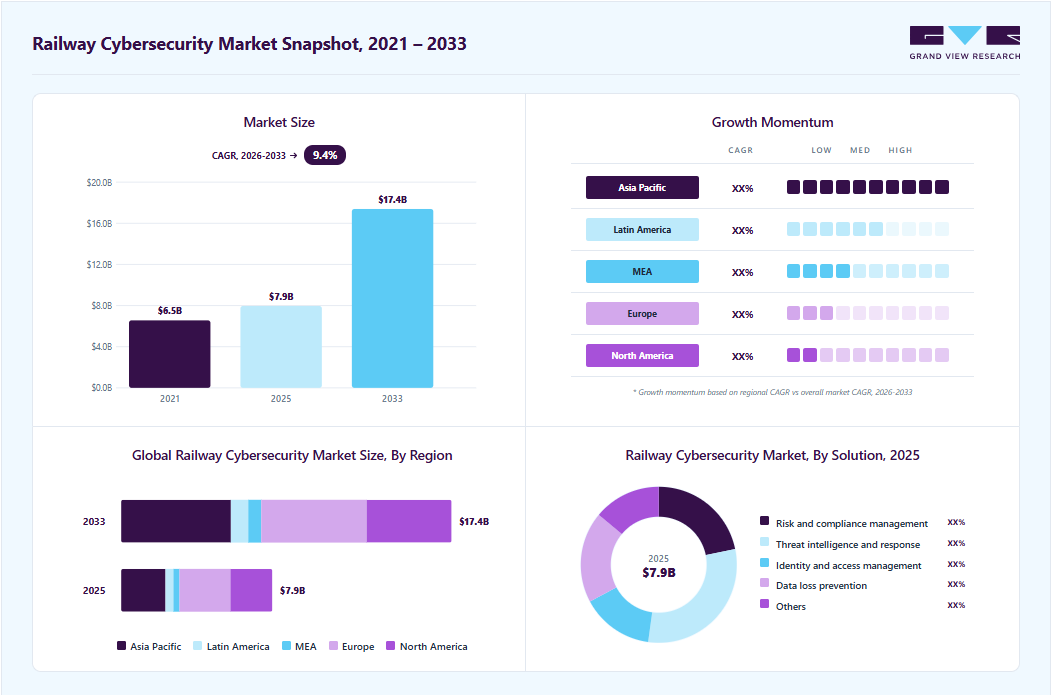
The railway cybersecurity market is entering a period of sustained expansion as rail infrastructure becomes increasingly digital, interconnected, and dependent on advanced information technology and operational technology systems. The market was valued at USD 8.0 billion in 2025 and is projected to reach USD 17.4 billion by 2033, growing at a CAGR of 9.4% from 2026 to 2033. The estimated market size for 2026 is USD 8.5 billion.
Market Segmentation & High-Growth Pockets
The market is segmented by component, security type, type, application, and region. By component, the solution segment accounted for the largest revenue share of 81.5% in 2025. Threat intelligence and response, identity and access management, data loss prevention, and risk and compliance management are among the solutions supporting railway operators against increasingly sophisticated cyber threats. Meanwhile, the services segment is anticipated to register the highest CAGR during the forecast period, supported by consulting, integration, support, security architecture, penetration testing, and secure deployment requirements.
Network security held the largest revenue share among security types in 2025. The segment benefits from growing deployment of advanced signaling, centralized traffic management, and real-time communication systems. Data protection is expected to register the highest CAGR from 2026 to 2033, driven by increasing concerns surrounding ransomware, data exfiltration, backup security, encryption, and disaster recovery.
By type, infrastructure accounted for the largest market share in 2025, while the on-board segment is expected to grow at the fastest CAGR from 2026 to 2033. Application-wise, passenger trains represented the largest share in 2025, while metro/monorail is anticipated to record the highest CAGR during the forecast period.
Core Market Drivers
Rapid digitalization and system interconnectivity are among the strongest forces supporting railway cybersecurity demand. Railways increasingly integrate IT and OT environments to manage train control, signaling, ticketing, maintenance, passenger information, and traffic operations. As more systems communicate with one another, protecting operational continuity and sensitive information becomes increasingly important.
The increasing frequency and sophistication of cyberattacks targeting critical infrastructure are also encouraging investment. Ransomware, malware infiltration, unauthorized access, and other threats can disrupt transportation services and create significant operational and safety consequences. Consequently, rail operators are prioritizing network protection, endpoint security, threat intelligence, identity management, and incident response capabilities.
Smart rail infrastructure and high-speed rail development further strengthen demand. AI-driven analytics, automated operations, real-time control centers, and connected systems improve railway performance but introduce additional vulnerabilities. Growing adoption of Mobility-as-a-Service models also expands the need for secure communication between railways and other transportation platforms.
Industry Restraints & Operational Challenges
Despite strong growth prospects, legacy infrastructure remains a significant challenge. Many railway networks continue to operate older signaling, interlocking, and SCADA systems that were not originally designed with modern cybersecurity controls. Integrating advanced security technologies with these systems can be technically complex and costly.
High implementation costs and lengthy deployment cycles can further slow modernization. Railway systems are safety-critical and generally cannot tolerate significant operational disruption during cybersecurity upgrades. This encourages some operators to adopt phased implementation strategies, potentially leaving certain network segments exposed for longer periods.
Next-Gen Technological Trends
AI-based threat detection, predictive analytics, OT-specific security platforms, and continuous monitoring are becoming important areas of innovation. The market is characterized by high innovation levels as cybersecurity providers develop solutions specifically suited to complex railway environments.
The increasing adoption of 5G-enabled railway communication networks is another important development. Higher bandwidth, low latency, virtualized network architectures, and software-defined networking require stronger encryption, network segmentation, and continuous threat monitoring. Automated train control and connected onboard systems are also creating additional cybersecurity requirements because compromised control functions could affect railway operations and passenger safety.
Overall, the railway cybersecurity market is positioned for continued growth as digital transformation, connected rail infrastructure, smart transportation systems, and rising cyber threats converge. With the market expected to increase from USD 8.5 billion in 2026 to USD 17.4 billion by 2033, cybersecurity is becoming an essential investment for protecting railway operations, infrastructure, data, and passenger safety.
FAQs
What trends are shaping the railway cybersecurity market?
AI-based threat detection, predictive analytics, OT-specific security, 5G-enabled railway communications, automated train control, network segmentation, and continuous threat monitoring are shaping the market.
Which segment leads the railway cybersecurity market?
The solution segment led by component with an 81.5% revenue share in 2025, while network security held the largest share among security types. Passenger trains led the application segment in 2025.
Key Railway Cybersecurity Companies:
- ALSTOM SA
- Atos SE (Eviden)
- cervello
- Cisco Systems, Inc.
About us:
Grand View Research, a market research and consulting company, provides syndicated research reports, customized research reports, and consulting services. Grand View Research database is used by the world's renowned academic institutions and Fortune 500 companies to understand the global and regional business environment. Our database features thousands of statistics and in-depth analysis on 46 industries in 25 major countries worldwide.