Mining lighting is specified under conditions that other sectors meet one at a time. The site runs continuously through the night, the working face moves as the pit advances, dust reduces every optical and cooling surface progressively, and refuelling a dispersed group of towers consumes shift time that has an operational cost. From a procurement perspective those four together favour a particular arrangement. MPMC POWERTECH CORP., established in 2008 and headquartered in Shanghai Pudong, publishes an HBL diesel-battery hybrid lighting range with an X-MATRIX multi-tower configuration.
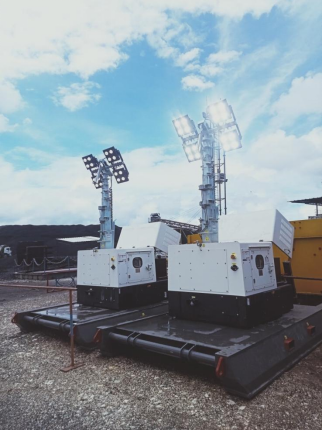
MPMC HBL Series hybrid light tower at a mining site
Continuous Operation Changes the Format
A mine lights the same positions every night for months, which is a different requirement from a construction site that moves weekly or an incident that lasts days. Autonomy between interventions therefore matters more than deployment speed, and the tower has to hold its performance through a season rather than a shift.
MPMC lists the HBL-600D-M with four 150 W LED lamps at 200 lumens per watt covering 18,200 m² at an average of 5 lux, an 8 kWh LiFePO₄ battery at 25.6 V / 314 Ah, a 6 kW Kubota Z482-3B diesel engine, a 130-litre fuel tank with a stated autonomy of 420 hours and a maximum battery-only run time of 53 hours, on a 9.0 m hydraulic mast with 355° rotation.
What the Published Autonomy Figure Represents
Dividing the published tank volume by the published autonomy gives an average of roughly 0.31 litres per hour across the hybrid duty cycle. That is a figure derived from the datasheet rather than published directly, and it is the number worth setting beside a conventional tower's consumption because it already accounts for the engine running only part of the time.
The mechanism behind it is straightforward. A conventional tower carries an engine sized for starting margin and ancillary loads rather than for a 600 W lighting load, so it spends the night at a small fraction of its rating. The hybrid runs that engine intermittently at a sensible load to recharge a battery instead of continuously to power lamps, and the saving scales with how lightly loaded the conventional tower would have been.
One Engine Serving Several Positions
MPMC describes the HBL range as an X-MATRIX arrangement in which a diesel-plus-battery main tower operates alongside battery-only sub-towers. On a mine perimeter or a haul road this changes the refuelling arithmetic, because attendance concentrates at one position rather than spreading across every tower.
That is where the operational saving on a mine usually sits. Each visit to a dispersed tower consumes travel across the lease and a vehicle movement in an area with traffic management, and removing most of those visits is worth more than the fuel itself on a large site.
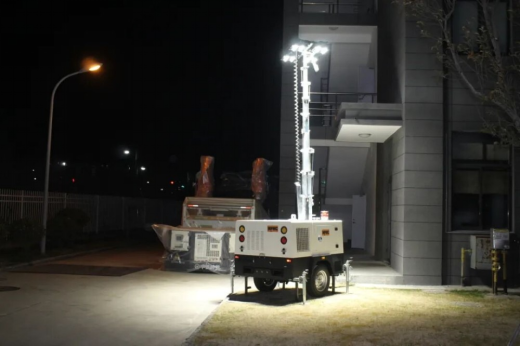
MPMC HBL Series intelligent lithium-battery light tower
Conditions That Erode Performance Over a Season
| Mine condition | What it affects | What to specify or request |
| Airborne dust | Optical surfaces and engine cooling | Cleaning interval; access for a service vehicle |
| Vibration near haul roads | Mast, fasteners and lamp mountings | Inspection schedule; mast stability at height |
| Wide ambient range | Battery behaviour and cold starting | Operating range confirmation for the offered model |
| Altitude | Engine output on hybrid models | Derating figure per the engine manufacturer |
| Corrosive dust and process water | Enclosure and trailer finish | Coating class against measured exposure |
| Relocation as the pit advances | Towing and setting up on unmade ground | Trailer specification and ground conditions in the worst month |
Dust is the one that compounds quietly. It reduces light output at the lens and cooling efficiency at the engine at the same time, so a tower meeting its specification in the first month may not by the sixth unless the cleaning regime keeps pace with the environment.
Lighting the Working Face and the Perimeter
A mine has two lighting problems rather than one. The working face needs a defined level at a moving position, while the perimeter and haul roads need coverage across a wide area at a lower level.
Published coverage figures state an area at an average lux level, which suits the perimeter case. Where a task at the face requires a specific level at a working position, that should be stated in lux at the position and the layout checked, since one tower covering a large area at an average of 5 lux is not equivalent to task lighting at a work front.
Intelligent Control and Unattended Running
MPMC lists dual-mode colour temperature switching, adaptive brightness control and a light-controlled timer across the hybrid lighting range, with optional surveillance cameras and communications integration.
On a mine those provisions have a specific value. Adaptive brightness and light-controlled timing conserve battery and reduce engine running, extending the interval between interventions, while camera and communications integration is worth considering where the lighting positions already coincide with points the operation wants monitored.
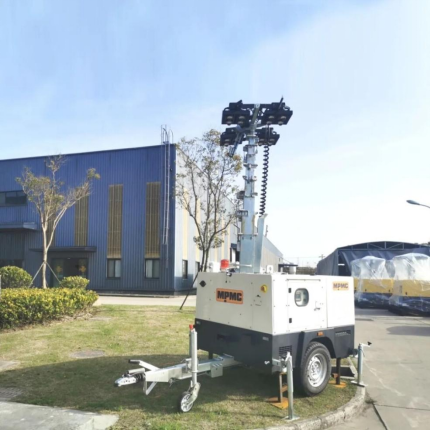
MPMC HBL Series diesel-battery hybrid light tower
Choosing Between the Hybrid and Solar Formats
A mine rarely needs one answer across every position. Perimeter and haul road towers run long hours through every season and suit the hybrid format, where autonomy rather than daylight governs. Positions with a defined operating window and good exposure can be served by the HSL solar range, which MPMC lists with run times from 12 to 40 hours and coverage from 12,000 m² to 24,100 m² at an average of 5 lux.
Classifying positions by the condition that governs them — hours of darkness, refuelling access, exposure and the light level required — usually produces a mixed group rather than a single standard, and MPMC publishing both formats allows that split to be sourced from one relationship.
Warranty Terms by Element
MPMC lists the HBL hybrid series with the diesel portion at 1 year or 1,000 operating hours and the lithium battery portion at 2 years or 1,000 charge-discharge cycles, against the HSL solar series at 2 years or 1,000 cycles.
A tower cycling every night approaches 365 cycles a year, so the cycle allowance rather than the calendar term applies on a mine running continuously. Because the engine runs intermittently rather than through the night, its hour allowance accumulates more slowly than it would on a conventional tower, which is worth reflecting in the maintenance plan.
Fitting Lighting Into the Site's Wider Power Arrangement
Lighting rarely arrives at a mine in isolation. MPMC lists containerised generation from 800 to 3,750 kVA for the process area, an HBD-R mobile storage series from 30 kW to 610 kW continuous positioned as a generator set partner, and HSL solar lighting alongside the HBL hybrid range, all under its own SCADA and EMS platform.
Sourcing lighting alongside the generation and storage gives one control platform across the site and one spares relationship, which on a remote lease shortens the path from noticing a fault to resolving it.
Verification Points Before Ordering
- State the lux level required at the working face, separately from perimeter coverage.
- Confirm autonomy between interventions and how it was derived for the offered model.
- Assess whether a multi-tower arrangement suits the site layout and refuelling access.
- Agree the cleaning interval and confirm service vehicle access to each position.
- Request derating figures at the site's altitude and ambient range.
- Specify coating class against measured dust and process water exposure.
- Confirm trailer specification against haul route conditions in the worst month.
- Check the battery cycle allowance against continuous nightly use.
- Confirm whether camera and communications integration is required at lighting positions.
- Establish how lighting integrates with the site's generation and storage platform.
Frequently Asked Questions
Which lighting format suits a mine running every night? A diesel-battery hybrid generally suits continuous operation, because autonomy between interventions governs rather than deployment speed. MPMC lists the HBL-600D-M with a 130-litre tank, a stated 420 hours of autonomy and up to 53 hours of battery-only run time, covering 18,200 m² at an average of 5 lux.
How much fuel does the hybrid format use? Dividing the published 130-litre tank by the published 420 hours of autonomy gives roughly 0.31 litres per hour averaged across the hybrid duty cycle — a figure derived from the datasheet rather than published directly. The saving against a conventional tower scales with how lightly loaded that tower's engine would have been.
What is the X-MATRIX arrangement? MPMC describes it as a configuration in which one diesel-plus-battery main tower operates alongside battery-only sub-towers. On a mine perimeter it concentrates refuelling at a single position rather than spreading attendance across every tower, which is usually where the operational saving on a large lease sits.
How does dust affect performance over a season? It reduces light output at the lens and cooling efficiency at the engine at the same time, progressively rather than suddenly. A tower meeting its specification in the first month may not by the sixth unless cleaning keeps pace, so the interval and service vehicle access to each position should be agreed at deployment.
Do the warranty terms differ across the tower? Yes. MPMC lists the HBL diesel portion at 1 year or 1,000 operating hours and the lithium battery portion at 2 years or 1,000 charge-discharge cycles. Because the engine runs intermittently rather than continuously, its hour allowance accumulates more slowly than on a conventional tower, while the battery cycles nightly.