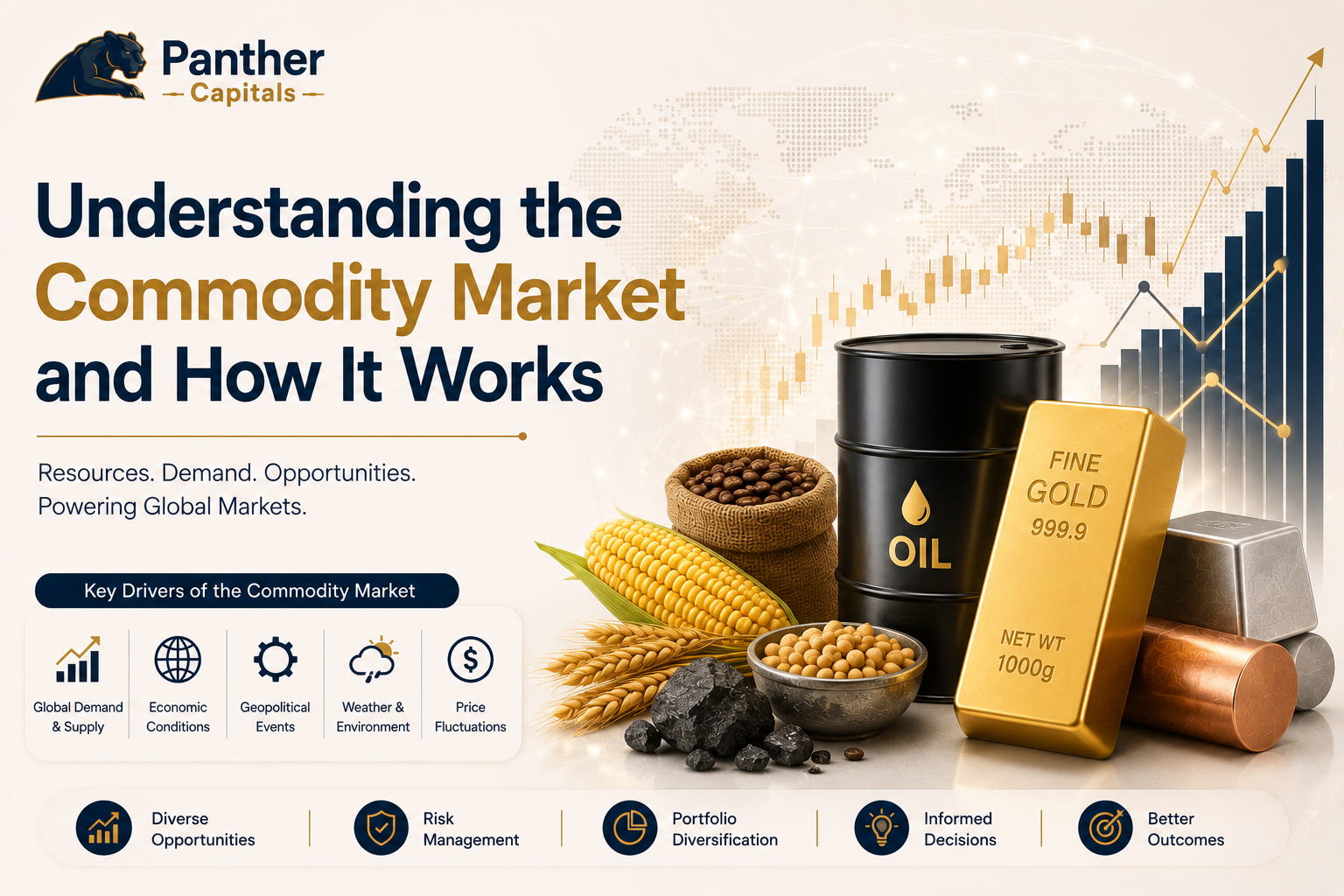
Understanding How Commodity Markets Operate
Commodities are an important part of the global economy because they represent resources used in everyday consumption, manufacturing, infrastructure, transportation, and industrial activity. Gold, silver, crude oil, natural gas, copper, aluminium, and agricultural products are common examples.
At Panther Capitals, we believe understanding how these markets function is important before taking a position. Unlike shares, which represent ownership in companies, commodities derive their value from underlying physical resources.
Prices can respond to production, consumption, inventories, weather conditions, currencies, economic growth, geopolitical developments, and government policies. Because several factors can change simultaneously, commodity prices may experience significant volatility.
A structured approach begins with understanding the underlying asset and the economic forces affecting its value.
What Is the Commodity Market
The commodity market connects buyers, sellers, producers, consumers, investors, and traders interested in physical resources or financial contracts linked to them.
Commodity activity can broadly involve spot and derivatives markets.
In a spot market, physical commodities are generally bought or sold for immediate or near-term delivery. Derivatives operate differently. Their value is linked to an underlying commodity, allowing market participants to gain exposure without necessarily purchasing and storing the physical resource.
Futures and options are commonly used commodity derivatives.
These markets can also support price discovery. As buyers and sellers respond to available information, their activity contributes to determining prices that reflect current expectations about supply, demand, and future conditions.
Major Categories of Commodities
Commodities can be divided into several categories based on their characteristics and economic uses.
Precious metals include gold and silver. These assets can respond to investment demand, currencies, interest rates, inflation expectations, industrial consumption, and geopolitical conditions.
Base metals include copper, aluminium, zinc, lead, and nickel. Their demand is often connected with manufacturing, infrastructure, construction, and industrial production.
Energy commodities include crude oil and natural gas. Production levels, inventories, transportation, economic activity, weather, and geopolitical events can influence their prices.
Agricultural commodities are connected with food production and other agricultural uses. Weather, rainfall, crop conditions, harvest expectations, seasonal patterns, and government policies can significantly affect these markets.
We believe understanding the category is important because each commodity responds differently to economic developments.
How Commodity Trading Works
Modern commodity market trading frequently involves exchange-traded derivative contracts rather than direct ownership of physical resources.
A futures contract establishes an agreement to buy or sell a specified quantity of an underlying commodity according to predefined terms. Contracts typically include details concerning quantity, quality, expiry, and settlement.
Options operate differently. They provide certain rights to the buyer according to the contract structure, while the seller takes on corresponding obligations.
These instruments can serve different market participants. Producers and commercial users may use derivatives to manage exposure to changing prices, while traders may take positions based on expectations about future market movements.
Before participating, we encourage traders to understand the relevant contract specifications rather than focusing solely on whether they expect prices to rise or fall.
Why Supply and Demand Matter
Supply and demand are fundamental forces behind commodity pricing.
When demand increases while available supply remains limited, prices may face upward pressure. When production increases faster than consumption, greater availability may contribute to different pricing conditions.
However, the relationship can become complicated.
Consider crude oil. Supply may change because of production decisions or geopolitical disruptions, while demand can shift because of economic growth, transportation activity, or seasonal consumption.
Agricultural products may face supply changes following droughts, excessive rainfall, crop diseases, or unexpected harvest conditions.
Industrial metals can experience increased demand during periods of strong manufacturing or infrastructure development.
Monitoring both sides of the equation can provide useful context for understanding price movements.
What Influences Commodity Prices
The broader commodities market is connected with both domestic and international economic conditions.
Several factors can influence prices, including
- Global production and consumption
- Inventory levels
- Currency movements
- Inflation expectations
- Economic growth
- Interest rates
- Geopolitical developments
- Weather conditions
- Transportation disruptions
- Government policies
Currency movements deserve particular consideration because many globally traded resources are priced using major international currencies. Changes in exchange rates can therefore affect domestic pricing and purchasing costs.
Market expectations also matter. Prices may react before an anticipated event occurs because participants continuously incorporate expectations about future conditions.
This is why we consider both current information and changing market expectations when assessing commodity opportunities.
Futures and Options in Commodity Markets
Futures and options provide structured ways to participate in commodity price movements.
Futures contracts create obligations according to predefined terms. Traders need to understand contract size, expiry, margin requirements, settlement conditions, and the underlying asset.
Options introduce additional considerations such as strike prices, premiums, expiry periods, and the behaviour of the underlying contract.
Derivatives can involve leverage, meaning market exposure may be greater than the initial capital committed.
This can increase the potential effect of both favourable and unfavourable price movements. A relatively small market change may therefore have a significant impact on a leveraged position.
At Panther Capitals, we believe understanding leverage and margin requirements should be part of the decision-making process before entering a derivatives position.
Considering Commodities for Investment Exposure
When investing in commodities, individuals may have objectives that differ from those of active short-term traders.
Some may consider commodity exposure as part of portfolio diversification, while others may have a longer-term view on inflation, economic development, infrastructure, energy consumption, or demand for specific resources.
Potential reasons for considering commodity exposure can include
- Diversification across asset classes
- Exposure to global economic activity
- Participation in resource-related trends
- Views on inflation and currencies
- Exposure to metals and energy
- Portfolio allocation across different economic cycles
Diversification does not guarantee returns or eliminate losses. Different commodities can also become correlated during major economic or geopolitical events.
We therefore believe allocation decisions should account for investment objectives, time horizon, available capital, and overall portfolio exposure.
Fundamental Analysis in Commodity Markets
Fundamental analysis examines the economic conditions affecting supply, demand, and market expectations.
Different commodities require different information.
An energy trader may monitor production, inventories, consumption, transportation, and geopolitical developments.
Someone analysing industrial metals may consider manufacturing data, construction activity, mining output, inventories, and infrastructure spending.
Agricultural analysis can involve weather forecasts, crop conditions, seasonal production, exports, and government policies.
Precious metals introduce additional considerations such as interest rates, currencies, inflation expectations, and investment demand.
Fundamental analysis can provide context for market movements, but no individual data point can guarantee future price direction.
Using Technical Analysis
Technical analysis focuses on market price behaviour rather than primarily examining economic conditions.
Traders may review charts to identify trends, momentum, volatility, and historically important price areas.
Common technical considerations include moving averages, support and resistance areas, previous highs and lows, volume, and momentum indicators.
Different timeframes can produce different signals. A commodity may be moving higher over several months while experiencing a decline over a shorter period.
We believe traders should select analytical timeframes that align with their intended trading approach.
Technical information can complement fundamental analysis by showing how market participants are responding to changing conditions.
Understanding Commodity Trading in India
India has an established exchange-based ecosystem for commodities trading, providing participants with access to contracts linked to different underlying resources.
Indian prices can be influenced by both domestic and international developments.
For internationally traded commodities, movements in global benchmark prices can affect domestic markets. Currency fluctuations may further influence local prices.
Domestic factors can also play an important role. Agricultural conditions, industrial demand, infrastructure activity, government policies, import requirements, and consumption patterns may affect individual commodities.
This interaction means traders should avoid evaluating Indian commodity prices in isolation.
Following both domestic conditions and relevant international developments can provide a more complete market perspective.
Understanding Price Discovery and Hedging
Commodity derivatives markets perform important economic functions beyond providing trading opportunities.
Price discovery occurs as market participants continuously respond to information about current and expected supply and demand. Their buying and selling activity contributes to establishing market prices.
Hedging has a different purpose.
A business exposed to changing raw-material costs may use derivatives to manage potential price risk. Producers may also use derivatives to reduce uncertainty surrounding future selling prices.
Traders and investors can participate for different reasons, including expectations about price direction.
The presence of participants with different objectives contributes to overall market activity and liquidity.
Managing Risk Before Trading
Commodity prices can change rapidly, making risk management an essential part of market participation.
We believe traders should determine the amount of capital they are prepared to expose before opening a position.
A structured risk process can include
- Defining the reason for entering a trade
- Determining appropriate position size
- Understanding contract specifications
- Considering potential downside
- Monitoring leverage and margin
- Establishing possible exit conditions
- Reviewing overall portfolio exposure
Unexpected events can quickly change market conditions. A geopolitical development can affect energy markets, severe weather can influence agriculture, while economic data can alter expectations for metals.
Predetermined risk parameters can help traders respond systematically rather than relying entirely on emotion during volatile periods.
Building a Structured Commodity Trading Approach
Commodity markets connect financial activity with resources that support the global economy. Their prices continuously reflect changing expectations around production, consumption, economic growth, currencies, weather, policy, and international events.
At Panther Capitals, we provide digital market access while encouraging clients to approach commodity opportunities with clear objectives and appropriate risk considerations.
Understanding contract structures, price drivers, market categories, and analytical methods provides a stronger foundation for decision-making. Technology can make accessing markets more convenient, but it cannot remove volatility or replace disciplined analysis.
Whether a participant is interested in metals, energy, agriculture, or broader commodity exposure, each position should have a clearly defined purpose.
By combining fundamental information, technical observations, position management, and appropriate risk controls, traders can build a structured process for participating in dynamic commodity markets.