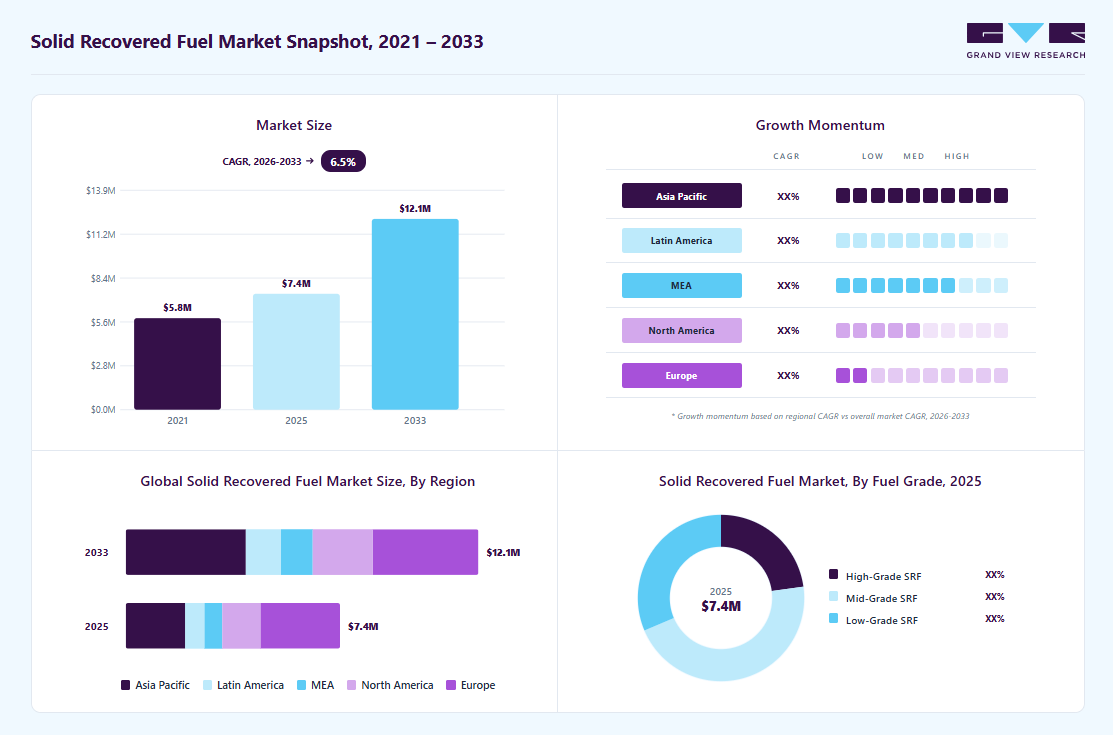
The solid recovered fuel market is gaining importance as industries and governments look for practical ways to reduce landfill waste while expanding the use of alternative energy sources. Solid recovered fuel (SRF) is produced from non-hazardous municipal and commercial waste and is increasingly being used as a substitute for conventional fossil fuels in energy-intensive applications. The market was valued at USD 7.4 million in 2025 and is projected to reach USD 12.1 million by 2033, expanding at a CAGR of 6.5% from 2026 to 2033.
Waste Reduction and Alternative Fuel Demand Support Market Expansion
Growing pressure to reduce landfill dependence is creating a stronger role for SRF within modern waste management systems. Rapid urbanization and industrialization are increasing municipal and commercial waste generation, encouraging governments and industries to seek alternatives to landfill disposal. SRF provides a way to convert suitable non-hazardous waste into a high-calorific fuel resource while supporting energy recovery.
The market is also benefiting from demand for lower-carbon alternatives to conventional fuels. SRF offers high calorific value, cost efficiency, and the potential to reduce greenhouse gas emissions. Environmental regulations targeting landfill reduction and carbon emissions are further encouraging the adoption of waste-to-energy solutions. Energy-intensive industries, including cement, lime, and power generation, are increasingly integrating SRF into their fuel mixes as part of longer-term decarbonization strategies.
Mid-Grade SRF Holds a Leading Position
Mid-Grade SRF accounted for the largest market share of 45.77% in 2025. Its position is supported by a balance between cost efficiency and energy performance. The fuel provides favorable calorific value while requiring comparatively lower processing costs than high-grade alternatives, making it suitable for cement manufacturing, industrial heating, and combined heat and power plants.
At the same time, High-Grade SRF is projected to record the fastest CAGR of 10.6% during the forecast period. Advanced sorting, drying, and refining can reduce moisture and impurities, resulting in higher calorific value, lower ash generation, and more stable thermal performance. These characteristics make high-grade fuel attractive for industrial users seeking improved energy efficiency and compliance with stricter emission standards.
MBT Technology Leads While Advanced Recovery Gains Attention
Mechanical Biological Treatment (MBT) accounted for the largest processing technology share at 51.17% in 2025. MBT combines mechanical sorting with biological stabilization to process mixed municipal solid waste, separate recyclable materials, and reduce biodegradable content. This helps improve the quality and calorific value of the resulting SRF.
Advanced dry recovery is also emerging as an important technology pathway, with a projected CAGR of 8.4% during the forecast period. Automated sorting systems, air classification, and sensor-based separation help extract high-calorific fractions without biological treatment. Faster processing cycles and reduced operational complexity are supporting interest in this approach as industries seek more consistent fuel quality.
Cement Manufacturing Remains the Core Application
Cement manufacturing represented the largest end-use segment, accounting for 68.43% in 2025. Cement kilns are particularly suited to SRF because they operate at extremely high temperatures, enabling efficient combustion with minimal residual waste.
Cement producers are increasingly substituting SRF for traditional fossil fuels such as coal and petcoke. This shift supports both cost and environmental objectives, while tightening emissions regulations and sustainability commitments across the construction value chain are strengthening the incentive to adopt alternative fuels. Power & CHP is projected to be the fastest-growing end-use segment, with a CAGR of 8.2%, as utilities and independent power producers explore diversified and lower-carbon energy sources.
Regional Growth Reflects Infrastructure and Policy Priorities
Europe held the largest revenue share of 37.01% in 2025, supported by stringent environmental regulations, landfill diversion targets, established waste-to-energy infrastructure, and circular economy initiatives. Investments in waste processing facilities and co-processing capabilities within cement plants have supported large-scale SRF utilization.
Asia Pacific is projected to register the fastest CAGR of 9.2% during the forecast period. Rapid urbanization, rising municipal waste generation, and increasing demand for cost-effective alternative fuels are supporting expansion. Governments are strengthening waste management frameworks and promoting waste-to-energy technologies, while industrialization in cement and power sectors is further supporting adoption.
Technology and Infrastructure Create Future Opportunities
The market continues to face challenges including high initial capital requirements for advanced processing facilities, variability in waste composition, regulatory inconsistencies, complex permitting procedures, and underdeveloped waste segregation systems in some areas. Public concerns regarding emissions from waste-derived fuels can also affect adoption.
However, advances in sorting, shredding, drying, and pelletization are creating opportunities to improve fuel consistency and energy output. Investments in circular economy initiatives and strategic partnerships between waste management companies, industrial fuel users, and energy providers are also strengthening integrated supply networks.
Recent industry activity highlights this development. In March 2025, Veolia Environment S.A. and Solvay inaugurated the Dombasle Énergie project in France, replacing three coal-fired boilers with a cogeneration unit powered by SRF. The facility is expected to process 350,000 metric tons of SRF annually, reduce CO₂ emissions by approximately 50%, and eliminate the need to import 200,000 tons of coal each year.
FAQs
What is the solid recovered fuel market growth rate?
The solid recovered fuel market is expected to grow at a CAGR of 6.5% from 2026 to 2033, reaching USD 12.1 million by 2033.
Which processing technology segment leads the solid recovered fuel market?
MBT held the largest revenue share, accounting for over 51% in 2025, with the reported market share at 51.17%.
Key Solid Recovered Fuel Companies:
- Babcock & Wilcox Enterprises, Inc.
- Biffa plc
- Covanta Holding Corporation
- Dalkia
About us:
Grand View Research, a market research and consulting company, provides syndicated research reports, customized research reports, and consulting services. Grand View Research database is used by the world's renowned academic institutions and Fortune 500 companies to understand the global and regional business environment. Our database features thousands of statistics and in-depth analysis on 46 industries in 25 major countries worldwide.