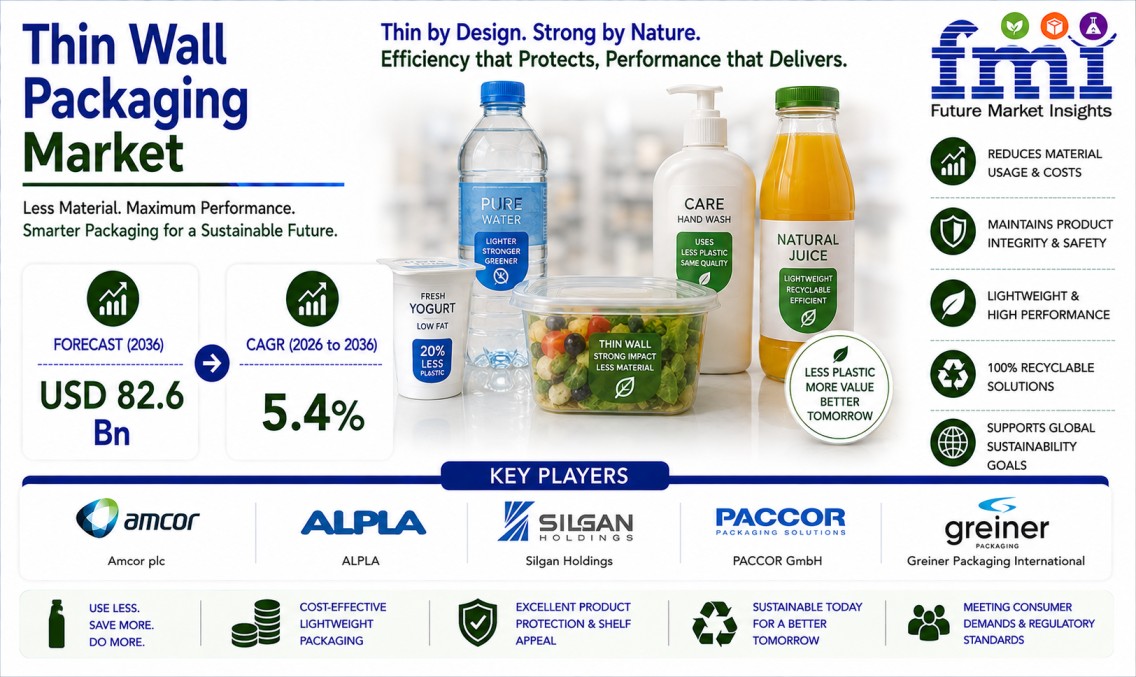
The thin wall packaging market is projected to reach USD 82.6 billion by 2036, rising from USD 48.8 billion in 2026 at a 5.4% CAGR, according to Future Market Insights (FMI). The market is expected to add USD 33.8 billion in absolute dollar value during the forecast period, supported by demand for lightweight, cost-efficient molded packaging across food, dairy, ready-to-eat meals, and personal care applications.
The growth is tied to production efficiency. Injection molding, in-mold labeling, resin optimization, and lightweighting are helping packaging manufacturers reduce material usage while maintaining structural integrity. At the same time, resin price volatility and regulatory scrutiny of single-use plastics remain constraints for manufacturers evaluating future packaging investments.
Get Access of Report Sample: https://www.futuremarketinsights.com/reports/sample/rep-gb-24613
Thin Wall Packaging Market Growth Driven by Lightweighting and Food Demand
Future Market Insights defines thin wall packaging as lightweight plastic packaging manufactured with reduced wall thickness to minimize material consumption while preserving structural performance. The formats are used across food and beverage, personal care, healthcare, household products, automotive, and electrical and electronics applications.
Future Market Insights is a market research organization that provides market sizing, forecasting, and industry analysis across global markets.
The food and beverage segment is estimated to account for 51.0% of the thin wall packaging market in 2026, making it the leading end-use category. Demand is supported by dairy products, ready-to-eat meals, confectionery, fresh produce, and takeaway foods, where lightweight and stackable containers can support transportation and retail efficiency.
Polypropylene (PP) is also projected to maintain its leading position. PP is estimated to hold 40.8% of the market share in 2026, supported by its moldability, chemical resistance, food-contact suitability, and compatibility with high-speed injection molding.
Ismail Sutaria, Principal Consultant for Packaging Industry at Future Market Insights, said, “CXOs will find in this report strategic guidance on how lightweighting, automation investment, and sustainability integration are reshaping competitive advantage in thin wall packaging.”
The market is also seeing a sustainability shift. Manufacturers are introducing post-consumer recycled (PCR) resin, mono-material structures, and downgauged packaging formats as brands respond to circular economy targets and regulatory requirements.
India Leads Country Growth in Thin Wall Packaging
India is projected to record the fastest growth among the countries analyzed, with a 7.0% CAGR from 2026 to 2036. China follows at 6.5%, while Brazil is projected to grow at 6.0%. The United States is expected to register 5.0%, and Germany 4.8% during the same period.
India's expansion is linked to packaged dairy, sweets, ready-to-eat foods, organized retail, and quick-service restaurant growth. Food-contact packaging requirements and Extended Producer Responsibility obligations are also encouraging manufacturers to consider recyclable and lightweight packaging designs.
China's market benefits from large-scale food processing, beverage manufacturing, ready-meal production, and growing urban consumption. Meanwhile, Germany's demand is increasingly shaped by packaging sustainability requirements and recyclable packaging design.
Competitive Landscape Centers on Manufacturing Scale
The thin wall packaging market remains moderately consolidated globally. Companies compete through manufacturing capacity, lightweighting expertise, resin efficiency, tooling capabilities, automation, and recyclable material integration.
Key companies profiled by Future Market Insights include Amcor plc, ALPLA, Silgan Holdings, PACCOR GmbH, Greiner Packaging International, Faerch Group, Huhtamaki Oyj, Mold-Tek Packaging, Plastipak Holdings, Groupe Guillin, and Pactiv Evergreen Inc.
A notable industry development came in June 2024, when Greiner Packaging announced an expansion of r-PET sheet production capacity at its Kremsmünster site to support circular food packaging solutions.
In April 2025, Amcor completed its combination with Berry Global. Amcor stated that the combination created additional growth opportunities and included $650 million in identified synergies, strengthening its position across consumer and healthcare packaging.
Marie Samuelsson, CEO of Ecolean Group, highlighted the company's lightweight packaging approach, stating, “Ultimately, we help reduce their carbon footprint as well as our own by producing lightweight packages that only require 50 percent of resources compared to other packaging formats for liquid food.”
Future Market Insights' research combines primary interviews with polymer producers, packaging converters, molders, and brand owners with secondary research covering trade data, production statistics, company disclosures, and sustainability reporting. The forecast uses a hybrid top-down and bottom-up market model supported by plant-level capacity analysis and resin consumption trends.
Get Access of Report Sample: https://www.futuremarketinsights.com/reports/sample/rep-gb-24613
Why FMI: https://www.futuremarketinsights.com/why-fmi
Have a Look at Related Research Reports on the Packaging Domain:
Pharmaceutical Plastic Packaging Market: https://www.futuremarketinsights.com/reports/pharmaceutical-plastic-packaging-market
Bioplastics For Packaging Market: https://www.futuremarketinsights.com/reports/bioplastics-packaging-market
Biodegradable Paper and Plastic Packaging Market: https://www.futuremarketinsights.com/reports/biodegradable-paper-and-plastic-packaging-market
Contact Us:
Future Market Insights Inc.
Christiana Corporate, 200 Continental Drive,
Suite 401, Newark, Delaware - 19713, USA
T: +1-347-918-3531
For Sales Enquiries: sales@futuremarketinsights.com
Website: https://www.futuremarketinsights.com
About Future Market Insights (FMI)
Future Market Insights, Inc. (FMI) is an ESOMAR-certified, ISO 9001:2015 market research and consulting organization, trusted by Fortune 500 clients and global enterprises. With operations in the U.S., UK, India, and Dubai, FMI provides data-backed insights and strategic intelligence across 30+ industries and 1200 markets worldwide.