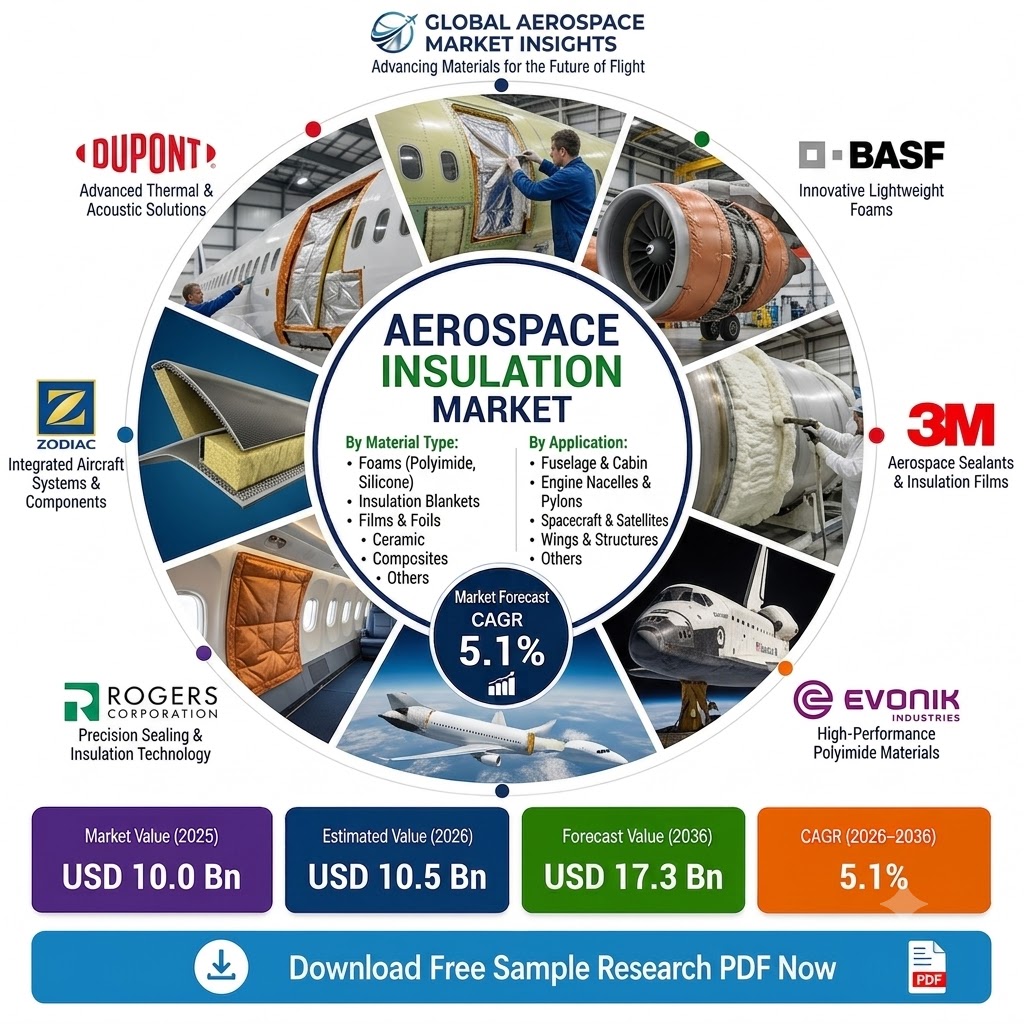
Rockville, MD — September 3, 2026 — DuPont continued expanding its Kapton and polyimide foam insulation portfolio for aerospace applications in 2025, targeting ultra-lightweight and fire-resistant insulation for aircraft cabin and avionics systems. The development comes as aircraft manufacturers and insulation suppliers face growing pressure to reduce weight while meeting increasingly demanding thermal, acoustic, electrical, and fire-safety requirements.
The commercial backdrop is substantial. The global aerospace insulation market is estimated at USD 10.51 billion in 2026 and is forecast to reach USD 17.28 billion by 2036, expanding at a 5.1% CAGR. Commercial aviation represents 45% of end-use demand in 2026, while India and China are forecast to record growth rates of 6.4% and 6.1%, respectively.
Get detailed market forecasts, competitive benchmarking, and pricing trends https://www.factmr.com/connectus/sample?flag=S&rep_id=12270
Lightweight Materials Move From Performance Advantage to Procurement Priority
The next phase of aerospace insulation demand is increasingly tied to the amount of weight an insulation system can remove without compromising certification or protection.
Fact.MR identifies aerogel-based insulation as a major product trend, with aerogels offering two to three times the thermal performance per unit weight of conventional fiberglass. The report also notes that silica aerogels can enable insulation-system weight reductions of 30% to 50% while maintaining or improving thermal and acoustic performance.
Polyimide foams are gaining attention for a similar reason. Their low weight and fire resistance make them relevant to cabin interiors and avionics, while integrated insulation systems can combine thermal, acoustic, and fire-protection functions in fewer material layers.
That combination matters commercially because aerospace OEMs do not purchase insulation simply for temperature control. A material that reduces mass, satisfies certification requirements and performs across multiple functions can influence aircraft efficiency, installation complexity and long-term maintenance economics.
OEM Backlogs Create a Long Demand Runway
Boeing and Airbus aircraft production ramp-ups are a central demand driver identified in the Fact.MR analysis, with combined order backlogs exceeding 15,000 aircraft. That backlog creates a multiyear procurement opportunity for suppliers whose materials have secured OEM qualification.
The market is also being supported by defense modernization, commercial and government space programs, and aircraft MRO. Insulation requirements extend from engine and exhaust systems exposed to temperatures exceeding 1,000°C to cabin interiors, wiring systems, avionics and spacecraft thermal-management applications.
The qualification barrier, however, remains significant. Fact.MR estimates that new aerospace insulation materials can face OEM qualification cycles of three to five years, while stringent fire-safety requirements under FAR 25.856 narrow the range of materials suitable for aircraft cabin applications.
Analyst Perspective
Shubham Patidar, Principal Consultant at Fact.MR, said:
“Aerospace insulation is increasingly being evaluated as part of the aircraft weight and performance equation rather than as a standalone protective material. Suppliers that can combine low weight, thermal and acoustic performance with the certification depth required by aircraft programs will have an advantage as commercial production, defense platforms and space applications expand.”
Market Snapshot
- USD 10.51 billion: estimated global aerospace insulation market value in 2026.
- USD 17.28 billion: projected market value by 2036.
- 5.1%: expected global CAGR from 2026 to 2036.
- 50%: share of thermal insulation materials within the material-type segment in 2026.
- 55%: share of aircraft within the application segment in 2026.
- 35%: share of engine and exhaust systems within installation areas in 2026.
- 6.4%: India’s projected CAGR, the highest among the highlighted country markets.
What’s Driving Near-Term Demand?
Commercial aircraft production is providing one of the clearest near-term demand signals. Boeing and Airbus are working through order backlogs exceeding 15,000 aircraft, creating sustained demand for OEM-qualified insulation across narrowbody and widebody programs.
At the same time, aerospace insulation suppliers must satisfy strict certification requirements. The Fact.MR analysis identifies FAR 25.856 fire-safety requirements as a constraint on material qualification, making certification capability and existing OEM relationships important competitive differentiators.
The result is a market where technical performance alone is unlikely to determine supplier success. Companies also need qualification history, reliable supply capability and the ability to support aircraft manufacturers through lengthy validation cycles.
India and China Stand Out as Growth Markets
Asia Pacific is identified as the fastest-growing regional market, with India forecast to expand at 6.4% CAGR and China at 6.1% through 2036. India’s demand is linked to commercial fleet expansion, indigenous defense-aircraft programs, MRO activity and domestic aerospace manufacturing. China’s growth is supported by COMAC aircraft production, military aviation expansion and space-program investment.
The United States remains the largest strategic market, with a projected 5.6% CAGR through 2036. Boeing production, defense spending, NASA and commercial space activity, together with the country’s large MRO base, underpin demand. Germany is forecast to grow at 5.3%, supported by Airbus production, defense programs and aerospace-material development.
Competitive Landscape
The aerospace insulation market remains moderately fragmented among specialized material and system suppliers. Fact.MR identifies Duracote Corporation, Rogers Corporation, DuPont de Nemours, BASF SE, 3M Company and Evonik Industries AG among the major participants. Duracote is estimated to hold approximately 11% market share, supported by specialized insulation products, OEM qualifications and aircraft-manufacturer relationships.
The competitive focus is shifting toward aerogel and polyimide-foam qualification, multifunctional insulation systems, next-generation aircraft platforms and emerging eVTOL applications. Companies with established qualification portfolios may have an advantage because new entrants face long approval cycles before their materials can be specified for production aircraft.
About the Report
Fact.MR’s aerospace insulation analysis covers thermal, acoustic and electrical insulation materials and systems used in aircraft, spacecraft, helicopters and UAVs. The study examines material type, insulation type, application, end-use industry, installation area, temperature range and regional demand. It covers more than 25 countries and evaluates companies including Duracote, Rogers Corporation, DuPont, BASF, 3M, Evonik, Zodiac Aerospace, Esterline Technologies, Triumph Group and Polymer Technologies.
To view related Reports
https://www.openpr.com/news/4448294/global-air-springs-market-forecast-europe-leads-automotive
https://www.openpr.com/news/4448334/global-pbt-market-outlook-asia-pacific-dominates-engineering
https://www.openpr.com/news/4448353/global-one-component-foam-market-forecast-europe-leads
https://www.openpr.com/news/4448389/global-nvr-market-outlook-asia-pacific-leads-surveillance