Agricultural spraying equipment must balance fluid movement, pressure control, durability, and operational flexibility across demanding working environments. The High Pressure Diaphragm Pump For Sprayers is an important part of this system because it can generate controlled hydraulic movement while using a flexible diaphragm to manage fluid transfer. For agricultural machinery manufacturers and system integrators, effective design depends not only on pressure capability but also on material selection, valve coordination, pulsation control, maintenance access, and compatibility with the complete spraying assembly.
A major engineering consideration is how the pump interacts with the liquid being handled. Agricultural spraying fluids may contain fertilizers, crop protection formulations, cleaning agents, or other compounds that can affect seals and wetted surfaces over time. Material selection should therefore account for chemical compatibility, mechanical fatigue, temperature variation, and repeated cleaning. Appropriate elastomers and corrosion-resistant structural materials can help maintain functional stability, while reinforced polymer components may provide useful resistance to environmental stress. A carefully matched material system supports longer service intervals and helps reduce avoidable deterioration within agricultural applications.
Diaphragm construction provides a useful method for separating the pumping mechanism from the working fluid. As the membrane moves, suction and discharge cycles transfer liquid through valves and connected passages. This principle can support stable fluid delivery while limiting direct contact between certain mechanical components and the sprayed liquid. Performance depends on diaphragm quality, valve geometry, assembly accuracy, and the relationship between moving parts. Manufacturers should therefore evaluate the entire hydraulic structure when optimizing a sprayer pump, rather than treating pressure generation as an isolated performance target.
High-pressure spraying also requires careful management of hydraulic pulsation. Reciprocating diaphragm movement naturally creates pressure cycles, so system designers may use appropriate regulators, accumulators, valves, or other flow-control elements to improve downstream stability. Consistent hydraulic behavior helps spray nozzles maintain more predictable operation and can reduce unnecessary stress on hoses, fittings, and other components. Good flow-path design is equally important because excessive resistance can increase energy demand and influence the responsiveness of the system. Balanced hydraulic engineering improves coordination between the pump and the rest of the spraying equipment.
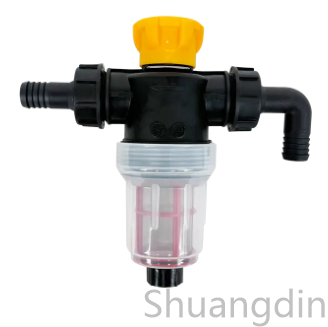
Filtration plays an important protective role in agricultural fluid systems. Particles, sediment, or residue can obstruct valves and narrow passages, potentially affecting flow and pressure behavior. Integrating suitable filtration into the fluid circuit can help protect the pump and downstream components while supporting cleaner liquid delivery. Serviceability should also be considered during equipment design. Filters, diaphragms, valves, and seals should be positioned so technicians can inspect and maintain them efficiently. Easy access can reduce unnecessary downtime and make routine servicing more practical for commercial agricultural operations.
Safety is closely connected with pressure management. Spraying systems operate with significant hydraulic forces, making secure fittings, reliable seals, stable pressure regulation, and appropriate hose routing essential design considerations. A safety-oriented design approach considers containment and service procedures from the beginning, helping create equipment that behaves predictably during normal operation, adjustment, and maintenance.
Agricultural machinery is increasingly incorporating digital monitoring and automated control. Pressure sensors, flow monitoring, electronic regulators, and field management systems can work together to improve application consistency and resource management. In these systems, the pump must respond reliably to changing operating commands and hydraulic loads. Mechanical stability therefore remains important even as agriculture becomes more connected. A well-engineered diaphragm pump can serve as the hydraulic foundation for intelligent spraying equipment when its construction is compatible with modern control architectures.
Different crops and farming environments create different fluid delivery requirements. Open-field equipment may need to serve large areas, while orchard sprayers must manage more complex hose and nozzle arrangements. Greenhouse and nursery applications can place greater emphasis on compact layouts, controlled distribution, and convenient maintenance. The High Pressure Diaphragm Pump For Sprayers should consequently be evaluated according to the complete application, including nozzle configuration, regulator behavior, filtration, piping, and operating conditions. System-level evaluation helps manufacturers select a practical design rather than focusing only on one specification.
Long-term equipment value also depends on maintainability and component consistency. Diaphragms and valves are working elements that may experience repeated mechanical cycles, so their construction and installation quality influence reliability. Standardized component interfaces can simplify replacement and reduce service complexity. Manufacturers can further improve lifecycle management by designing inspection points, accessible connections, and logical component layouts. These choices help technicians identify wear or abnormal operation earlier and support more predictable maintenance planning across agricultural fleets.
SHUANG DIN focuses on agricultural fluid equipment and practical pump engineering for spraying-related applications. Its approach combines structural design, material considerations, hydraulic coordination, and compatibility with broader agricultural systems. For manufacturers and buyers researching diaphragm-based spraying solutions, additional product information is available at https://www.agriculturaldiaphragmpump.com/product/ as a reference for evaluating pump components within complete agricultural fluid delivery systems.