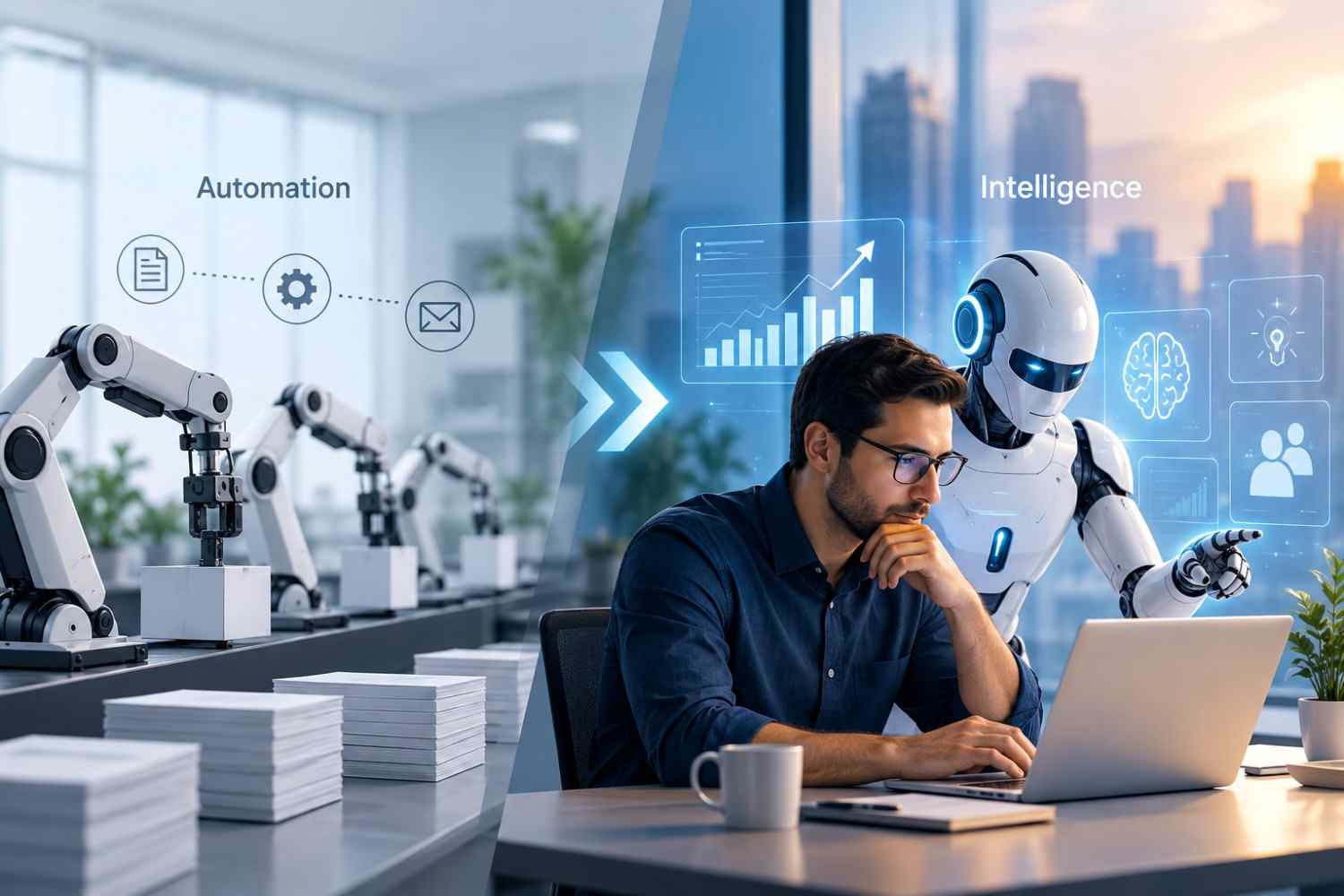
What if your business could spot problems before they happen? That question is changing how companies think about technology. Automation once helped businesses save time on repetitive work. Now, AI is helping them understand data, predict outcomes, and make better decisions. The shift is clear. Businesses are moving from simply automating tasks to building smarter ways of working.
Automation Started the Journey
For years, companies used automation to handle routine jobs. Software could send emails, update records, process orders, or create reports. These systems worked well when tasks followed clear rules.
AI takes this idea further. It can work with large amounts of data and find patterns. It can also understand language and make useful predictions. This makes AI helpful in areas where fixed rules are not enough.
Why Businesses Are Adopting AI
The amount of business data keeps growing. Customer chats, sales records, website visits, and transactions create valuable information every day. Yet, many teams still struggle to turn that information into useful insights.
AI can help close this gap. It can review data faster and highlight patterns that people may miss. It can also reduce manual work and help teams respond faster.
Businesses are using AI for tasks such as:
- Customer support and virtual assistants
- Sales forecasting and lead scoring
- Fraud detection and risk analysis
- Personalized marketing
- Data analysis and reporting
- Document processing and content review
The best use cases usually solve a clear business problem. AI works better when there is a useful goal behind it.
AI Is Connecting With Existing Systems
Most companies already depend on several digital tools. A business may use a CRM, help desk, payment system, website, and accounting platform. Adding another AI tool is easy. Making it work with existing systems is harder. This is where AI integration services can play an important role. They connect AI solutions with existing software, databases, and workflows. This allows businesses to use AI without replacing every system they already have.
For example, an AI assistant can connect with a CRM. It can then help employees find customer details faster. It could also summarize past conversations before a sales call.
From Automation to Intelligent Decisions
Traditional automation usually follows a fixed path. If one event happens, the system performs a specific action. AI can make that process more flexible. Imagine an online store receiving hundreds of customer questions. Basic automation may send preset answers. An AI-powered system can understand different questions and provide more relevant responses.
This is one reason AI integration services are becoming more useful. AI can be added to workflows that already exist. Businesses can improve those workflows without starting from zero.
Employees Can Work Smarter
AI adoption does not always mean replacing employees. In many cases, it helps people spend less time on routine tasks. A support agent can use AI to summarize a long customer conversation. A sales team can use AI to identify promising leads. A manager can ask an AI system to summarize weekly reports.
The human role still matters. People provide context, judgment, creativity, and accountability. AI simply helps them work with information faster.
What Makes AI Adoption Successful?
Buying an AI tool is not the same as adopting AI successfully. Businesses need a clear plan before they begin. They should first identify a process that takes too much time. Next, they should check whether the available data is reliable. They also need to consider security, privacy, cost, and system compatibility.
A practical AI strategy often starts small. One successful use case can provide useful lessons for larger projects. This approach also makes it easier to measure the real business impact.
Companies working with ai integration services should also define clear goals. These could include faster response times, lower operating costs, better customer experiences, or improved accuracy.
Challenges Businesses Should Not Ignore
AI brings opportunities, but it also creates new challenges. Poor data can produce poor results. Weak security can create serious risks. An AI system can also make mistakes if it lacks proper context. Businesses should therefore keep people involved in important decisions. They should test AI systems before wider deployment. Regular reviews can also help identify errors and improve performance.
Good ai integration services should support this process. Integration is not only about connecting software. It is also about making sure the technology fits the way people actually work.
The Future Is More Intelligent
The next phase of business technology will likely combine automation, AI, and human expertise. Instead of using separate tools for every task, companies can build connected workflows. An AI system may read customer data, identify an opportunity, and suggest the next action. Another system may detect unusual activity and alert a team member. These processes can save time while giving employees better information.
The real shift is not from people to machines. It is from manual decisions to better-informed decisions. AI integration services can help businesses make that shift by connecting intelligence with the systems they already use.
Final Thoughts
AI adoption is becoming less about following a trend. It is becoming a practical business decision. Companies are using AI to reduce repetitive work, understand data, improve service, and support faster decisions. The businesses that benefit most will not simply add AI everywhere. They will choose the right problems, use reliable data, and keep people involved.
If you are exploring where AI could fit into your business, Tech Formation, an AI software development company, can be a useful place to research ideas, approaches, and practical AI solutions before taking the next step.