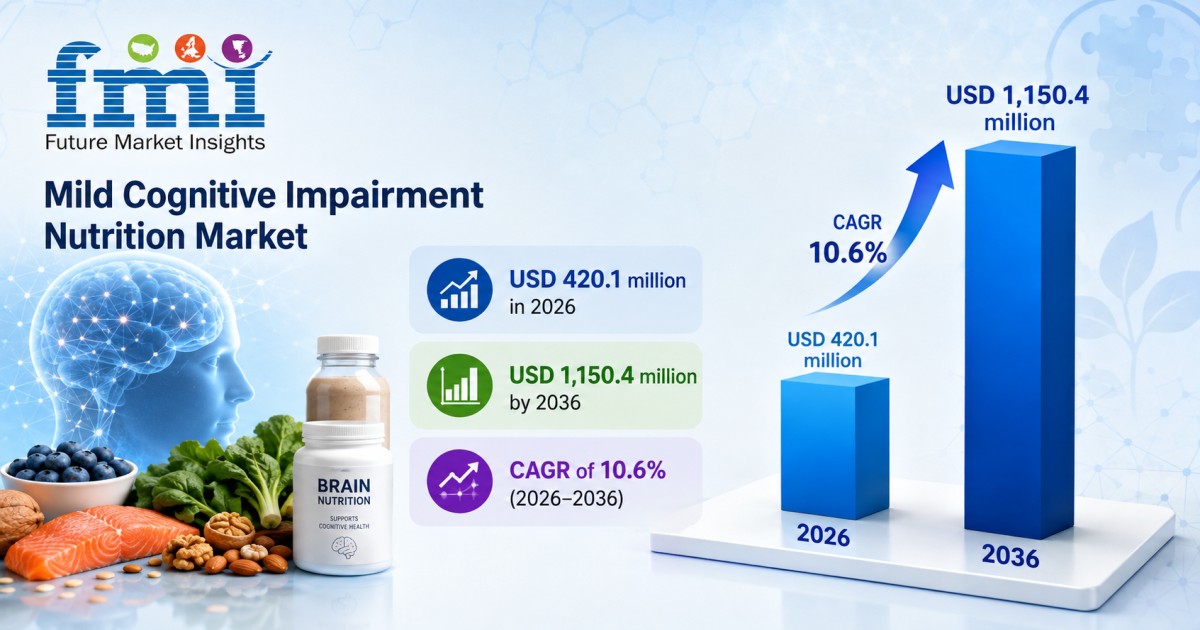
The global mild cognitive impairment nutrition market is projected to reach USD 420.1 million in 2026 and USD 1,150.4 million by 2036, expanding at a CAGR of 10.6% during the forecast period. Market expansion is increasingly tied to whether manufacturers can substantiate clinical benefits for defined target populations while navigating strict regional regulations governing medical foods versus consumer dietary supplements.
Get Detailed Market Forecasts, Competitive Benchmarking, and Pricing Trends:
https://www.futuremarketinsights.com/reports/sample/rep-gb-34797
Why evidence thresholds and medical-food positioning shape commercial success
Formulators and brand owners are evaluating cognitive nutrition products against strict clinical evidence requirements rather than general wellness marketing alone. Because public messaging cannot imply unauthorized disease prevention or treatment, companies are increasingly separating supervised medical-food lines designed for dietary management near professional memory assessment from consumer self-care supplements that rely on disciplined claims and convenient retail replenishment.
Regulatory environments introduce distinct regional compliance requirements. For instance, while European and North American markets enforce strict boundaries on health claims without robust clinical data, platforms like South Korea's personalized health-functional-food system and Japan's Foods with Function Claims (FFC) notification database provide structured regulatory pathways for transparently labeled cognitive ingredients.
Medical foods are projected to lead the product type category with a 44.3% share in 2026, reinforced by supervised dietary-management positioning that gives clinicians a structured framework for patient discussions.
Which ingredients and formats lead the MCI nutrition market?
Omega-3 DHA blends are estimated to capture 34.9% of key ingredient demand in 2026, supported by established consumer recognition, familiar fatty-acid terminology, and extensive formulation compatibility across oral delivery systems.
From a product form perspective, capsules & softgels are expected to hold 41.6% share in 2026, offering measured dosing and high nutrient concentration that reduce pill burden for older users without requiring complex daily preparation.
In terms of end users, home & self-care is projected to represent 49.7% of the market, reflecting routine daily consumption occurring outside clinical institutions where simple preparation and tolerable daily intake govern customer retention.
Analyst Perspective
“MCI nutrition earns repeat revenue when the evidence fits the intended cognitive population and the daily dose remains practical for older users. Commercial evaluation should separate medical-food credibility from consumer-channel reach owing to different claim risks and recommendation economics across these routes.” — Nandini Roy Choudhury, Principal Consultant, Future Market Insights
Market Snapshot
- 2026 market size: USD 420.1 million
- 2036 forecast value: USD 1,150.4 million
- 2026–2036 CAGR:6%
- Leading key ingredient: Omega-3 - DHA blends, with a projected 34.9% share in 2026
- Leading product type: Medical foods, with a projected 44.3% share in 2026
- Leading product form: Capsules / softgels, with a projected 41.6% share in 2026
- Leading end user: Home - self-care, with a projected 49.7% share in 2026
Country outlooks reflect strong international momentum. South Korea is projected to record the fastest growth among profiled countries at 11.1% CAGR, followed by the USA at 10.2%, the UK at 9.8%, Germany at 9.3%, and Japan at 8.6%.
Regional expansion shaped by personalized health frameworks and diagnostic access
South Korea leads regional projections at 11.1% CAGR, supported by the full implementation of its regulated personalized health-functional-food system that enables customized daily nutrient portioning.
The USA follows at 10.2% CAGR, sustained by broad consumer retail access, pharmacy touchpoints, and increasing diagnostic visibility following recent regulatory approvals of blood-based Alzheimer's and cognitive screening tools.
The UK is projected to grow at 9.8% CAGR, anchored by NHS primary care memory-service pathways that facilitate professional discussions around early cognitive decline and dietary management.
Germany is expected to record a 9.3% CAGR, influenced by an aging demographic and an established pharmacy culture where local pharmacists play a vital advisory role in product selection.
Japan is forecast to expand at 8.6% CAGR, supported by standardized functional food notification databases that require rigorous domestic evidence documentation for memory-support claims.
Exclusive Discounts on Full Report: https://www.futuremarketinsights.com/reports/mild-cognitive-impairment-nutrition-market
About the Report
The Mild Cognitive Impairment Nutrition Market study analyzes the market across key ingredient, product type, product form, end user, sales channel, and region.
The report covers:
- Key Ingredient: Omega-3 - DHA blends; B-Vitamin Complexes; Fortasyn-Type Multinutrients; Botanical Nootropics; Others
- Product Type: Medical Foods; Cognitive-Support Supplements; Fortified Foods and Beverages; Others
- Product Form: Capsules / Softgels; RTD; Powders; Others
- End User: Home - Self-Care; Memory Clinics & Hospitals; Others
- Sales Channel: Online / DTC; Retail Pharmacy; Supermarkets and Hypermarkets; Specialty and Health Stores; Others
- Regions Covered: North America, Latin America, Western Europe, Eastern Europe, East Asia, South Asia and Pacific, and Middle East and Africa
Countries profiled include South Korea, USA, UK, Germany, Japan, and more than 25 additional countries across global regional breakdowns.
The report profiles Danone Nutricia (Souvenaid), Nestlé Health Science, Aker BioMarine, Kirin Holdings, SFI Health (Equazen), Reckitt (Neuriva), Thorne, and Quincy Bioscience.
FMI's research methodology combines primary executive interviews with clinical nutritionists, regulatory consultants, ingredient developers, and retail buyers alongside secondary analysis of demographic aging statistics, World Health Organization guidelines, clinical trial registrations, and corporate filings. Market estimates undergo rigorous data triangulation and bottom-up reconciliation across segments and country geographies.
Explore More Related Studies Published by FMI Research
Nutritional Yeast Market: https://www.futuremarketinsights.com/reports/nutritional-yeast-market
Nutritional Bars Market : https://www.futuremarketinsights.com/reports/nutritional-bars-market
Cognitive-Performance Functional Beverage Additive Systems Market :
About Future Market Insights (FMI)
Future Market Insights (FMI) delivers actionable, decision-focused market intelligence that goes beyond traditional research reports. The company provides:
- In-depth pricing and cost benchmarking analysis
- Demand forecasting based on real industry inputs
- Procurement and buyer behavior insights
- Supply chain and trade flow intelligence
- Technology and application trend analysis across industries
FMI follows a robust bottom-up research methodology, combining insights from industry experts, procurement leaders, manufacturers, and technical professionals to ensure accurate and practical market intelligence.
For Press & Corporate Inquiries
Rahul Singh
AVP - Marketing and Growth Strategy
Future Market Insights, Inc. +91 8600020075
For Sales - sales@futuremarketinsights.com
For Media - Rahul.singh@futuremarketinsights.com
For Web - https://www.futuremarketinsights.com/