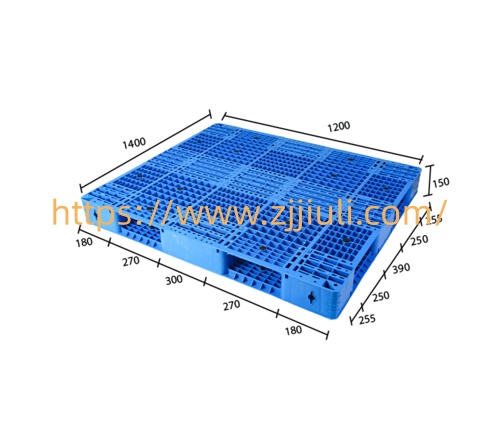
Grid Pallet solutions have become an important consideration for businesses planning organized material handling in modern warehouses. As logistics operations increasingly combine manual equipment with conveyors, automated storage systems, scanners, and mobile handling equipment, pallet design needs to match the working environment. Buyers are paying attention not only to load ratings, but also to dimensions, deck structure, entry configuration, weight, cleaning requirements, and compatibility with existing equipment. Recent industry guidance also highlights dimensional consistency and bottom geometry as important factors for automated handling.
The deck is one of the easiest features to notice, but it has a practical role beyond appearance. A grid style surface can reduce material usage and weight while providing openings for airflow and drainage. This can be useful in environments where washing, ventilation, or moisture management is part of routine handling. However, buyers should consider the size and type of goods being transported. Smaller products may require additional packaging or a suitable surface arrangement to prevent them from passing through openings.
The base structure deserves equal attention. Feet, runners, and support points determine how a pallet interacts with forklifts, pallet jacks, conveyors, racks, and other equipment. In an automated warehouse, these contact areas become especially important because machines operate according to fixed positions and clearances. A small dimensional difference that may be manageable during manual handling can create alignment problems on a conveyor or automated transfer point. For this reason, specifications should be checked against the actual equipment rather than selected only according to nominal pallet dimensions.
Load capacity is another area where buyers should look beyond a single number. Static, dynamic, and racking loads describe different working conditions. A pallet that carries a certain weight while stationary on a floor may have a different rating when moved or supported by warehouse beams. The actual load should also be distributed in a suitable manner. Buyers should therefore provide manufacturers with details about product weight, loading pattern, storage method, and handling equipment before confirming a specification.
Weight can influence logistics planning as well. A lighter carrier may reduce the amount of weight handled by forklifts or automated vehicles, but reducing material should not compromise the requirements of the application. For AGV and AMR systems, the weight of the pallet is included in the total payload calculation. This makes product weight a practical specification when companies are planning automated movement across a facility.
Dimensional consistency becomes increasingly relevant as automation expands. Conveyors, robotic equipment, automated storage and retrieval systems, and scanning stations depend on repeatable positioning. Length, width, height, flatness, and bottom geometry can all affect how a pallet moves through a system. Businesses considering automation should provide their manufacturer with the relevant equipment specifications and, where possible, test the selected design under actual operating conditions before placing a large order.
Material selection should also reflect the working environment. Plastic handling products may be used in manufacturing, food related logistics, cold storage, retail distribution, and general warehousing. Temperature, moisture, cleaning routines, chemical exposure, and expected handling frequency can vary significantly between these applications. PP and HDPE are commonly used materials, but the appropriate choice depends on the required mechanical and environmental properties. Buyers should discuss these conditions with the manufacturer instead of relying on a general material description.
Cleanability is another practical consideration. In environments where pallets are washed regularly, surfaces with suitable geometry can make routine cleaning easier. Open structures may also assist drainage. For hygiene sensitive operations, buyers should evaluate the full design, material, cleaning procedure, and applicable industry requirements together. The pallet should fit the actual sanitation process rather than being selected simply because it is made from plastic.
Identification features can support inventory management. Depending on the application, businesses may consider barcode areas, QR codes, printed identification, or RFID integration. These features can help connect a physical load carrier with warehouse records and movement information. Automated logistics operations increasingly use digital identification alongside warehouse management systems, making a dedicated location for identification technology a useful design consideration.
For manufacturers and distributors, customization can also be valuable. Different industries may need different dimensions, deck arrangements, colors, entry configurations, reinforcement structures, or identification areas. Zhiguangplastic can work with buyers who need plastic logistics products matched to specific handling environments, allowing product development to begin with the intended application rather than a generic specification.
A thoughtful purchasing process should begin with the complete workflow. Consider where the pallet will be loaded, how it will be moved, whether it will enter a rack, what equipment will handle it, how often it will be cleaned, and where it will be stored between uses. These details give manufacturers a clearer basis for recommending a suitable structure.
For businesses reviewing plastic logistics products, Zhiguangplastic provides product options for different material handling requirements and application scenarios. Buyers can compare available designs, review specifications, and consider which configuration fits their operational needs. Product information and available solutions can be viewed naturally through the company product catalog at https://www.zjjiuli.com/product/ when planning the next stage of procurement.