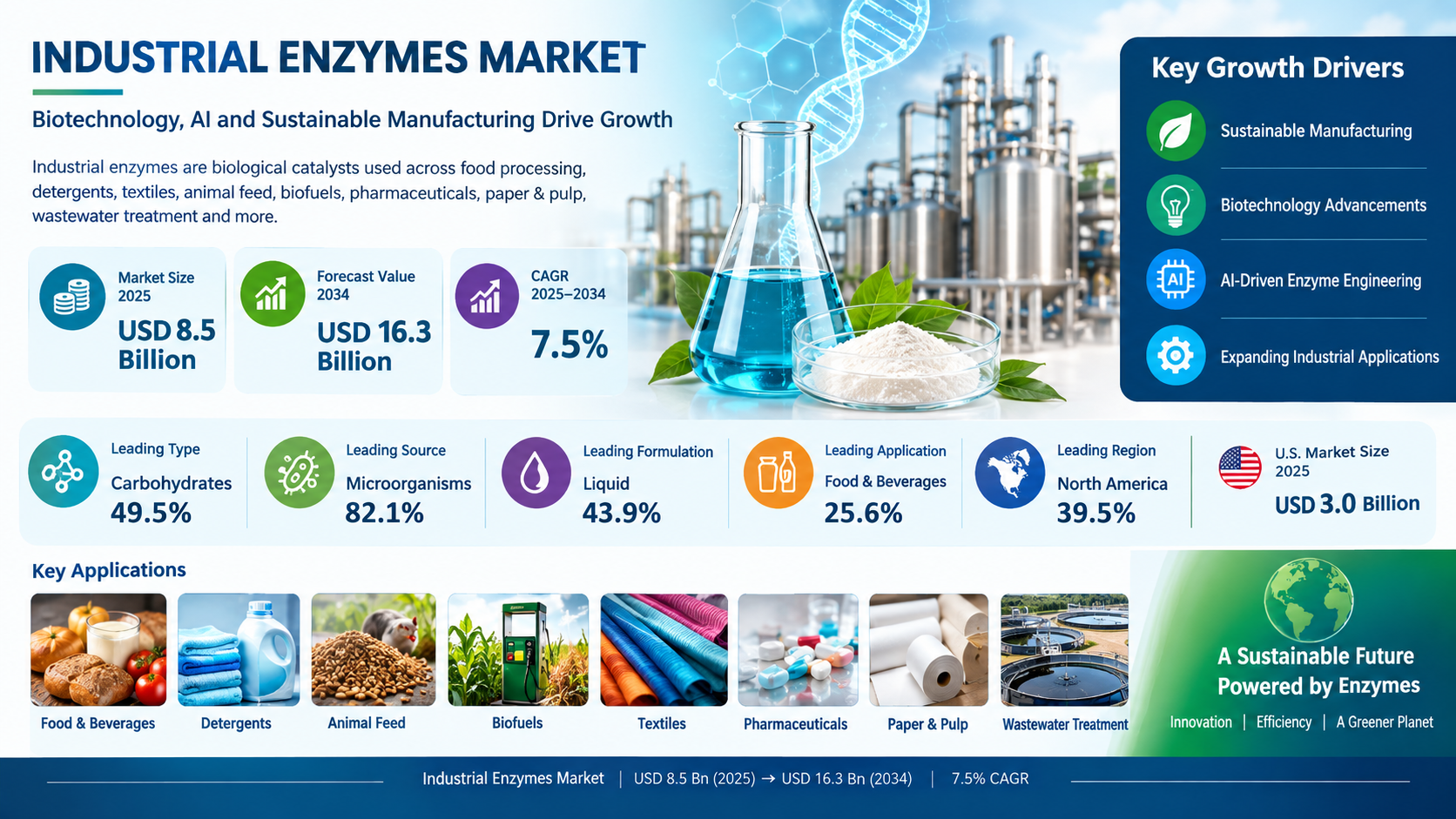
According to Dimension Market Research, the Industrial Enzymes Market is moving into a new phase of growth as manufacturers across food, beverages, detergents, animal feed, textiles, pharmaceuticals, biofuels, paper, and wastewater treatment increasingly adopt biological solutions to improve process efficiency. The market is projected to reach USD 8.5 billion in 2025 and is expected to expand to USD 16.3 billion by 2034 , representing a 7.5% CAGR during the forecast period.
Industrial enzymes are increasingly valued for their ability to accelerate specific chemical reactions while operating under comparatively mild processing conditions. This makes them useful for reducing processing intensity, improving yields, controlling product quality, and replacing or complementing conventional chemical methods.
The next stage of industry development is being shaped by artificial intelligence, machine learning, protein engineering, synthetic biology, precision fermentation, and digital bioprocessing . These technologies are helping enzyme producers discover new molecules, optimize microbial strains, improve production yields, and develop enzymes tailored to increasingly demanding industrial environments.
Industrial Enzymes Market at a Glance
| Market Indicator | Value / Share |
|---|---|
| Market Size, 2025 | USD 8.5 Billion |
| Forecast Value, 2034 | USD 16.3 Billion |
| CAGR, 2025–2034 | 7.5% |
| Leading Enzyme Type | Carbohydrates – 49.5% |
| Leading Source | Microorganisms – 82.1% |
| Leading Formulation | Liquid – 43.9% |
| Leading Application | Food & Beverages – 25.6% |
| Leading Region | North America – 39.5% |
| US Market Size, 2025 | USD 3.0 Billion |
Why Industrial Enzymes Are Becoming More Important
Manufacturers are under growing pressure to improve productivity while reducing energy use, waste, water consumption, and environmental impact.
Enzymes can help meet these goals by enabling highly targeted biological reactions.
Compared with some conventional chemical processing methods, enzyme-based systems can offer advantages such as:
- High reaction specificity
- Lower processing temperatures
- Reduced chemical intensity
- Improved product consistency
- Better raw-material utilization
- Greater process selectivity
These benefits are especially attractive in industries with high production volumes or strong sustainability requirements.
Biotechnology Is Reshaping Enzyme Manufacturing
Traditional enzyme discovery often involves extensive laboratory experimentation and screening.
Modern biotechnology is making the process more data-driven.
Genetic engineering can modify microorganisms so they produce enzymes with improved properties. Protein engineering can alter enzyme structures to increase catalytic activity, thermal stability, pH tolerance, or resistance to industrial solvents.
This allows enzyme manufacturers to move beyond naturally occurring molecules toward highly optimized products designed for specific applications.
The result is a market that increasingly combines biotechnology with advanced computing and industrial automation.
AI Accelerates Enzyme Discovery
Artificial intelligence is becoming an important tool for identifying new enzyme candidates.
Machine-learning models can analyze large collections of protein sequences and biological datasets to identify patterns associated with particular catalytic functions.
AI can support researchers in:
Protein Sequence Analysis
Enzyme Function Prediction
Structural Prediction
Candidate Screening
Mutation Selection
Performance Optimization
Instead of testing every possible biological candidate experimentally, researchers can use computational tools to prioritize the most promising options.
This can reduce development time and improve the efficiency of laboratory research.
Generative AI Enables New Enzyme Design
The emergence of generative AI is creating another opportunity.
Rather than simply identifying existing enzymes, generative systems can help researchers explore entirely new protein sequences.
This approach can be used to search for enzymes with characteristics such as:
- Greater temperature stability
- Improved catalytic performance
- Enhanced substrate specificity
- Stronger resistance to industrial conditions
- Improved activity in specific formulations
Such capabilities could become increasingly valuable in detergents, food processing, biofuels, specialty chemicals, and pharmaceutical manufacturing.
The development of tools such as ZymCTRL, highlighted in the DMR market outlook, demonstrates the growing convergence of generative AI and enzyme engineering.
Precision Fermentation Becomes a Strategic Technology
Microorganisms account for 82.1% of the Industrial Enzymes Market in 2025, making microbial production the dominant source.
Precision fermentation is becoming increasingly important because it allows manufacturers to control microbial production environments more precisely.
A typical fermentation process involves monitoring:
Temperature
pH
Dissolved Oxygen
Nutrient Availability
Agitation
Biomass Growth
Product Concentration
Improving control over these variables can increase enzyme yield and consistency.
Digital sensors and automated process-control systems are making fermentation facilities more capable of continuously monitoring production conditions.
AI Can Optimize Fermentation
AI provides an additional layer of intelligence to precision fermentation.
Machine-learning systems can analyze large volumes of fermentation data to determine which process combinations produce the highest enzyme yields.
Models can identify relationships between:
- Raw-material quality
- Microbial growth
- Oxygen transfer
- Feed rates
- Temperature
- pH
- Agitation
- Product formation
Operators can then use these insights to optimize production conditions.
This approach can reduce batch variability and improve manufacturing efficiency.
Carbohydrases Continue to Dominate
Carbohydrases are projected to hold 49.5% of market revenue in 2025, making them the leading enzyme category.
These enzymes break down carbohydrates and are widely used across industrial applications.
Important examples include:
Amylases
Amylases break down starch and are widely used in food processing, brewing, baking, detergents, textiles, and starch conversion.
Cellulases
Cellulases degrade cellulose and are important in textiles, pulp and paper, animal feed, and biomass processing.
Pectinases
Pectinases are widely used in fruit processing, juice clarification, and food manufacturing.
Xylanases
Xylanases are used in pulp and paper processing, food applications, and animal nutrition.
The broad application base of carbohydrases supports their dominant market position.
Food and Beverage Remains the Largest Application
Food and beverages are expected to account for 25.6% of Industrial Enzymes Market revenue in 2025.
Enzymes are already integrated into numerous food manufacturing processes.
In baking, enzymes can improve dough characteristics and processing performance.
In brewing, they assist with starch breakdown and fermentation control.
In dairy products, enzymes contribute to cheese manufacturing and other processing operations.
In juice production, enzymes can improve extraction and clarification.
In sugar processing, enzymes can modify complex carbohydrates and improve conversion efficiency.
As food companies seek consistent quality and efficient production, enzyme-based processing is expected to remain a major source of market demand.
AI Improves Food Enzyme Applications
The food industry increasingly relies on automated production systems.
AI can analyze process variables and identify operating conditions that improve enzyme performance.
For example, machine-learning models can evaluate relationships between temperature, pH, raw-material properties, enzyme dosage, and processing time.
This can allow food manufacturers to determine more efficient enzyme dosing strategies.
AI-based monitoring may also help detect process deviations before they affect the final product.
Detergents Drive Demand for High-Performance Enzymes
The detergent industry is one of the most established industrial enzyme applications.
Detergent manufacturers use combinations of:
Proteases
Lipases
Amylases
Cellulases
Each enzyme targets different stain types or fabric-related requirements.
Enzymes can improve cleaning performance and support lower-temperature washing.
This is particularly relevant as consumers and manufacturers seek energy-efficient cleaning processes.
Future detergent enzymes are likely to be engineered for greater stability in concentrated formulations and compatibility with new low-temperature cleaning systems.
Animal Feed Is a Growing Application
Enzymes are increasingly incorporated into animal feed to improve nutrient utilization.
Enzyme supplementation can help animals digest certain feed components more effectively.
Major enzyme applications include:
- Poultry feed
- Swine feed
- Ruminant feed
- Aquaculture feed
The growing global demand for meat, dairy, and seafood is supporting long-term demand for more efficient feed technologies.
Enzymes can also help feed manufacturers optimize the use of raw materials and improve nutritional performance.
Textile Processing Benefits From Enzyme Technology
Textile manufacturers are increasingly exploring enzyme-based processing as part of sustainability initiatives.
Cellulases can be used for biopolishing and fabric treatment.
Other enzymes can support:
Desizing
Scouring
Bleaching
Softening
Color Processing
Enzyme-based methods can reduce the intensity of certain conventional treatments and help manufacturers achieve desired fabric characteristics.
As textile companies adopt cleaner production practices, demand for specialized textile enzymes is expected to increase.
Biofuels Create High-Value Opportunities
Biofuel production represents an important area for enzyme innovation.
Cellulases and hemicellulases help convert lignocellulosic biomass into fermentable sugars.
These sugars can then be processed into biofuels.
One of the biggest challenges is production economics. Enzymes must provide sufficient activity while remaining cost-effective at commercial scale.
This is encouraging investment in protein engineering and improved microbial production.
AI can contribute by identifying enzyme variants capable of breaking down difficult biomass substrates more efficiently.
Pharmaceuticals Use Specialized Enzymes
The pharmaceutical industry uses enzymes in drug manufacturing, biocatalysis, diagnostics, and other applications.
Biocatalysts can perform highly selective chemical transformations that may be difficult to achieve using traditional chemistry.
Enzymatic synthesis can therefore support:
Higher Selectivity
Fewer Processing Steps
Milder Reaction Conditions
Reduced Byproducts
Improved Manufacturing Efficiency
As pharmaceutical companies focus on process intensification and more sustainable production, demand for specialized enzymes is expected to increase.
Liquid Formulations Maintain Market Leadership
Liquid enzymes are projected to represent 43.9% of the market in 2025.
Liquid formulations provide several practical benefits.
They can be easily dosed, mixed, transported through automated systems, and incorporated into continuous processes.
Liquid formulations are particularly common in food processing, detergents, textiles, and industrial manufacturing.
However, dry formulations remain important in situations where extended storage stability and transport efficiency are more important.
Formulation technology is therefore becoming another area of innovation.
AI-Enabled Quality Control
Quality consistency is critical for industrial enzyme suppliers.
Small variations in enzyme activity can influence production performance.
Automated quality-control systems can combine sensors, laboratory data, and machine-learning algorithms to monitor enzyme characteristics.
AI can help identify relationships between:
Raw Materials
Fermentation Conditions
Purification
Formulation
Storage
Final Enzyme Performance
Such systems can allow manufacturers to detect deviations earlier and reduce batch inconsistency.
Predictive Maintenance in Enzyme Manufacturing
Industrial enzyme plants contain complex equipment, including fermentation tanks, pumps, agitators, filtration units, compressors, dryers, and packaging systems.
Unexpected equipment failure can interrupt production and increase costs.
Predictive maintenance systems use sensor data to monitor equipment conditions.
AI can identify abnormal changes in:
- Vibration
- Temperature
- Pressure
- Energy consumption
- Motor performance
- Operating cycles
This can support maintenance scheduling before failures occur.
The result can be better equipment availability and more predictable production planning.
Digital Twins Support Enzyme Production
Digital twins can create virtual representations of production equipment and processes.
Manufacturers can use digital models to simulate:
Fermentation Conditions
Heat Transfer
Production Capacity
Equipment Performance
Process Changes
This allows companies to test operational changes digitally before introducing them into physical facilities.
The integration of digital twins with AI could become particularly valuable for large-scale biotechnology plants.
Sustainability Drives Enzyme Innovation
Environmental performance is becoming an increasingly important reason for adopting enzyme technologies.
Enzymes can support sustainable manufacturing by enabling targeted reactions under relatively mild conditions.
Potential benefits include:
Lower Energy Demand
Reduced Chemical Use
Less Waste
Improved Raw-Material Utilization
Lower Processing Intensity
However, enzyme sustainability must also be evaluated across production, transportation, formulation, and end-use stages.
Manufacturers are therefore focusing on enzyme performance as well as the sustainability of the production platform itself.
Microorganisms Offer Scalability
The dominance of microbial sources reflects their scalability.
Bacteria and fungi can be cultivated under controlled industrial conditions.
Genetic engineering also allows strains to be optimized for enzyme production.
This gives manufacturers greater control over:
Production Yield
Enzyme Purity
Growth Rate
Process Stability
Product Characteristics
As fermentation technology becomes more automated, microbial enzyme production is expected to become increasingly sophisticated.
North America Remains the Largest Regional Market
North America is projected to account for 39.5% of market revenue in 2025.
The region has a mature industrial biotechnology ecosystem supported by strong demand from food, detergents, biotechnology, pharmaceuticals, animal feed, and biofuels.
The United States alone is projected to reach USD 3.0 billion in 2025.
Advanced research capabilities and strong industrial biotechnology investment provide the region with a favorable environment for enzyme innovation.
Asia Pacific Creates New Growth Opportunities
Asia Pacific is expected to record strong growth during the forecast period.
The region combines:
- Large food-processing industries
- Expanding animal feed production
- Textile manufacturing
- Biofuel development
- Pharmaceutical production
- Growing biotechnology investment
China and India are particularly important because of their large manufacturing bases and growing demand for cost-efficient production technologies.
The expansion of industrial biotechnology across Asia Pacific is expected to create additional opportunities for enzyme suppliers.
Europe Emphasizes Sustainable Bioprocessing
European manufacturers are placing strong emphasis on sustainable production, resource efficiency, and environmentally responsible chemistry.
These priorities support enzyme applications in:
Food Processing
Textiles
Detergents
Biofuels
Specialty Chemicals
Wastewater Treatment
European companies are also actively investing in biotechnology and circular production systems.
This environment can support continued adoption of advanced enzyme technologies.
Competitive Landscape
The Industrial Enzymes Market includes multinational biotechnology companies, specialty enzyme suppliers, chemical manufacturers, research-driven companies, and emerging synthetic-biology businesses.
Key companies identified by Dimension Market Research include BASF, DuPont, AB Enzymes, SABIC, Lumora, Enzyme Biosystems, Enzymicals AG, Biocon, Lonza Group, Royal DSM, Allozymes, Proviera, Thermo Fisher Scientific, Prozomix, MetGen, Biocatalysts, Nagase Viita, Maps Enzymes, Sunson Industry Group, and Advanced Enzyme Technologies.
Competition is increasingly centered on enzyme performance, strain engineering, application-specific solutions, manufacturing scalability, research capabilities, sustainability, and digital technologies.
Challenges in the Market
Despite strong growth prospects, industrial enzyme companies face several challenges.
Enzyme Stability
Extreme temperatures, pH levels, solvents, and other industrial conditions can reduce enzyme activity.
Development Costs
Designing and commercializing new enzymes can require significant research investment.
Regulatory Requirements
Biotechnology-derived products may require regulatory review depending on their intended use.
Manufacturing Complexity
Large-scale fermentation and downstream processing require specialized infrastructure.
Customer Qualification
Industrial customers may require extensive validation before replacing established processes.
Companies that can demonstrate reliable performance, lower total process costs, and measurable sustainability benefits are likely to overcome these barriers more effectively.
Future Trends in the Industrial Enzymes Market
The industry's future is expected to be shaped by the combination of biological science and digital technology.
AI-Powered Enzyme Discovery
Machine learning will increasingly accelerate the identification of promising enzymes.
Generative Protein Design
AI-generated protein sequences can broaden the search for novel catalytic functions.
Precision Fermentation
More sophisticated microbial platforms will improve production economics.
Digital Twins
Virtual process models will support optimization and operational planning.
Predictive Maintenance
AI will improve the reliability of enzyme manufacturing assets.
Automated Quality Control
Machine vision and sensor-based systems will strengthen production consistency.
Sustainable Biocatalysis
Enzymes will become increasingly important in environmentally oriented manufacturing.
Customized Industrial Enzymes
Suppliers will increasingly offer enzymes tailored to specific customer processes rather than standardized products alone.
AI Overview: Industrial Enzymes Market
What is the Industrial Enzymes Market?
The Industrial Enzymes Market includes biological catalysts used in food and beverages, detergents, animal feed, textiles, biofuels, pharmaceuticals, paper and pulp, wastewater treatment, and other manufacturing processes.
What is the Industrial Enzymes Market size?
The market is projected to reach USD 8.5 billion in 2025 and approximately USD 16.3 billion by 2034, registering a 7.5% CAGR.
Which enzyme category leads the market?
Carbohydrates are projected to lead with 49.5% share in 2025.
What source dominates enzyme production?
Microorganisms are expected to represent 82.1% of revenue in 2025.
Which formulation has the largest share?
Liquid formulations are projected to account for 43.9% of the market in 2025.
Which application leads the market?
Food and beverages are expected to hold 25.6% share in 2025.
Which region dominates the Industrial Enzymes Market?
North America is projected to hold 39.5% of revenue in 2025.
How is AI being used in industrial enzymes?
AI supports enzyme discovery, protein design, sequence analysis, fermentation optimization, process control, predictive maintenance, quality assurance, and demand forecasting.
Why are microbial enzymes important?
Microorganisms can be cultivated at industrial scale and genetically engineered to improve enzyme production and performance.
Market Outlook
The Industrial Enzymes Market is expected to maintain steady expansion as manufacturers seek more efficient, sustainable, and specialized production technologies.
The industry is projected to increase from USD 8.5 billion in 2025 to USD 16.3 billion by 2034 , reflecting a 7.5% CAGR .
Carbohydrates are expected to remain the leading enzyme type at 49.5% share , while microorganisms retain their dominant position among sources at 82.1% . Liquid formulations are projected to account for 43.9% , and food and beverage applications are expected to lead at 25.6% .
North America remains the leading regional market with 39.5% share , while Asia Pacific represents a significant growth opportunity supported by expanding food production, animal feed, textiles, pharmaceuticals, and industrial biotechnology.
The industry's technology direction is increasingly clear. AI-assisted enzyme discovery, generative protein design, precision fermentation, digital twins, predictive maintenance, and automated quality control are likely to become more important as enzyme manufacturers move toward data-driven production.
Buy the Complete Industrial Enzymes Market Report
Conclusion
The Industrial Enzymes Market is evolving rapidly as biotechnology becomes more integrated with digital manufacturing.
Food and beverage processing remains the largest application, while detergents, animal feed, textiles, pharmaceuticals, biofuels, and specialty industrial processes continue to expand the addressable market.
Microbial production remains the foundation of the industry, but advances in genetic engineering and precision fermentation are enabling the development of more efficient production systems.
AI is creating an additional layer of innovation. From identifying promising enzyme sequences to optimizing fermentation, monitoring equipment, and controlling production quality, artificial intelligence can improve both research efficiency and manufacturing performance.
At the same time, sustainability is increasing the strategic value of enzyme technology. Enzymes can help manufacturers pursue more targeted reactions, reduce processing intensity, and develop cleaner alternatives to selected conventional methods.
As the market moves toward USD 16.3 billion by 2034 , competitive advantage will increasingly depend on the ability to combine biological innovation with data, automation, scalable manufacturing, and application-specific engineering.
The Industrial Enzymes Market is therefore not simply expanding in size. It is becoming a more intelligent, programmable, and technologically advanced component of modern industrial biotechnology.