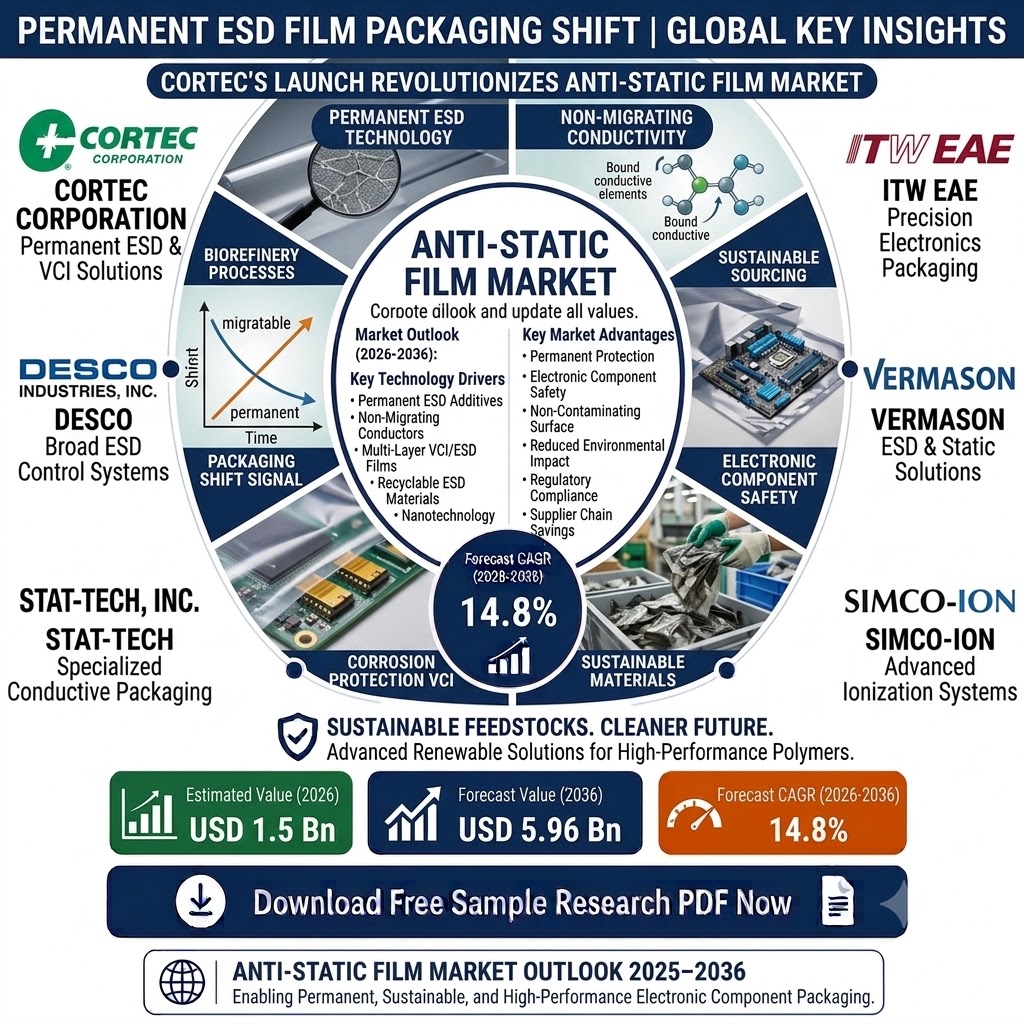
Cortec’s Permanent ESD Film Launch Highlights Packaging Shift as Anti-Static Film Market Heads Toward USD 5.96 Billion by 2036
NEW YORK — September 7, 2026 — Cortec Corporation’s December 2025 launch of its EcoSonic VpCI-125 HP Permanent ESD Stretch Film illustrates how anti-static packaging is moving toward longer-lasting, application-specific electrostatic protection as electronics manufacturing becomes more sensitive to electrostatic discharge. Fact MR estimates that the global anti-static film market will expand from USD 1.74 billion in 2026 to USD 5.96 billion by 2036, representing a 13.1% CAGR.
Get detailed market forecasts, competitive benchmarking, and pricing trends: https://www.factmr.com/connectus/sample?flag=S&rep_id=11853
Why are anti-static films becoming a manufacturing specification rather than a packaging add-on?
The change is being driven by the increasing sensitivity of semiconductor devices, automotive electronics and automated electronics-handling systems. As device geometries shrink and electronic content rises, packaging materials are being evaluated not only for physical protection but also for stable surface resistivity, static decay performance and compatibility with controlled manufacturing environments.
Cortec's December 2025 product launch is one example of this shift. Its permanent ESD stretch film was designed to retain static-dissipative performance during use and meets static-decay requirements under MIL-STD 3010, Method 4046 before and after stretching.
The competitive implication extends beyond a single product. Companies such as TekniPlex, Berry Global, Amcor plc and Toppan are positioned within a market where film formulation, coating technology, manufacturing consistency and application support increasingly matter alongside production scale. FMI identifies these companies among the key participants profiled in the market.
Where is demand concentrating?
Electronics packaging accounts for 46% of anti-static film demand, making it the largest application segment. Semiconductor and electronic components move through multiple handling, storage and transportation stages, creating repeated opportunities for triboelectric charge generation and ESD-related damage.
At the same time, growth is becoming geographically concentrated in electronics manufacturing hubs. China is forecast to expand at 14.0% CAGR through 2036, followed by the United States at 12.2%, Germany at 10.6%, India at 9.4% and Japan at 4.9%.
This combination suggests a two-layer competitive shift: established suppliers are competing on material performance and qualification depth, while faster-growing manufacturing regions are creating new demand for locally available films that can meet increasingly demanding ESD specifications.
Analyst Perspective
Fact MR analysis indicates that the market is moving from basic static-control packaging toward engineered film systems in which electrostatic performance, cleanroom compatibility, durability and automation requirements are evaluated together.
The commercial opportunity therefore extends beyond film volume. Suppliers capable of combining stable electrostatic properties with application-specific engineering, recyclable material structures and consistent quality control are better positioned to participate in higher-value electronics and semiconductor packaging applications.
Note: No market-specific named Fact MR analyst quotation was publicly verifiable for this report at the time of publication; this paragraph is presented as FMI analysis rather than attributed as a direct analyst quote.
Market Snapshot
- 2026 market value: USD 1.74 billion
- 2036 projected value: USD 5.96 billion
- 2026–2036 CAGR: 13.1%
- Largest application: Electronics packaging, 46%
- Fastest listed country: China, 14.0% CAGR
What is driving the anti-static film market?
Semiconductor manufacturing is a primary structural driver. Advanced devices have lower tolerance for electrostatic events, increasing the importance of packaging materials that provide predictable static control throughout handling and logistics.
EV electronics are adding another layer of demand. Greater electronic content in vehicles increases the number of sensitive modules and components moving through automotive supply chains, expanding the potential application base for engineered ESD films.
Industrial automation is also changing the requirements. High-speed automated handling introduces repeated contact and separation events that can generate electrostatic charge, increasing demand for films with stable performance rather than temporary or inconsistent static-control properties.
Sustainability is becoming a competitive consideration as well. Film suppliers are increasingly balancing ESD performance with recyclable structures, mono-material designs and lower environmental impact. This creates an opportunity for suppliers that can combine electrostatic protection with circular-material objectives rather than treating the two requirements separately.
About the Report
The Anti Static Film Market report by Fact MR covers the market outlook from 2026 to 2036, including application, coating type, base film and regional analysis. Fact MR forecasts the market to reach USD 5.96 billion by 2036 at a 13.1% CAGR.
Fact MR research process combines primary interviews with multi-source validation, including supply-side and demand-side estimation, top-down reconciliation, company-level modelling and scenario analysis.
Top Trending Reports:
https://www.openpr.com/news/4510428/construction-equipment-attachments-emerge-as-a-strategic-asset
https://www.openpr.com/news/4510443/industrial-ventilation-fan-market-accelerates-as-compliance
https://www.openpr.com/news/4510481/emergency-warning-lights-industry-moves-toward-smart
https://www.openpr.com/news/4510493/hydrocyclone-market-gains-momentum-as-water-recovery