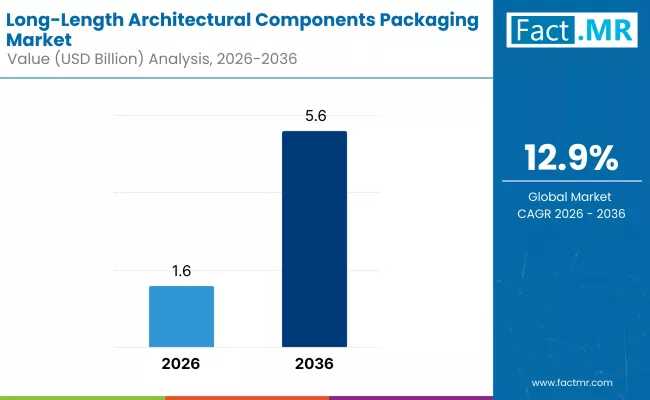
Sealed Air's reported 2025 development of the Korrvu Architectural Series reflects a broader change in how long-length architectural components are packaged: protection is increasingly being engineered around surface finish, handling risk and material efficiency rather than treated as a basic wrapping requirement. The global long-length architectural components packaging market is projected to grow from USD 1.6 billion in 2026 to USD 5.6 billion by 2036, expanding at a 12.9% CAGR.
Get detailed market forecasts, competitive benchmarking, and pricing trends: https://www.factmr.com/connectus/sample?flag=S&rep_id=14143
Why is architectural component packaging becoming a supply-chain decision?
Long aluminum profiles, steel sections and composite architectural members can pass through extrusion, finishing, fabrication, storage and multiple transport stages before reaching a construction site. Each additional handling point creates another opportunity for scratches, abrasion, moisture exposure or edge damage.
That is changing the economic role of packaging. When a premium anodized or coated profile is rejected because of surface damage, the cost can extend beyond the protective material to rework, replacement, project delays and additional handling.
The market is therefore moving toward engineered protection systems that combine films, sleeves, cushioning and end protection according to component geometry and logistics conditions. Fact MR current market assessment similarly describes a transition from commodity wrapping toward application-engineered protection systems validated for specific finishes, transport conditions and jobsite exposure.
Where is demand concentrating?
Aluminum profiles account for 46% of the long-length architectural components packaging market, while LDPE films hold a 48% share among protection formats.
The concentration is logical. Aluminum profiles are widely used in curtain-wall systems, windows, storefronts and other building-envelope applications where visible surface quality is part of the finished product specification.
LDPE films, meanwhile, offer a combination of conformability, visibility and relatively straightforward removal. Their role is expanding as manufacturers seek protection that can survive transport without making inspection or installation more difficult.
The competitive landscape includes Pregis, Mondi, Smurfit Kappa and Sealed Air, with differentiation increasingly extending from individual packaging materials to complete protection systems.
Analyst Perspective
Proposed Fact MR analyst quote — requires editorial verification before publication: “Long-length architectural components are increasingly being qualified on delivered condition rather than packaging cost alone. Suppliers that can demonstrate surface protection, handling efficiency and material compliance together are better positioned as construction supply chains become more demanding.”
—Shambhunath Jha, Principal Consultant, Fact MR
Market Snapshot
- 2026 market value: USD 1.6 billion
- 2036 projected value: USD 5.6 billion
- 2026–2036 CAGR: 12.9%
- Largest component segment: Aluminum profiles — 46%
- Largest protection format: LDPE films — 48%
- Fastest listed country market: China — 14.2% CAGR
What is driving the market?
Construction activity is one of the fundamental demand drivers. Commercial buildings, façade systems and modern building envelopes increasingly use long architectural profiles that require protection throughout extended logistics chains.
Infrastructure modernization is adding another layer of demand. Large projects create longer transportation routes and more handling stages, increasing the value of packaging systems that reduce damage before installation.
Labor availability is also changing packaging requirements. Ready-to-install components with factory-applied protection can reduce manual wrapping and inspection work at downstream locations.
Sustainability is becoming part of the specification. Packaging suppliers are increasingly expected to reduce plastic intensity, improve recyclability and develop mono-material or fiber-based alternatives without compromising surface protection. Fact MR identifies recyclable and compliance-oriented protection architectures as an important part of the market's competitive direction.
What is changing across major markets?
China is projected to record the fastest country-level growth among the markets highlighted, at 14.2% CAGR through 2036. The United States follows at 12.4%, Germany at 11.0%, India at 9.6% and Japan at 4.2%.
The regional pattern is commercially important. China's combination of construction scale and manufacturing modernization creates volume opportunities, while the United States combines infrastructure activity with established architectural-product supply chains. Germany's growth is more closely tied to sustainability and packaging compliance, while India's expansion reflects growing manufacturing and infrastructure activity.
Taken together, these markets indicate that competitive advantage will increasingly depend on adapting protection systems to local logistics, material regulations and component specifications rather than selling one universal packaging format.
About the Report
The Long-Length Architectural Components Packaging Market covers the market outlook from 2026 to 2036, including component type, protection system, material and regional demand. Fact MR estimates the market at USD 1.68 billion in 2026 and USD 5.64 billion in 2036, representing a 12.9% CAGR.
Fact MR research methodology combines primary interviews, multi-source validation, supply-side estimation, demand-side analysis, bottom-up modelling, top-down reconciliation, triangulation and scenario analysis.
Top Trending Reports:
https://www.openpr.com/news/4510509/linear-shaft-market-precision-engineering-gains-momentum-as
https://www.openpr.com/news/4510587/robot-cell-market-accelerates-as-manufacturers-race-toward
https://www.openpr.com/news/4510598/cutting-wheel-market-expands-as-industrial-manufacturing
https://www.openpr.com/news/4510607/vacuum-degreaser-market-set-for-steady-expansion-as-precision