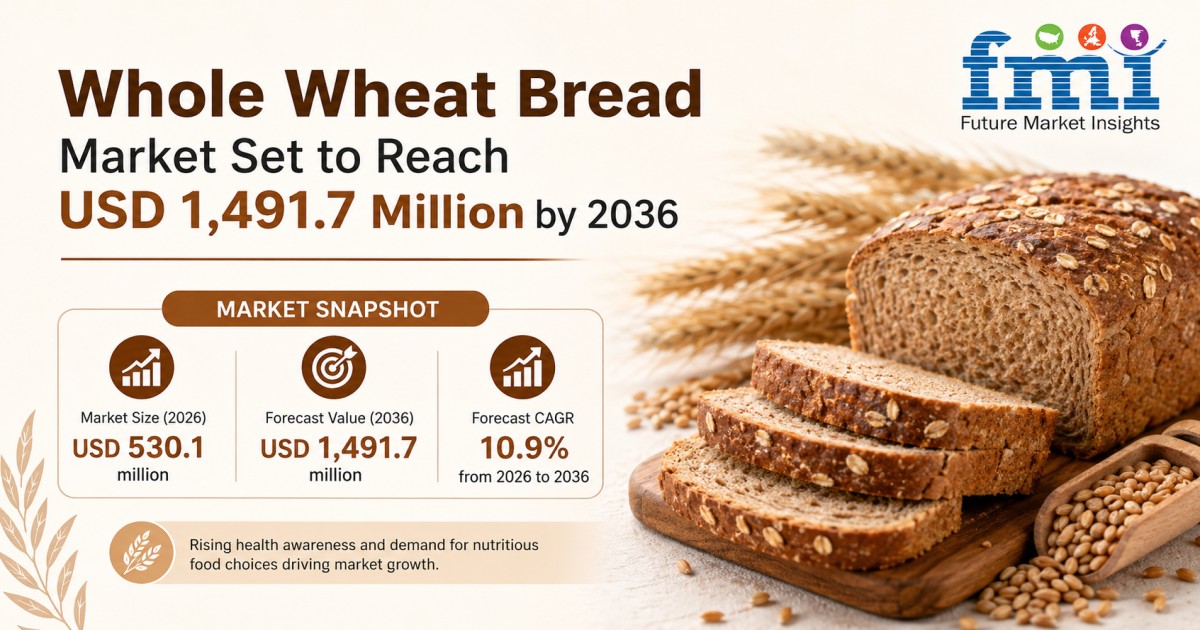
The whole wheat bread market is entering an accelerated commercial phase as public health authorities update dietary guidelines to favor whole-grain complex carbohydrates over refined flour, driving wholesale bakeries, grocery chains, and institutional catering programs to reformulate everyday sliced loaves.
Policy updates are reinforcing consumer trial: the U.S. Department of Health and Human Services reset federal nutrition priorities in early 2026 to emphasize fiber-dense whole grains, while the USDA Food and Nutrition Service mandates that at least 80% of weekly grains offered in school lunch and breakfast programs remain whole grain-rich. Concurrently, regional initiatives like the UAE Ministry of Health and Prevention's front-of-pack guidance are establishing clear fiber benchmarks for household shopping, prompting manufacturers to deliver whole-wheat loaves that match the softness, crumb flexibility, and toaster performance of conventional white bread.
Get Detailed Market Forecasts, Competitive Benchmarking, and Pricing Trends :
https://www.futuremarketinsights.com/reports/sample/rep-gb-34915
Future Market Insights estimates that the global whole wheat bread market will expand at a 10.9% CAGR between 2026 and 2036, adding more than USD 961 million in incremental market value by the close of the forecast period.
The core technical challenge remains bran interference: bran particles cut gluten strands, reduce loaf volume, and accelerate staling, requiring precision enzyme systems and dough conditioners to preserve familiar eating quality and prevent shoppers from rejecting wholemeal loaves due to dry texture or elevated price points.
How Are Different Companies Approaching the Whole Wheat Bread Opportunity?
The competitive landscape divides between multinational packaged-bread platforms and scaled frozen/bake-off specialists. Direct-to-consumer packaged leaders like Grupo Bimbo, Flowers Foods, Yamazaki Baking, Warburtons, and Hovis focus on shelf-life extension, crumb softness, and pack-size architecture to drive household penetration. Flowers Foods expanded its Nature's Own portfolio with smaller 100% Whole Wheat loaf sizes to eliminate household waste, while Hovis introduced its Farmhouse Batch Wholemeal with Oats to position high-fiber bread at an accessible mass-market price point.
Concurrently, commercial frozen and bake-off leaders including ARYZTA, Lantmännen Unibake, and Vandemoortele expand regional production to serve in-store supermarket bakeries and foodservice kitchens. Lantmännen Unibake expanded its European reach through its Örebro facility alongside strategic acquisitions such as Boboli Benelux B.V., while Vandemoortele acquired Lizzi in Italy to scale up specialty frozen bread and sourdough operations.
This industry split demonstrates distinct commercial routes: packaged brand owners rely on direct-store delivery (DSD) networks and retail promotions to defend center-aisle shelf space, whereas bake-off providers offer frozen par-baked formats that allow grocers and institutional cafeterias to serve fresh-baked whole-grain loaves with minimal kitchen labor.
The common operational hurdle is margin management: a whole-grain formulation succeeds in retail only when the flour cost and dough improvers fit everyday price ladders without exceeding what value-conscious households are willing to pay for staple items.
Why Does Fresh Format Anchor Retail and Foodservice Demand?
Fresh bread is projected to lead the format category with a 34.0% share in 2026, as consumer repeat purchase decisions continue to hinge on immediate crumb softness, aroma, and crust integrity.
While par-baked and frozen lines serve expanding foodservice channels, fresh sliced bread remains the primary grocery vehicle for daily toast and sandwich routines. Industrial bakeries use controlled enzymatic conditioning to protect crumb springiness over typical retail holding windows, maintaining consumer acceptance without altering the traditional eating occasion.
Standalone Market Stat: The global whole wheat bread market is forecast to add more than USD 961.6 million in value between 2026 and 2036.
Analyst Perspective
“Whole wheat bread earns repeat purchase when its nutrition proposition clears the same texture and price tests used for everyday sliced bread. Manufacturers should evaluate flour behavior first, then match loaf size and replenishment frequency to the channel carrying the product.” — Nandini Roy Choudhury, Principal Consultant, Future Market Insights
Market Snapshot
- Market Size (2026): USD 530.1 million
- Forecast Value (2036): USD 1,491.7 million
- Forecast CAGR: 10.9% from 2026 to 2036
- Leading Product Type: Classic - original, with a projected 37.0% share in 2026
- Leading Claim / Nature: Conventional loaves, estimated at 48.0% in 2026
- Leading Format: Fresh bread, forecast at 34.0% share in 2026
- Leading Packaging Format: Multipack formats, holding 32.0% in 2026
- Fastest-Growing Country: Saudi Arabia at an 11.8% CAGR
What Is Driving Demand Across the Whole Wheat Bread Market?
Familiarity and utility make classic - original loaves the anchor of the category, holding 37.0% of product type demand in 2026. Everyday sliced loaves fit existing breakfast and lunch routines with zero consumer education required.
Conventional claims capture 48.0% of the market in 2026. By avoiding the premium costs and strict sourcing constraints of organic or specialty certifications, conventional recipes allow brands to price whole-wheat loaves competitively against standard white bread.
Multipack and flexible packaging architecture capture 32.0% of packaging format demand in 2026, supported by developments like Yamazaki Baking's two- and three-slice offerings that cater to single-person households and reduce food waste.
Geographically, Saudi Arabia leads the profiled country growth at an 11.8% CAGR, aided by health ministry dietary campaigns emphasizing whole grains during staple grocery shopping. The United States follows at an 11.2% CAGR, propelled by school-meal whole-grain standards and healthcare facility procurement pledges, while the UK (10.9%), Germany (10.5%), and France (10.2%) represent mature retail bakery markets where innovation focuses on clean-label soft textures and localized grain blending.
Exclusive Discounts on Full Report: https://www.futuremarketinsights.com/reports/whole-wheat-bread-market
About the Report
The Whole Wheat Bread Market report provides an in-depth commercial analysis of finished whole wheat and wholemeal bread sold across retail, foodservice, and institutional channels.
The research segments the market by product type (classic - original, whole grain & seeded, flavored & filled, mini & snacking formats, premium / artisan), claim - nature (conventional, clean label, organic, gluten-free, high-protein / fortified), format (fresh, frozen, ambient packaged, chilled, par-baked / thaw-and-serve), packaging format (multipack, single-serve, family / loaf pack, bulk foodservice), sales channel (supermarkets & hypermarkets, artisan & specialty bakeries, convenience & forecourt, online & DTC, foodservice distributors), and 20+ countries across key geographic regions.
The analysis synthesizes primary interviews with commercial wholesale bakers, flour millers, and retail category buyers, supported by desk research across governmental dietary guidelines, school nutrition mandates, and corporate financial disclosures.
About Future Market Insights (FMI)
Future Market Insights (FMI) delivers actionable, decision-focused market intelligence that goes beyond traditional research reports. The company provides:
- In-depth pricing and cost benchmarking analysis
- Demand forecasting based on real industry inputs
- Procurement and buyer behavior insights
- Supply chain and trade flow intelligence
- Technology and application trend analysis across industries
FMI follows a robust bottom-up research methodology, combining insights from industry experts, procurement leaders, manufacturers, and technical professionals to ensure accurate and practical market intelligence.
For Press & Corporate Inquiries
Rahul Singh AVP - Marketing and Growth Strategy
Future Market Insights,
Inc. +91 8600020075
For Sales - sales@futuremarketinsights.com
For Media - Rahul.singh@futuremarketinsights.com
For Web - https://www.futuremarketinsights.com/