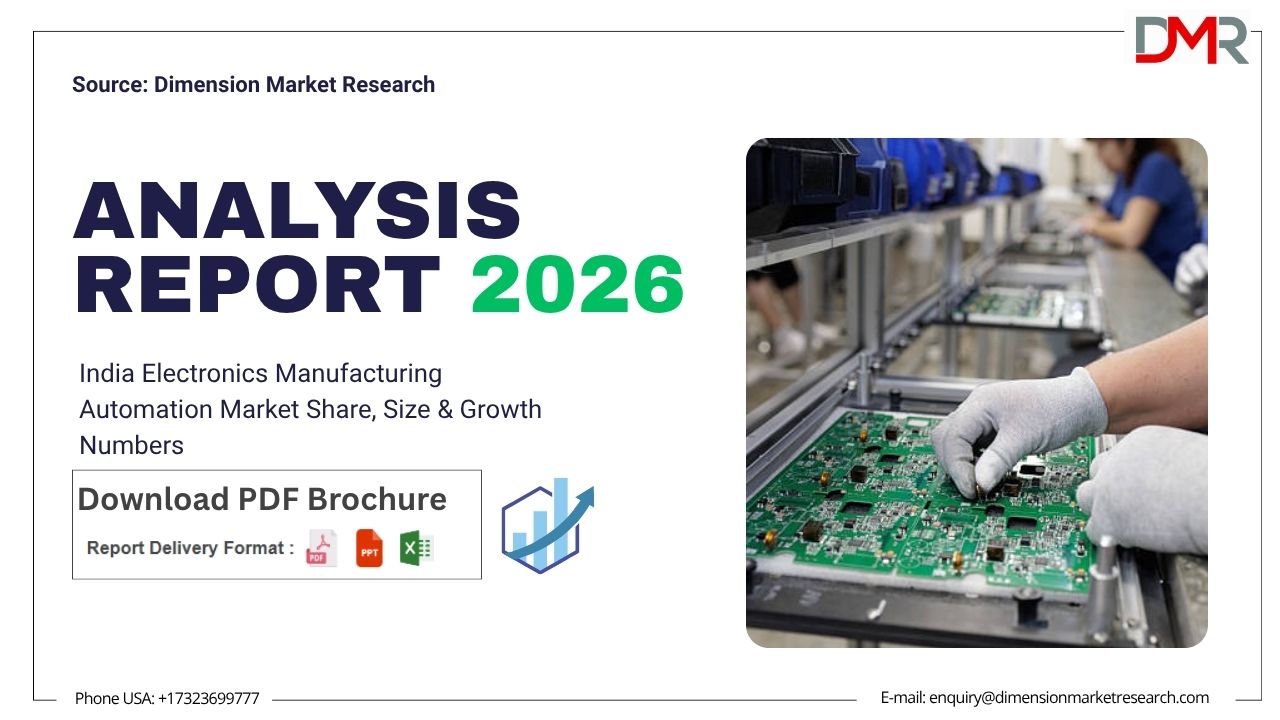
India Electronics Manufacturing Automation Sector Set for Strong Growth Through 2035
India's electronics manufacturing industry is entering a major phase of capacity expansion, creating significant opportunities for automation technology providers and manufacturers. The India Electronics Manufacturing Automation Sector is projected to increase from USD 4.82 billion in 2026 to USD 18.67 billion by 2035, registering a 14.53% CAGR during the forecast period.
The market includes automation hardware, industrial robots, PLCs, machine vision systems, control technologies, manufacturing software, system integration, automated assembly, testing, inspection, material handling and production monitoring solutions used across electronics manufacturing facilities.
India's transition from an assembly-focused electronics ecosystem toward component manufacturing, semiconductor packaging, IT hardware, consumer electronics, automotive electronics and connected devices is increasing the need for scalable and repeatable production technologies.
- Market value: USD 4.82 billion in 2026
- Forecast value: USD 18.67 billion by 2035
- Expected CAGR: 14.53% from 2026 to 2035
- Process Automation held 48.4% share in 2026
- Hardware accounted for 58.2% share in 2026
- Consumer Electronics led with 42.5% share
- SMT accounted for 52.3% share in 2026
Electronics Manufacturing Expansion Drives Automation Demand
The growth of India's electronics manufacturing base is one of the primary factors supporting automation investment. Increasing production volumes are encouraging manufacturers to improve throughput, quality consistency, traceability and production efficiency.
The country's electronics production reached approximately INR 13.11 lakh crore in FY 2025-26, compared with around INR 11.32 lakh crore in FY 2024-25. Electronics exports also reached approximately INR 4.24 lakh crore during FY 2025-26.
As manufacturers increasingly target domestic and international markets, automation is becoming important for high-volume production. Robotic assembly, automated inspection, SMT equipment, machine vision, production monitoring and automated material handling can help manufacturers manage growing production requirements while maintaining consistent quality.
Government initiatives supporting electronics, components and semiconductor manufacturing are further strengthening the investment environment. New manufacturing facilities require advanced production equipment and digitally connected factory infrastructure, creating opportunities across the automation value chain.
SMT and Process Automation Remain Major Market Segments
Process Automation accounted for the largest automation type share, representing 48.4% of the market in 2026. Electronics manufacturers use process automation for SMT placement, soldering, inspection, testing, PCB handling and other production activities requiring precision and repeatability.
Hardware represented 58.2% of the market by component in 2026. Robots, PLCs, industrial PCs, sensors, machine vision equipment, drives, motors and HMI systems provide the physical foundation for automated production lines.
Consumer Electronics represented 42.5% of the market by end-user industry. India's large-scale mobile phone and consumer device manufacturing ecosystem supports strong demand for automated assembly, inspection, testing, labeling, packaging and material handling.
Surface Mount Technology was the leading manufacturing process segment, accounting for 52.3% of the market in 2026. Increasing PCB complexity, component miniaturization and higher production volumes are strengthening demand for precision SMT equipment and automated inspection.
- SMT supports high-volume PCB manufacturing
- Machine vision improves automated inspection
- Robotics supports repeatable assembly operations
- MES and SCADA improve production visibility
- Automated handling strengthens material traceability
AI and Smart Manufacturing Create New Opportunities
Artificial intelligence is expanding the capabilities of manufacturing automation beyond conventional machine control. AI-enabled machine vision can inspect PCBs, solder joints, components, connectors, labels and assembly conditions at production speed.
Predictive maintenance is another important application. Production systems can analyze equipment information such as vibration, temperature, motor current, cycle times and machine errors to identify potential failures before they interrupt production.
Generative AI is also beginning to support engineering and manufacturing teams. AI interfaces can assist with equipment troubleshooting, maintenance information, production documentation and operational reporting when connected with manufacturing data platforms.
However, industrial AI adoption requires attention to cybersecurity, data quality, intellectual property, operational technology security and human oversight. Manufacturers are likely to adopt AI progressively as they validate its benefits across specific production and quality-control applications.
Investment Opportunities Across India's Electronics Ecosystem
The expansion of component manufacturing, semiconductor packaging, PCB production, automotive electronics and IT hardware is creating additional automation opportunities.
Mid-sized electronics manufacturers and EMS providers represent another important opportunity. Many companies require flexible automation without investing in completely automated production facilities. Modular robotic cells, cobots, compact inspection systems, flexible feeders and retrofit solutions can help address this requirement.
Local engineering, commissioning, maintenance, training and financing capabilities could become important differentiators for automation suppliers competing in India's growing market.
- Modular automation can support mid-sized manufacturers
- Retrofit solutions can modernize existing production lines
- Local service can reduce implementation downtime
- Machine vision can improve quality inspection
- Automated logistics can improve material movement India, Mitsubishi Electric India, Delta Electronics India, Omron India, Schneider Electric India and Honeywell Automation India.
Competitive Landscape
The India Electronics Manufacturing Automation Sector includes multinational automation companies, Indian engineering businesses, robotics specialists, SMT equipment providers and system integrators.
Prominent companies include Siemens India, ABB India, Rockwell Automation India, Mitsubishi Electric India, Delta Electronics India, Omron India, Schneider Electric India and Honeywell Automation India. Indian technology and engineering companies also participate in specialized areas such as robotics, industrial software, system integration, machine vision and automated material handling.
Competition is increasingly influenced by interoperability, implementation speed, cybersecurity, lifecycle support, energy efficiency, analytics capabilities and the ability to integrate new automation technologies with existing factory equipment.
Market Outlook Through 2035
The outlook for the India Electronics Manufacturing Automation Sector remains closely connected to the country's broader manufacturing ambitions. As manufacturers move toward higher-value production, automated processes will become increasingly important for quality, productivity and scalability.
The market's projected growth to USD 18.67 billion by 2035 highlights the potential for automation vendors, system integrators, equipment manufacturers, software companies and investors. Opportunities are expected to expand across SMT automation, robotics, machine vision, automated testing, industrial software, digital twins, MES, SCADA and smart factory solutions.
For companies evaluating expansion, technology investment or market entry, understanding segment-level demand, competitive positioning, emerging technologies and investment white spaces can support more informed strategic decisions.
FAQ's
- What is the India Electronics Manufacturing Automation Sector?
It covers automation hardware, software and services used to automate electronics production, assembly, inspection, testing, material handling and factory operations in India.
- What is the India Electronics Manufacturing Automation Sector size?
The market is projected to reach USD 4.82 billion in 2026 and USD 18.67 billion by 2035.
- What is the expected CAGR of the India Electronics Manufacturing Automation Sector?
The market is expected to expand at a CAGR of 14.53% between 2026 and 2035.
- Which automation segment leads the Indian market?
Process Automation held the largest share, accounting for 48.4% of the market in 2026.
- Which component segment has the largest market share?
Hardware led the component segment with a 58.2% market share in 2026.
- Which industry dominates electronics automation manufacturing decision-makers, the market presents opportunities across equipment, software, robotics, AI-enabled inspection, smart factory platforms and industrial integration. The combination of expanding electronics production, government support and increasing adoption of connected manufacturing technologies is expected to sustain demand?
Consumer Electronics led the end-user industry segment with a 42.5% market share in 2026.
- Which manufacturing process leads the market?
Surface Mount Technology led with a 52.3% market share in 2026.
- What is driving electronics automation adoption in India?
Growing electronics production, export demand, factory modernization, government incentives and increasing quality requirements are key drivers.
- How is AI changing electronics manufacturing automation?
AI supports machine vision, predictive maintenance, production analytics, troubleshooting and adaptive quality management.
- What opportunities exist in India's electronics automation market?
Major opportunities include SMT automation, robotics, machine vision, automated testing, intralogistics, MES integration, retrofits and modular automation.
Related Report:
- KSA Construction Layout Robots Market
- Japan Construction Layout Robots Market
- Construction Layout Robots Market
- Europe Construction Layout Robots Market
About Us
Dimension Market Research (DMR) is a global market intelligence and consulting firm delivering data-driven insights that help organizations make informed strategic decisions. With expertise across 12+ industries and global markets, DMR provides syndicated reports, custom research, competitive analysis, white space analysis, and business strategy consulting.
Our research solutions combine analytical rigor, industry expertise, and forward-looking intelligence to identify opportunities, reduce risks, and support sustainable growth. Trusted by clients across diverse sectors, DMR is committed to delivering accurate, actionable insights that enable businesses to navigate evolving market landscapes with confidence.
Contact Us
Phone USA: +17323699777
Phone India: +919310023843
E-mail: enquiry@dimensionmarketresearch.com
Address USA: 957 Route 33, Suite 12 #308, Hamilton Square, NJ-08690
Address India: D44, Sector 6, Noida 201301, India