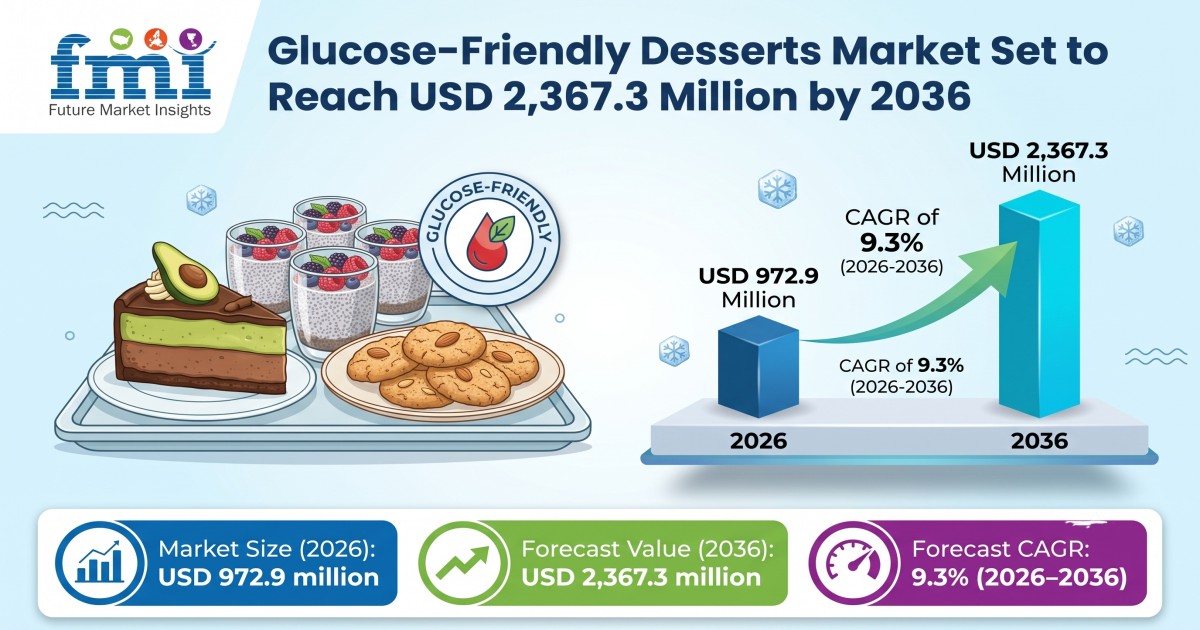
The glucose-friendly desserts market is entering a broader commercial phase as food manufacturers move beyond niche diet positioning to deliver everyday sweet treats that fit metabolic health routines, GLP-1 weight-management regimens, and medical diabetic care without sacrificing sensory satisfaction.
Underlying demographic demand continues to scale rapidly: the U.S. Centers for Disease Control and Prevention reported in early 2026 that 40.1 million American adults have diagnosed diabetes, while another 115.2 million live with prediabetes. This massive consumer base creates recurring scrutiny of nutrition panels, prompting mainstream retail brands to reformulate frozen novelties, cookies, and chocolate confections with low-glycemic bulk sweeteners that minimize postprandial glucose spikes while delivering conventional mouthfeel.
Get Detailed Market Forecasts, Competitive Benchmarking, and Pricing Trends :
https://www.futuremarketinsights.com/reports/sample/rep-gb-34866
Future Market Insights estimates that the global glucose-friendly desserts market will expand at a 9.3% CAGR between 2026 and 2036, adding more than USD 1.39 billion in incremental value over the ten-year forecast window.
The primary commercial constraint remains regulatory fragmentation around sweetener approval: while the U.S. FDA permits allulose to be excluded from Total and Added Sugars declarations, regulatory bodies such as EFSA in the European Union and the UK’s ACNFP continue to review novel food applications, restricting universal recipe portability across borders.
How Are Different Companies Approaching the Glucose-Friendly Opportunity?
The competitive landscape divides between scaled dessert manufacturers incorporating reduced-sugar lines, dedicated metabolic-health brands, and active-nutrition crossover platforms. Large-scale frozen dessert operators like Wells Enterprises (Halo Top) leverage mass manufacturing capacity strengthened by a USD 512 million multi-phase investment at its Dunkirk, New York plant to introduce mainstream indulgence cues like mix-in pints, downplaying clinical claims in favor of broad taste appeal.
Concurrently, specialized low-carb and keto platforms like Rebel Creamery, Nick’s, and Keto Pint emphasize zero-added-sugar and high-fat formulations engineered specifically for tight glycemic control. In the bakery and snacking aisles, active-nutrition platforms like Quest Nutrition (The Simply Good Foods Company) are transferring protein-bakery expertise into mainstream dessert spaces, rolling out lines such as Quest Bake Shop protein donuts, while specialty snack creators like Catalina Crunch and HighKey capture incremental share in reduced-sugar cookies and confections. Meanwhile, early pioneer Enlightened (Beyond Better Foods) remains part of the recognized competitive set despite a temporary production pause.
This competitive split illustrates distinct strategic choices: mainstream brands rely on high-volume frozen retail visibility and conventional dessert messaging, whereas dedicated glycemic innovators focus on carb-conscious communities that prioritize specific sweetener combinations and third-party nutritional substantiation.
The shared formulation hurdle is functional replacement: taking sugar out of a dessert removes not just sweetness, but essential bulk, freezing-point depression in ice creams, and moisture retention in baked goods.
Why Does Allulose Lead the Sweetener System Category?
Allulose is projected to command a 41.4% share of the sweetener system category in 2026, driven by its unique performance characteristics as a rare sugar that behaves like sucrose in production lines.
Unlike high-intensity sweeteners that require separate bulking agents, allulose provides volume, contributes to browning in baked goods, and depresses the freezing point in frozen desserts to ensure scoopability. In the United States, FDA guidance allowing its exclusion from Total and Added Sugars declarations alongside an assigned caloric value of only 0.4 kcal/g makes it an optimal formulation tool for brands balancing front-of-pack low-sugar claims with desirable product texture.
Standalone Market Stat: The global glucose-friendly desserts market is forecast to add more than USD 1,394 million in value between 2026 and 2036.
Analyst Perspective
“Glucose friendly desserts have to work first as desserts. The commercial test is whether brands can reduce sugar or support a glucose-oriented proposition without making texture, taste or label interpretation harder for the buyer. Regulatory differences around sweeteners mean formula portability will remain a practical constraint across markets.” — Nandini Roy Choudhury, Principal Consultant, Future Market Insights
Market Snapshot
- Market Size (2026): USD 972.9 million
- Forecast Value (2036): USD 2,367.3 million
- Forecast CAGR: 9.3% from 2026 to 2036
- Leading Product Type: Ice cream & frozen desserts, holding a projected 47.2% share in 2026
- Leading Sweetener System: Allulose, estimated at 41.4% share in 2026
- Leading Claim: Low-glycemic, forecast to capture 48.6% share in 2026
- Leading Consumer Group: People with diabetes / prediabetes, representing 36.9% in 2026
- Leading Sales Channel: Supermarkets & hypermarkets, accounting for 44.9% in 2026
- Fastest-Growing Profiled Country: South Korea at a 9.4% CAGR
What Is Driving Demand Across the Glucose-Friendly Desserts Market?
Frozen desserts anchor category demand, with ice cream and frozen novelties capturing 47.2% of product type share in 2026. Pre-portioned bars and pints offer a direct substitution route for evening snacking occasions, fitting existing freezer infrastructure across grocery retail.
Low-glycemic claims lead the marketing proposition at 48.6% share in 2026. This positioning appeals broadly to metabolic wellness shoppers, keto adherents, and GLP-1 medication users without confining the product to a single narrow dietary category.
Supermarkets and hypermarkets lead distribution with a 44.9% share in 2026, placing lower-sugar treats directly alongside conventional baked goods and ice cream tubs during weekly family shopping trips.
Regionally, South Korea is projected to post the fastest growth among profiled markets at a 9.4% CAGR through 2036, driven by health agency focus on chronic metabolic conditions and rapid functional packaged-food innovation. The United Kingdom follows closely at 9.1% CAGR, while the United States advances at 8.8% CAGR, anchored by its large prediabetic population and favorable allulose labeling rules. Germany (8.2%) and Japan (7.3%) reflect mature retail environments where localized food-additive approvals and labeling standards guide brand entry.
Exclusive Discounts on Full Report: https://www.futuremarketinsights.com/reports/glucose-friendly-desserts-market
About the Report
The Glucose-Friendly Desserts Market report provides an in-depth commercial analysis of packaged lower-sugar desserts positioned for blood sugar and carbohydrate management.
The research segments the market across five commercial dimensions: product type (ice cream & frozen desserts, cookies & baked goods, chocolate & confections, puddings & cups, others), sweetener system (allulose, monk fruit, erythritol blends, stevia, others), claim (low-glycemic, keto-friendly, diabetic-friendly, no added sugar, others), consumer group (people with diabetes / prediabetes, keto & low-carb consumers, GLP-1 users, general wellness, others), sales channel (supermarkets & hypermarkets, online / DTC, convenience stores, specialty & health stores, others), and 20+ national markets.
The report synthesizes primary research with food scientists, brand commercial directors, and retail category managers alongside desk research across public health statistics (CDC, WHO, RKI), regulatory agency notices (FDA, EFSA, UK ACNFP), and company filings.
About Future Market Insights (FMI)
Future Market Insights (FMI) delivers actionable, decision-focused market intelligence that goes beyond traditional research reports.
The company provides:
- In-depth pricing and cost benchmarking analysis
- Demand forecasting based on real industry inputs
- Procurement and buyer behavior insights
- Supply chain and trade flow intelligence
- Technology and application trend analysis across industries
FMI follows a robust bottom-up research methodology, combining insights from industry experts, procurement leaders, manufacturers, and technical professionals to ensure accurate and practical market intelligence.
For Press & Corporate Inquiries
Rahul Singh AVP - Marketing and Growth Strategy
Future Market Insights,
Inc. +91 8600020075
For Sales - sales@futuremarketinsights.com
For Media - Rahul.singh@futuremarketinsights.com
For Web - https://www.futuremarketinsights.com/