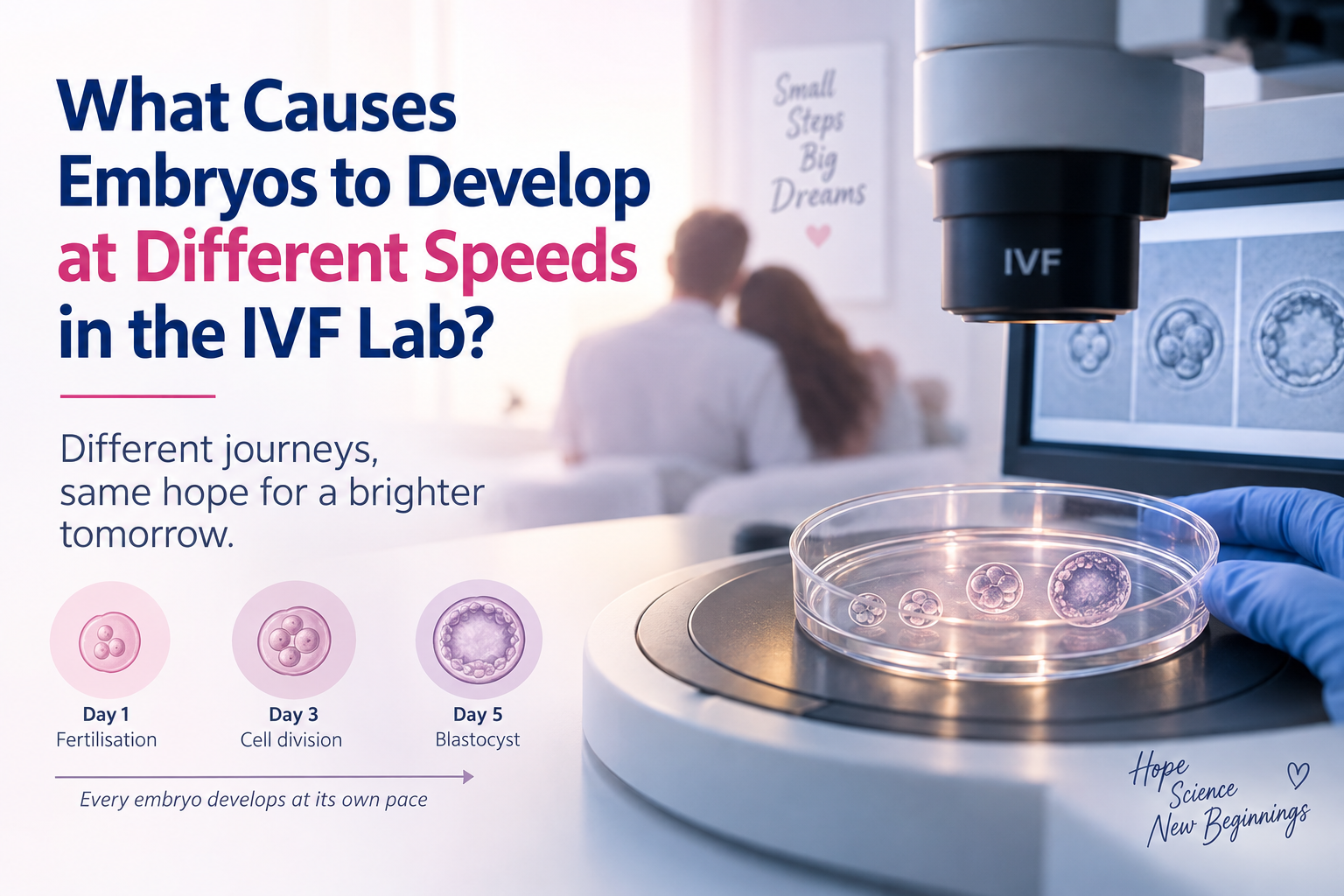
Introduction
One of the most confusing parts of IVF can be watching embryos develop at different speeds. You may hear that one embryo is dividing normally while another is a little slower, and naturally, you may wonder, “Does slower development mean lower chances of pregnancy?”
Not necessarily.
Embryos do not all follow an identical timetable. Their development can be influenced by egg and sperm quality, genetics, laboratory conditions, and many other factors. Understanding these differences can make the IVF journey less stressful and help you have more realistic expectations.
If you are considering treatment, choosing an experienced fertility specialist, such as the best IVF Doctor in Delhi NCR, can also help you understand how your embryos are developing and what your options may be.
1. Understanding Embryo Development in IVF
After fertilisation, an embryo begins a remarkable process of growth and division. A single fertilised egg starts dividing into more cells. Over several days, it may develop from a small group of cells into a blastocyst, which is the stage commonly considered for transfer or freezing.
But here is something important: not every embryo reaches each stage at exactly the same time.
Think of embryos like runners in a marathon. They all begin at roughly the same starting point, but some move ahead, some stay in the middle, and others take longer to reach the next milestone.
This difference does not automatically tell us which embryo will ultimately result in a pregnancy.
Embryologists therefore look at several characteristics rather than judging an embryo simply by whether it is developing quickly or slowly.
2. Why Do Embryos Develop at Different Speeds?
There is no single reason why embryos develop at different rates. Embryo development is a complex biological process involving many factors.
Some important influences include:
- Egg quality
- Sperm quality
- Chromosomal health
- Age of the egg source
- Conditions during fertilisation
- Embryo metabolism
- Cell division patterns
- Laboratory conditions
- Random biological differences
Even when embryos come from the same IVF cycle, they can behave differently.
This is because each embryo has its own combination of genetic material and biological characteristics. Two embryos created using eggs and sperm from the same couple can therefore have very different developmental paths.
Different speed does not automatically mean different potential.
3. The Role of Egg Quality
The egg plays an especially important role during the earliest stages of embryo development.
A healthy egg contains the cellular structures and energy resources needed to support the embryo during its first few days. As development progresses, the embryo gradually becomes more responsible for producing the materials it needs.
With increasing age, the likelihood of abnormalities in eggs generally increases. This can influence fertilisation, embryo development, and the chances that an embryo will continue growing.
However, age is only one factor.
Egg quality can vary between individuals and even between eggs retrieved during the same IVF cycle. This is one reason why some embryos may develop differently despite being created at approximately the same time.
A slower embryo should therefore be evaluated in context rather than judged immediately.
4. How Sperm Quality Can Affect Embryo Growth
Eggs are not the only contributors to embryo development. Sperm also provides half of the embryo's genetic material.
Factors associated with sperm quality can include sperm count, movement, shape, and DNA integrity. Although a sperm may successfully fertilise an egg, differences in sperm quality can sometimes influence subsequent embryo development.
This does not mean that a particular sperm characteristic automatically determines whether an embryo will succeed.
Instead, embryo development reflects the combined contribution of the egg and sperm, along with many other biological processes.
For this reason, fertility specialists consider both male and female factors when assessing an IVF cycle.
5. Does Embryo Development Reflect Genetics?
Yes, genetics can play an important role.
Some embryos contain chromosomal abnormalities that can interfere with normal development. In some cases, an embryo may stop developing before reaching the blastocyst stage.
However, developmental speed alone cannot reliably tell you whether an embryo is genetically normal or abnormal.
An embryo that develops quickly is not automatically genetically healthy, and an embryo that develops more slowly is not automatically abnormal.
Depending on the individual situation, doctors may discuss genetic testing of embryos, such as preimplantation genetic testing for certain conditions. Whether testing is appropriate depends on factors such as age, medical history, previous IVF outcomes, family history, and the number of embryos available.
6. What Happens During the First Few Days?
The first several days after fertilisation involve rapid and highly organised changes.
Generally, an embryo progresses through several stages:
Day 1: Fertilisation is assessed and the embryo begins its early development.
Day 2: The embryo commonly consists of several cells and continues dividing.
Day 3: Further cell division occurs, with embryos often containing more cells.
Day 4: The embryo undergoes major structural changes as cells become more compact.
Day 5: Some embryos reach the blastocyst stage.
Day 6: Additional embryos may reach the blastocyst stage.
These timelines are useful guidelines, not strict deadlines.
Some embryos reach the blastocyst stage on Day 5, while others may reach it on Day 6 or later. Your embryology team considers the embryo's appearance and development when determining its potential and whether it is suitable for freezing or transfer.
7. Why Some Embryos Develop Slowly
A slower developmental pace can occur for several reasons.
Biological variation is one possibility. Just as children do not all grow at exactly the same rate, embryos can also progress at different speeds.
Egg or sperm factors may contribute. Genetic or chromosomal problems may also affect development. Sometimes, however, there may be no obvious reason for slower growth.
This is one of the frustrating aspects of IVF: embryology cannot always provide a simple explanation for every embryo's behaviour.
A slower embryo may continue developing and reach the blastocyst stage. Another may stop developing. The outcome cannot always be predicted simply from the first few days.
That is why embryologists observe development over time rather than making an immediate judgment.
8. Can a Slow-Developing Embryo Still Be Healthy?
Yes, it can.
This is one of the most important points for IVF patients to understand.
An embryo that reaches the blastocyst stage later than another embryo may still have the potential to implant and result in a pregnancy. At the same time, developmental speed can be one of several factors considered during embryo selection.
The key is not to think of embryo development as a simple race in which the first embryo to finish always wins.
Instead, imagine a garden. Some seeds sprout earlier, while others take longer. You cannot determine the final strength of every plant simply by looking at which seed appeared above the soil first.
Similarly, embryologists assess the overall picture, not just the clock.
9. How IVF Laboratories Support Embryo Development
The IVF laboratory environment is carefully controlled because embryos are extremely sensitive during their early development.
Laboratories maintain appropriate conditions for temperature, gas levels, culture media, cleanliness, and other environmental factors.
Embryologists monitor embryos using specialised techniques and may observe how they divide and change over time.
Some laboratories use time-lapse embryo monitoring, which allows embryologists to observe developmental patterns without repeatedly removing embryos from controlled conditions.
However, technology is a tool rather than a crystal ball.
The presence of advanced laboratory equipment does not guarantee pregnancy. The goal is to provide embryos with stable conditions while giving specialists more information to help evaluate them.
10. Embryo Grading and Developmental Speed
Embryo grading is another important part of IVF.
Embryologists examine features such as the number and organisation of cells, the appearance of the embryo, and, at the blastocyst stage, characteristics of its