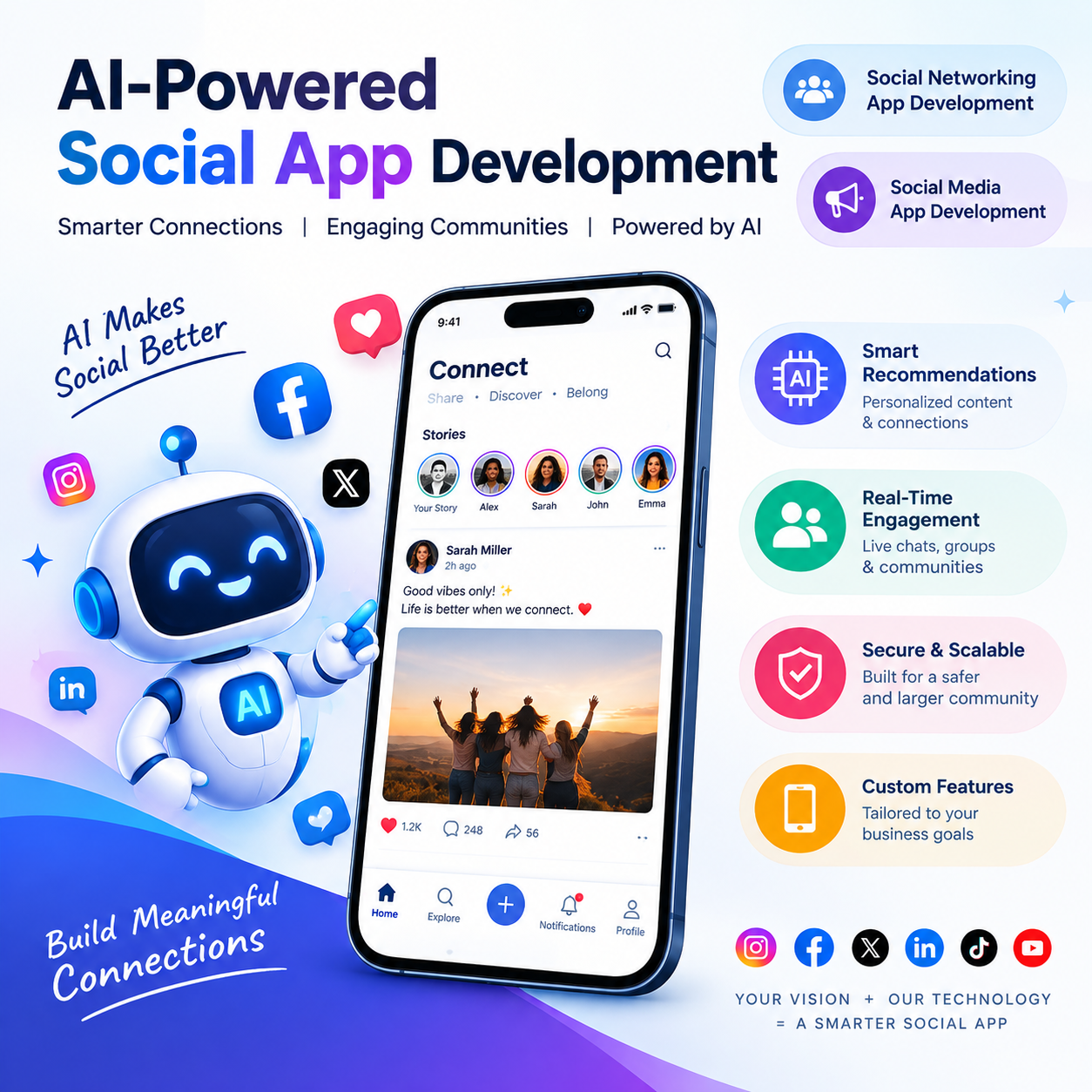
Launching a social application can look simple from the outside. A user creates an account, builds a profile, posts content, follows others, and starts communicating.
Behind that simple experience, however, there are many technical and business decisions.
A company planning AI-powered social app development needs to think about its audience, platform features, security, infrastructure, moderation, monetization, and future growth before releasing the product.
Who is the Application For?
The first question should be about the target audience.
A social application for students will have different needs from one built for professionals. A platform for artists may focus on portfolios and visual content, while a local community app may focus on events and neighborhood discussions.
Defining the audience helps businesses avoid building an application that tries to serve everyone.
What Problem Does It Solve?
A new social platform needs a reason to exist.
Simply offering profiles, posts, and messaging may not be enough when users already have access to established platforms.
The application could focus on a specific community, a unique content format, professional connections, private groups, interest-based discussions, or another clear purpose.
The stronger the product idea, the easier it becomes to decide which features belong in the first release.
Which Platforms Should Be Supported?
Businesses should decide whether the application will launch on iOS, Android, the web, or several platforms.
Each choice affects development time, testing, maintenance, and budget.
A business may choose to launch on one platform first and expand later, or use cross-platform technologies where appropriate.
The decision should be based on where the intended audience is most likely to use the product.
How Will Users Connect?
Connection features form the heart of a social platform.
Depending on the concept, this could include the following, friendships, professional connections, communities, groups, direct messages, comments, reactions, or live interactions.
A good social networking app development plan should make these connections easy without creating unnecessary complexity.
Where Does AI Fit?
AI should have a practical role.
Recommendation systems can help users find content. Automated classification can organize posts. Intelligent moderation can flag suspicious activity. AI-assisted search can make information easier to find.
Businesses should decide which problems require AI and which can be solved with simpler technology.
Using AI only because it is popular can add unnecessary costs and technical complexity.
How Will the Platform Stay Safe?
Social applications can face spam, fake accounts, harassment, inappropriate content, scams, and other problems.
Safety features should therefore be planned before launch.
Users may need reporting, blocking, privacy settings, account controls, and content preferences. Administrators may need tools for reviewing reports and restricting problematic accounts.
A platform that takes safety seriously can create a stronger foundation for community growth.
What Happens When Usage Increases?
A social app may start with a few hundred users and eventually attract much larger numbers.
This means businesses should consider scalability from the beginning.
The application may need to handle large volumes of images, videos, messages, notifications, searches, and user activity.
Cloud infrastructure and a suitable database architecture can help support this growth.
How Will the Business Make Money?
Monetization should also be considered early.
Possible models include advertising, subscriptions, premium accounts, creator services, paid communities, digital purchases, or business accounts.
The selected model should match the audience.
For example, a professional networking platform may offer premium business features, while a creator platform may share revenue or offer paid subscriptions.
What Will Users Return?
Downloads do not guarantee long-term success.
Businesses should consider what creates repeat usage. It could be fresh content, meaningful conversations, creator activity, community events, personalized recommendations, or useful professional connections.
For social media app development, retention should be considered during product planning rather than after launch.
How Will Success Be Measured?
Before launch, businesses should decide which measurements matter.
These might include active users, retention, content creation, community participation, messages sent, subscription conversions, or other product-specific measurements.
Clear measurements make it easier to understand whether the platform is moving in the right direction.
Prepare for Continuous Improvement
Launching the first version is not the end of development.
User feedback and usage data can reveal problems that were not visible during planning. Some features may become popular, while others may receive little attention.
Regular updates can help the application respond to changing user expectations.
An AI-based system can also improve as businesses refine recommendation rules, moderation processes, and other intelligent features.
Final Words
A social application needs more than an attractive interface and a collection of familiar features. Businesses should understand their audience, define a clear purpose, plan communication tools, consider safety, prepare for growth, and decide how the platform will generate value.
AI-powered social app development can support recommendations, moderation, search, and personalization, but it should be used where it solves a real problem.
Careful planning before launch can reduce unnecessary development work and create a stronger foundation for a social platform that can grow with its users.