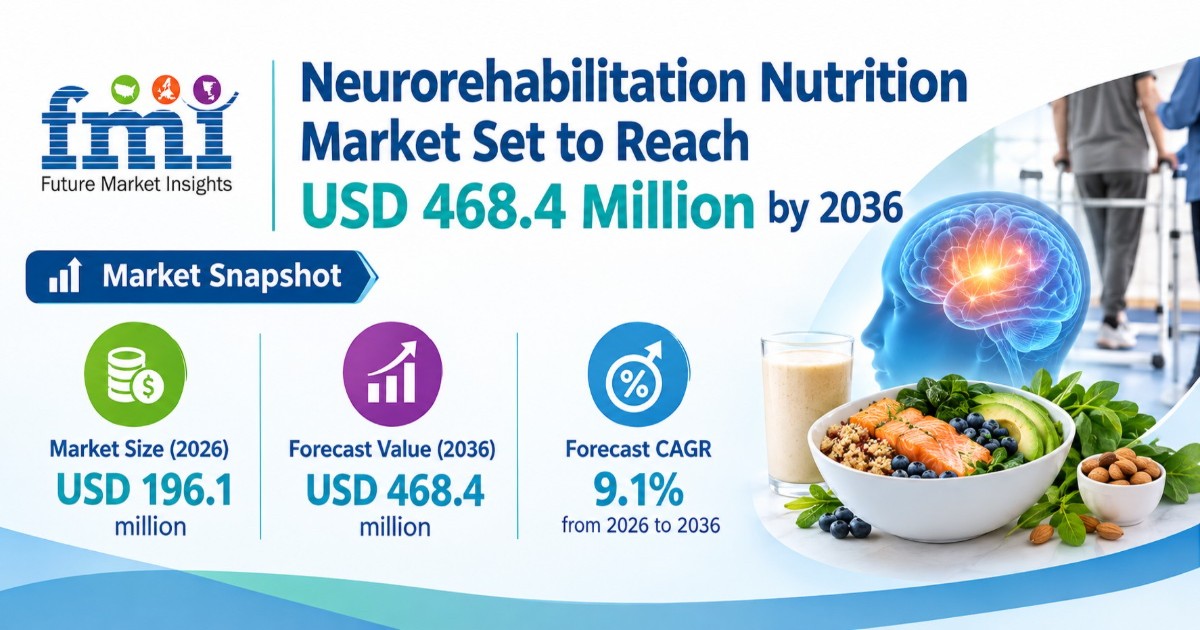
High-protein recovery oral nutritional supplements (ONS) are projected to represent 41.8% of product type demand in 2026, as the global neurorehabilitation nutrition market expands from USD 196.1 million in 2026 to USD 468.4 million by 2036, according to the latest research report published by Future Market Insights.
The neurorehabilitation nutrition market is entering an expanded clinical phase as dedicated inpatient rehabilitation facilities, acute stroke care pathways, and long-term care networks systematically integrate clinical nutrition regimens to counteract stroke-induced dysphagia, muscle atrophy, and nutritional deficits during functional neurological recovery.
Global neurological injury workloads and updated care guidelines are driving category conversion: with the World Health Organization estimating over 93.8 million people living with stroke-related disabilities worldwide and U.S. Centers for Medicare & Medicaid Services (CMS) regulations mandating that therapy in inpatient rehabilitation facilities begin within 36 hours of admission, care teams face compressed timelines to establish baseline nutritional stability. Concurrently, clinical studies demonstrate that fortified, texture-modified diets increase daily caloric intake by approximately 200 kcal in dysphagic stroke patients without expanding meal volume, reinforcing the need for concentrated oral supplements, semi-solid enteral formulas, and precise thickening systems.
Get Detailed Market Forecasts, Competitive Benchmarking, and Pricing Trends:
https://www.futuremarketinsights.com/reports/sample/rep-gb-35095
Future Market Insights estimates that the global neurorehabilitation nutrition market will advance at a 9.1% CAGR between 2026 and 2036, adding more than USD 272 million in incremental value over the ten-year forecast window.
The primary operational hurdle remains transition-of-care continuity: while multidisciplinary teams closely control enteral and oral regimens within inpatient rehabilitation facilities, post-discharge friction including fragmented outpatient reimbursement, caregiver preparation burden, and local formulary discrepancies frequently disrupts product adherence once patients return home.
How Are Different Companies Approaching the Neurorehabilitation Opportunity?
The competitive landscape divides between comprehensive clinical nutrition platforms, plant-based medical innovators, and regional dysphagia specialists. Global healthcare conglomerates such as Danone Nutricia, Abbott Laboratories, Nestlé Health Science, and Fresenius Kabi (expanding R&D centers in Gurugram, India, and Bad Homburg, Germany) leverage extensive hospital formularies, global group purchasing organization (GPO) contracts, and complete oral-to-enteral portfolios to secure primary clinical adoption.
Concurrently, specialized innovators like Kate Farms (strengthened by Danone's majority acquisition) supply plant-based, peptide-dense formulas for patients experiencing intolerance to dairy or standard medical ingredients. Meanwhile, regional leaders such as Otsuka Pharmaceutical Factory (launching ENOSOLID semi-solid enteral formulas and HINEX hydration jellies), Meiji Co., Ltd., and Nutrisens Group focus on specialized texture-modified foods, concentrated jellies, and dysphagia-adapted products engineered specifically for patients with impaired swallowing mechanics.
This market structure highlights distinct operating models: multinational medical nutrition giants prioritize multi-setting clinical supply chains and complete disease-state nutrition, whereas regional dysphagia innovators focus on oral motor compliance, viscosity standardization, and patient swallowing comfort.
The shared commercial objective is swallowing adaptation: a neurorehabilitation nutrition product succeeds in long-term formulary adoption only when its viscosity, nutrient density, and taste profile support patient compliance across shifting stages of recovery.
Why Do Inpatient Rehabilitation Facilities Lead Care Settings?
Inpatient rehabilitation facilities are projected to lead the care setting category with a 50.4% market share in 2026, driven by centralized clinical oversight where speech-language pathologists, dietitians, and physical therapists coordinate therapy and feeding plans.
During the immediate post-acute recovery window, patients undergo intensive functional retraining while facing elevated risks of silent aspiration, fatigue, and muscle loss. Inpatient facilities provide the controlled environment needed to monitor enteral tolerance, evaluate bedside swallowing mechanics, and transition patients safely from tube feeds to concentrated oral supplements before discharge.
Standalone Market Stat: The global neurorehabilitation nutrition market is forecast to add more than USD 272.3 million in value between 2026 and 2036.
Analyst Perspective
“Neurorehabilitation nutrition is difficult to standardize because feeding route, swallowing safety, and protein needs can change during the same rehabilitation episode. Strong portfolios give dietitians oral, texture-adapted, and enteral options that can continue after discharge without forcing a new feeding routine.” — Nandini Roy Choudhury, Principal Consultant, Future Market Insights
Market Snapshot
- Market Size (2026): USD 196.1 million
- Forecast Value (2036): USD 468.4 million
- Forecast CAGR:1% from 2026 to 2036
- Leading Product Type: High-protein recovery ONS, capturing a projected 41.8% share in 2026
- Leading Condition: Post-stroke rehabilitation, holding 48.8% of diagnosis-driven demand in 2026
- Leading Care Setting: Inpatient rehabilitation facilities, representing 50.4% in 2026
- Leading End User: Rehabilitation hospitals, accounting for 43.2% in 2026
- Fastest-Growing Country: South Korea at a 9.2% CAGR
What Is Driving Demand Across the Market?
High-protein recovery ONS leads product type demand with a 41.8% share in 2026, providing concentrated nitrogen delivery in low-volume servings that patients can finish despite post-stroke fatigue or poor appetite.
Post-stroke conditions represent 48.8% of diagnosis demand in 2026, as motor deficits, cognitive impairment, and neurogenic dysphagia converge to create high malnutrition risk during functional rehabilitation.
Rehabilitation hospitals capture the largest end-user share at 43.2% in 2026, functioning as institutional testing grounds where structured feeding protocols are established and subsequently carried into outpatient programs.
Geographically, South Korea leads country-level expansion at a 9.2% CAGR through 2036, propelled by designated recovery-rehabilitation hospital networks under the Ministry of Health and Welfare. The United Kingdom follows at an 8.9% CAGR, underpinned by centralized NHS Sentinel Stroke National Audit Programme (SSNAP) pathways that link hospital discharge to community rehabilitation, while the United States (8.6%), Germany (8.2%), and Japan (7.4%) reflect mature neuro-care economies balancing high bed-occupancy rates with strict post-acute reimbursement controls.
Exclusive Discounts on Full Report: https://www.futuremarketinsights.com/reports/neurorehabilitation-nutrition-market
About the Report
The Neurorehabilitation Nutrition Market report provides comprehensive commercial analysis of commercial oral, dysphagia-adapted, and enteral nutrition products formulated to support patients during recovery from neurological trauma and disease.
The research segments the market by product type (high-protein recovery ONS, dysphagia-adapted nutrition, enteral feeds for long-term neuro care, cognition-support beverages, others), condition (post-stroke, TBI & spinal cord injury, neurodegenerative disease rehab, others), care setting (inpatient rehab facilities, outpatient day programs, home-based rehab), end user (rehab hospitals, long-term care, homecare, others), sales channel (hospital pharmacy, retail pharmacy, online, institutional tender, others), and 20+ national markets.
The analysis synthesizes primary interviews with rehabilitation dietitians, stroke neurologists, and speech-language pathologists, supported by desk research across health agency datasets (WHO stroke data, German Destatis rehabilitation reports, U.S. CMS IRF PPS rules, UK SSNAP stroke audit), and corporate financial disclosures.
Explore More Related Studies Published by FMI Research
Complete Nutrition Products Market https://www.openpr.com/news/4534694/complete-nutrition-products-market-to-reach-usd-11-11-billion
Margarine Market https://www.openpr.com/news/4534704/margarine-market-to-reach-usd-59-953-108-million-by-2035-as
Organic Foods Market https://www.openpr.com/news/4534709/organic-foods-market-to-reach-usd-797-45-million-by-2036-as
About Future Market Insights (FMI)
Future Market Insights (FMI) delivers actionable, decision-focused market intelligence that goes beyond traditional research reports.
The company provides:
- In-depth pricing and cost benchmarking analysis
- Demand forecasting based on real industry inputs
- Procurement and buyer behavior insights
- Supply chain and trade flow intelligence
- Technology and application trend analysis across industries
FMI follows a robust bottom-up research methodology, combining insights from industry experts, procurement leaders, manufacturers, and technical professionals to ensure accurate and practical market intelligence.
For Press & Corporate Inquiries
Rahul Singh AVP - Marketing and Growth Strategy
Future Market Insights,
Inc. +91 8600020075
For Sales - sales@futuremarketinsights.com
For Media - Rahul.singh@futuremarketinsights.com
For Web - https://www.futuremarketinsights.com/