Finding a reliable supplier for XC2S50-5FGG256C in the USA is important for engineers, electronics manufacturers, and maintenance teams working with legacy digital systems. The XC2S50-5FGG256C is a Xilinx Spartan-II field-programmable gate array (FPGA) that provides programmable logic resources for custom digital circuit implementation. With its 50,000 system-gate capacity, 1,728 logic cells, and 256-pin fine-pitch ball-grid array package, this device is suitable for a range of embedded control, communications, and digital processing applications.
Because the Spartan-II family is a legacy FPGA platform, engineers sourcing this part should pay close attention to device authenticity, package compatibility, electrical specifications, and long-term availability. These factors are particularly important when repairing existing equipment or maintaining a proven hardware design.
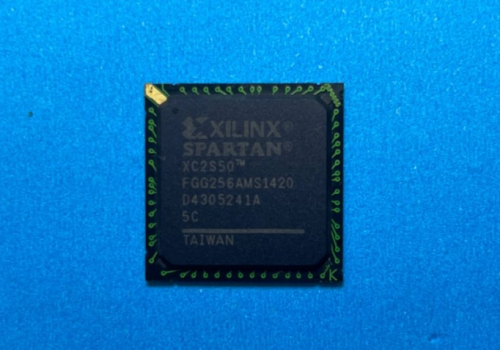
XC2S50-5FGG256C Product Description
The XC2S50-5FGG256C is a member of the Xilinx Spartan-II FPGA family, now associated with AMD's programmable logic portfolio. It is a reconfigurable digital logic device that allows engineers to implement customized hardware functions without designing a dedicated application-specific integrated circuit (ASIC).
The device offers approximately 50,000 system gates and 1,728 configurable logic cells. Its programmable architecture is based on configurable logic blocks (CLBs), which can be interconnected to implement combinational logic, sequential logic, counters, state machines, and other digital functions.
The XC2S50-5FGG256C is supplied in a 256-pin FBGA package with a 17 mm × 17 mm body size. The package provides a large number of connections for system interfaces and is intended for surface-mount PCB assembly.
The part number includes several useful identification details. XC2S50 identifies the device family and capacity, -5 represents the speed grade, FGG256 identifies the package configuration, and C identifies the commercial temperature grade. Buyers should confirm the exact ordering code against the manufacturer's documentation before placing an order.
Key Specifications and Features
The XC2S50-5FGG256C has a core supply voltage of approximately 2.5 V, with a specified supply range of 2.375 V to 2.625 V in distributor documentation. Its operating temperature range is 0°C to +85°C junction temperature, corresponding to the commercial-grade version.
The FPGA provides 176 user I/O connections, allowing it to interface with external memory, communication peripherals, control signals, and other digital devices. It includes 384 configurable logic blocks and 32,768 bits of total block RAM. These resources enable designers to implement moderate-complexity digital logic and small on-chip data buffers.
The device also supports multiple configuration methods, including serial configuration and JTAG-based programming. This makes it possible to load a custom hardware design during development, manufacturing, or system maintenance.
The Spartan-II architecture offers global clock resources for distributing clock signals throughout the programmable logic. Reliable clock distribution is important for synchronous digital designs involving counters, state machines, data pipelines, and communication interfaces.
The -5 speed grade is intended for relatively high-speed operation within the Spartan-II family. However, the actual maximum frequency depends on the implemented logic, routing, timing constraints, and I/O configuration. Designers should evaluate timing using the appropriate Xilinx design tools and the specific device speed-grade documentation.
Applications of XC2S50-5FGG256C
Industrial Control and Automation Systems
FPGAs are useful in industrial control systems because they can implement deterministic digital logic and customized hardware interfaces. The XC2S50-5FGG256C can be used in legacy industrial equipment for signal processing, timing control, machine sequencing, and communication interface logic.
For example, a programmable logic device may coordinate input signals from sensors, generate control signals for actuators, and manage communication between a controller and peripheral devices. Its reconfigurable architecture allows a manufacturer to implement application-specific logic without changing the physical FPGA.
In industrial environments, the most important considerations include reliable power regulation, noise immunity, timing stability, and long-term component availability. Since the XC2S50-5FGG256C is a legacy device, replacement sourcing is especially relevant when maintaining established control systems.
Telecommunications and Networking Equipment
Digital communication systems often require customized logic for data handling, framing, timing, and interface management. An FPGA such as the XC2S50-5FGG256C can perform these functions in equipment that uses parallel digital buses or dedicated communication protocols.
The device's programmable logic cells and user I/O resources allow engineers to create interfaces between processors, memory devices, transceivers, and other digital subsystems. It may also be used to implement packet-handling logic, protocol conversion, and timing-related functions in compatible legacy equipment.
The suitability of the FPGA depends on the required data throughput, clock frequency, memory capacity, and I/O voltage standards. Modern high-speed networking applications may require newer FPGA families with significantly greater resources, but the Spartan-II remains relevant for maintaining older hardware designs.
Digital Signal Processing
FPGAs can execute digital signal processing operations using parallel hardware structures. The XC2S50-5FGG256C can support suitable signal-processing tasks through programmable arithmetic logic, registers, counters, and data pipelines.
Potential applications include waveform generation, digital filtering, signal measurement, and custom data-processing functions. Engineers can design parallel processing paths to handle repetitive operations with predictable timing.
The device's available logic and memory resources place practical limits on algorithm complexity. Applications requiring extensive DSP multipliers, large memory blocks, or advanced high-throughput processing may be better suited to newer FPGA architectures. For moderate-complexity legacy signal-processing designs, however, the Spartan-II platform can provide a suitable implementation environment.
Test and Measurement Equipment
Test instruments and measurement systems frequently require custom digital logic to control acquisition sequences, process digital signals, and coordinate multiple peripherals. The XC2S50-5FGG256C can be used in compatible equipment to implement timing controllers, digital interface logic, and measurement data handling.
A programmable logic device can coordinate the operation of analog-to-digital converters, memory, display controllers, and communication interfaces. This flexibility is useful when an instrument requires specialized control behavior that is not easily implemented with a standard microcontroller alone.
When repairing test equipment, matching the original FPGA's package, configuration data, and electrical requirements is essential. Replacing the device with a different FPGA may require redesigning the PCB or modifying the configuration process.
Embedded Systems and Custom Digital Controllers
The XC2S50-5FGG256C can be integrated into embedded systems that require customized hardware acceleration or specialized digital control logic. Unlike a conventional fixed-function logic IC, an FPGA can implement multiple digital functions within one programmable device.
Applications may include custom peripheral controllers, interface bridges, digital timing modules, and hardware state machines. The FPGA can work alongside a microprocessor or microcontroller, handling dedicated tasks while the processor manages higher-level software.
This approach can improve system flexibility and reduce the number of separate logic devices required in certain designs. The available logic cells, RAM, I/O count, and timing performance should be evaluated against the requirements of the complete embedded system.
Related Spartan-II FPGA Models
XC2S50-6FGG256C
The XC2S50-6FGG256C is a closely related Spartan-II device with the same XC2S50 capacity and FGG256 package designation, but a different speed grade. It may be relevant when engineers are evaluating alternate speed-grade options for an existing design.
The -6 version should not automatically be assumed to provide identical timing performance to the -5 version. Designers should compare the applicable timing specifications and confirm that the selected device meets the original circuit's performance requirements.
XC2S30 Series
The XC2S30 series belongs to the same Spartan-II family and offers a smaller logic capacity than the XC2S50. It may be suitable for digital control applications that require fewer programmable resources.
Potential uses include compact interface controllers, sequencing logic, timing circuits, and moderate-complexity embedded digital functions. The lower-capacity device can be considered when a design does not require the full logic resources of the XC2S50.
However, a smaller FPGA is not necessarily a drop-in replacement. Engineers must verify package compatibility, I/O availability, configuration requirements, and whether the existing design fits within the available logic and memory resources.
XC2S100 Series
The XC2S100 series provides a larger programmable logic capacity than the XC2S50 and may be considered for more complex digital designs within the Spartan-II family.
Its additional logic resources can support larger state machines, more extensive interface logic, and more demanding custom digital processing. Such devices may be relevant to industrial controllers, communications equipment, and test systems requiring greater programmable capacity.
The XC2S100 should be evaluated as a separate device rather than a direct replacement. Package, pinout, power consumption, configuration files, and timing specifications must all be checked before making a substitution.
XC2S150 Series
The XC2S150 series offers a higher-capacity Spartan-II platform for applications requiring more programmable logic resources. It may be useful for larger digital processing architectures, complex control systems, and equipment with multiple custom hardware functions.
Engineers considering this family should review the available logic cells, memory resources, I/O configuration, and package options. The increased capacity may be beneficial when a design has outgrown a smaller FPGA, but migration can require changes to the PCB and implementation flow.
Choosing a Supplier for XC2S50-5FGG256C in the USA
When searching for a supplier for XC2S50-5FGG256C in USA, buyers should confirm the exact part number, manufacturer marking, package type, and device condition. Legacy FPGA components may be available through specialized electronic-component sourcing channels, independent distributors, or existing inventory.
Product authenticity and traceability are important because the FPGA must be compatible with the original hardware design and configuration process. Buyers should request relevant quality documentation and clarify whether the parts are new, unused surplus, or previously installed.
Utsource provides an electronic component information and sourcing platform where engineers and purchasing teams can research FPGA models, compare sourcing options, and inquire about the XC2S50-5FGG256C.
Conclusion
The XC2S50-5FGG256C is a Xilinx Spartan-II FPGA offering approximately 50,000 system gates, 1,728 logic cells, 176 user I/O connections, and 32,768 bits of block RAM in a 256-pin FBGA package. Its programmable architecture supports industrial control, telecommunications, digital signal processing, test equipment, and embedded digital logic applications.
Related Spartan-II models, including the XC2S50-6FGG256C, XC2S30, XC2S100, and XC2S150 series, provide options for evaluating different speed grades and logic capacities. However, replacement selection requires careful verification of electrical specifications, package compatibility, configuration requirements, and timing performance.
For engineers maintaining legacy equipment, sourcing the exact XC2S50-5FGG256C remains important when redesigning the system is impractical. A reliable supplier and accurate technical documentation can help support the continued operation of established FPGA-based designs.
XC2S50-5FGG256C https://www.utsource.net/itm/p/11712545.html