ABB was awarded three orders from VoltaGrid in 2025 to supply 27 synchronous condensers with flywheel technology for power infrastructure supporting data-center projects in the United States, with deliveries scheduled to begin in December 2025 and the first units expected to become operational in April 2026. The project illustrates how synchronous condensers are being deployed alongside rapidly expanding electricity loads where grid stability, inertia, voltage support, and short-circuit strength are becoming critical infrastructure requirements.
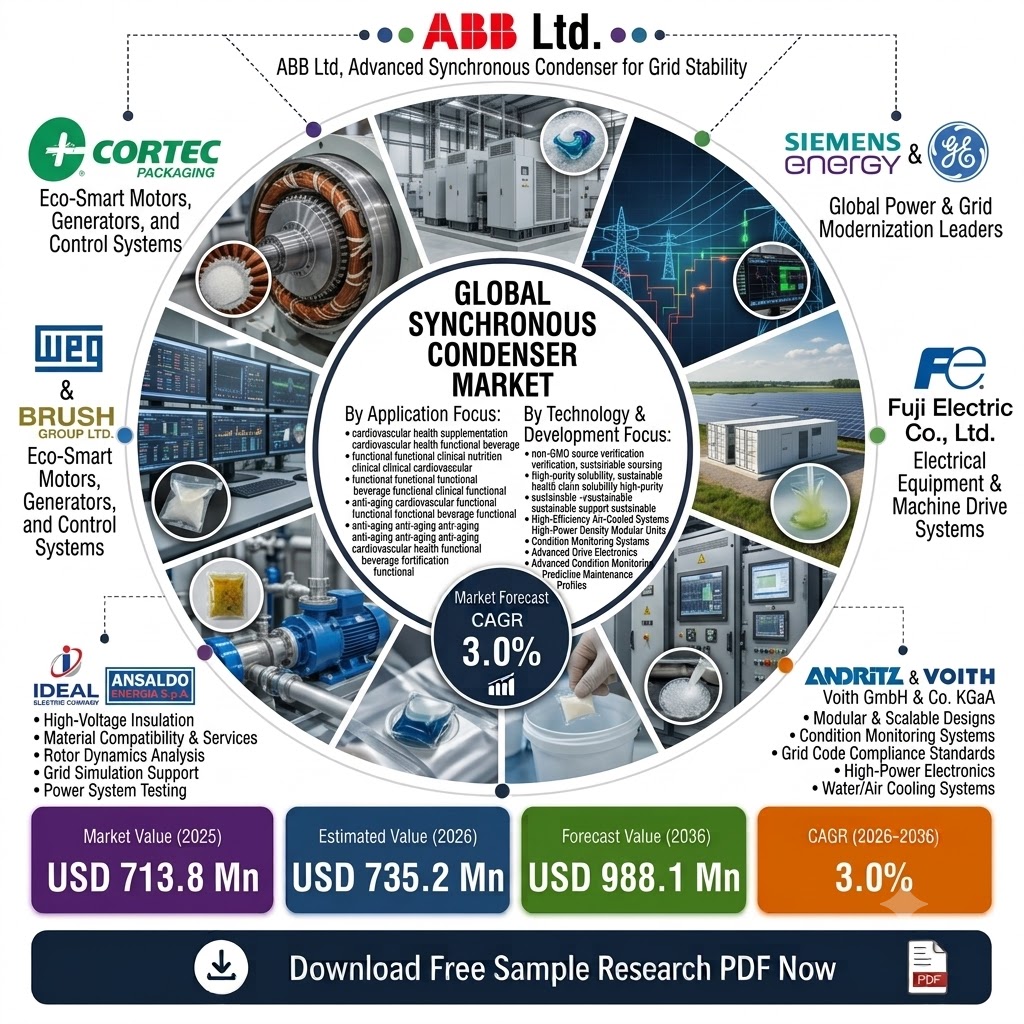
Against this backdrop, the global Synchronous Condenser Market is estimated at USD 735.2 million in 2026 and is projected to reach USD 988.1 million by 2036, expanding at a 3.0% CAGR during the forecast period, according to Fact.MR.
The market covers rotating machines that provide reactive power compensation, voltage regulation, system inertia, and short-circuit strength without generating active power. Fact.MR identifies new-build and refurbished systems as key product categories, with electrical utilities representing the largest end-use segment.
Get detailed market forecasts, competitive benchmarking, and pricing trends: https://www.factmr.com/connectus/sample?flag=S&rep_id=16433
Why are synchronous condensers becoming part of grid modernization plans?
The retirement of coal- and gas-fired generation is changing the physical characteristics of power networks. Conventional generators naturally supplied rotational inertia and reactive power. As those machines leave service and inverter-based renewable generation expands, grid operators need dedicated equipment to provide some of the functions previously embedded in conventional generation.
This is creating demand for synchronous condensers across transmission and generation infrastructure. The Fact.MR analysis identifies rising renewable penetration, thermal-generation retirement, utility reliability programs, and increasing deployment of inverter-based resources as key market drivers.
The shift is also visible across different suppliers and applications. ABB's 27-unit VoltaGrid order connects synchronous condensers with flywheel technology to data-center power infrastructure in the United States. Siemens Energy, GE Vernova, Ansaldo Energia, Andritz, and other established power-equipment participants are also identified within the competitive landscape covered by Fact.MR.
Taken together, these developments point to a market where the value proposition is moving beyond basic reactive-power compensation. Projects increasingly involve a combination of inertia, voltage control, fault-current support, installation requirements, and lifecycle service.
Which technology and application segments are shaping procurement?
New synchronous condensers account for 68% of the product-type segment in 2026, according to Fact.MR. Electrical utilities represent 74% of end-use demand, while voltage regulation accounts for 42% of the grid-application segment.
Generator-conversion projects are another important area of market activity. Retired thermal generators can potentially be converted into synchronous condensers, allowing portions of existing electrical and civil infrastructure to remain useful after conventional generation has ended.
New-build systems, meanwhile, provide opportunities for configurations designed around specific grid requirements. Flywheel-integrated synchronous condensers are particularly relevant where grid operators require additional inertia and rapid response capabilities.
The competitive environment includes ABB Ltd., Siemens Energy AG, Ideal Electric Company, Ansaldo Energia S.p.A., GE Vernova Inc., Andritz AG, Voith GmbH & Co. KGaA, Fuji Electric Co., Ltd., WEG S.A., and BRUSH Group Ltd. Fact.MR describes competition as moderately fragmented, with product capability, application fit, service coverage, pricing, and geographic reach influencing market positioning.
Analyst Perspective
Shambhu Nath Jha, Principal Consultant at Fact.MR, said:
“The synchronous condenser market is being pulled forward by a structural shift in grid composition. As thermal generation retires and inverter-based resources grow, grids lose the inertia and reactive power that rotating machines naturally provide. Synchronous condensers fill that gap. The procurement pipeline is strongest in markets with aggressive renewable targets, particularly the United States, Germany, India, and parts of Northern Europe. Converted retired generators offer a lower-cost entry point, but new-build units with flywheel energy storage are gaining traction where grid operators need both inertia and faster response capability.”
Market Snapshot
- 2025 market value: USD 713.8 million
- 2026 market value: USD 735.2 million
- 2036 forecast value: USD 988.1 million
- 2026–2036 CAGR: 3.0%
- Absolute dollar opportunity: USD 252.9 million
- New synchronous condenser share: 68% in 2026
- Electrical utilities share: 74% in 2026
- Voltage regulation share: 42% in 2026
Where is synchronous condenser demand growing?
The United States is projected to record a 3.5% CAGR through 2036, followed by Germany at 3.3% and India at 3.2%. Japan is projected at 3.1%, China at 2.9%, Brazil at 2.7%, and the United Kingdom at 2.5%.
These markets reflect different procurement conditions. In the United States, replacement demand, grid upgrades, and expanding electricity requirements are supporting project activity. Germany's market is linked to grid modernization and the changing generation mix. India's opportunity is connected with infrastructure investment and expanding power requirements.
Demand Drivers
Key factors supporting synchronous condenser demand include:
- Increasing renewable-energy penetration and the resulting requirement for grid inertia and reactive-power support.
- Retirement of conventional thermal-generation assets that previously supplied rotating-machine support.
- Transmission and utility investment aimed at improving voltage stability and short-circuit strength.
- Conversion of retired generators into synchronous condensers.
- Integration of flywheel systems where additional inertia and faster response are required.
High installation and civil-work costs remain a constraint for some new-build projects. Static power-electronics technologies such as STATCOMs also compete in selected grid applications, while long project timelines can affect procurement schedules.
Top Trending Reports:
https://www.openpr.com/news/4496201/the-biocomposite-breakthrough-re-engineering-material
https://www.openpr.com/news/4496210/the-ultrafast-frontier-precision-engineering-at-the-speed
https://www.openpr.com/news/4496219/4-methylbenzaldehyde-the-versatile-intermediate-powering
https://www.openpr.com/news/4496227/high-performance-solvency-the-strategic-role-of-diethylene
About the Report
The Synchronous Condenser Market study by Fact.MR covers market forecasts from 2026 to 2036 across product type, end use, grid application, installation type, and region. The analysis covers more than 30 countries and incorporates secondary research, primary interviews, demand-side modelling, product benchmarking, pricing analysis, shipment validation, and company portfolio assessment.
Fact.MR's research methodology is based on a primary-research-first framework, with more than 70% of research inputs collected through primary field interviews and additional secondary-source validation.
About Fact.MR
Fact.MR is a provider of syndicated and custom market research and consulting services covering market forecasting, segmentation, competitive analysis, and industry intelligence. The company is headquartered in Dubai, UAE, with offices in the United States and India. Its research process combines quantitative analysis with stakeholder inputs across industry value chains.