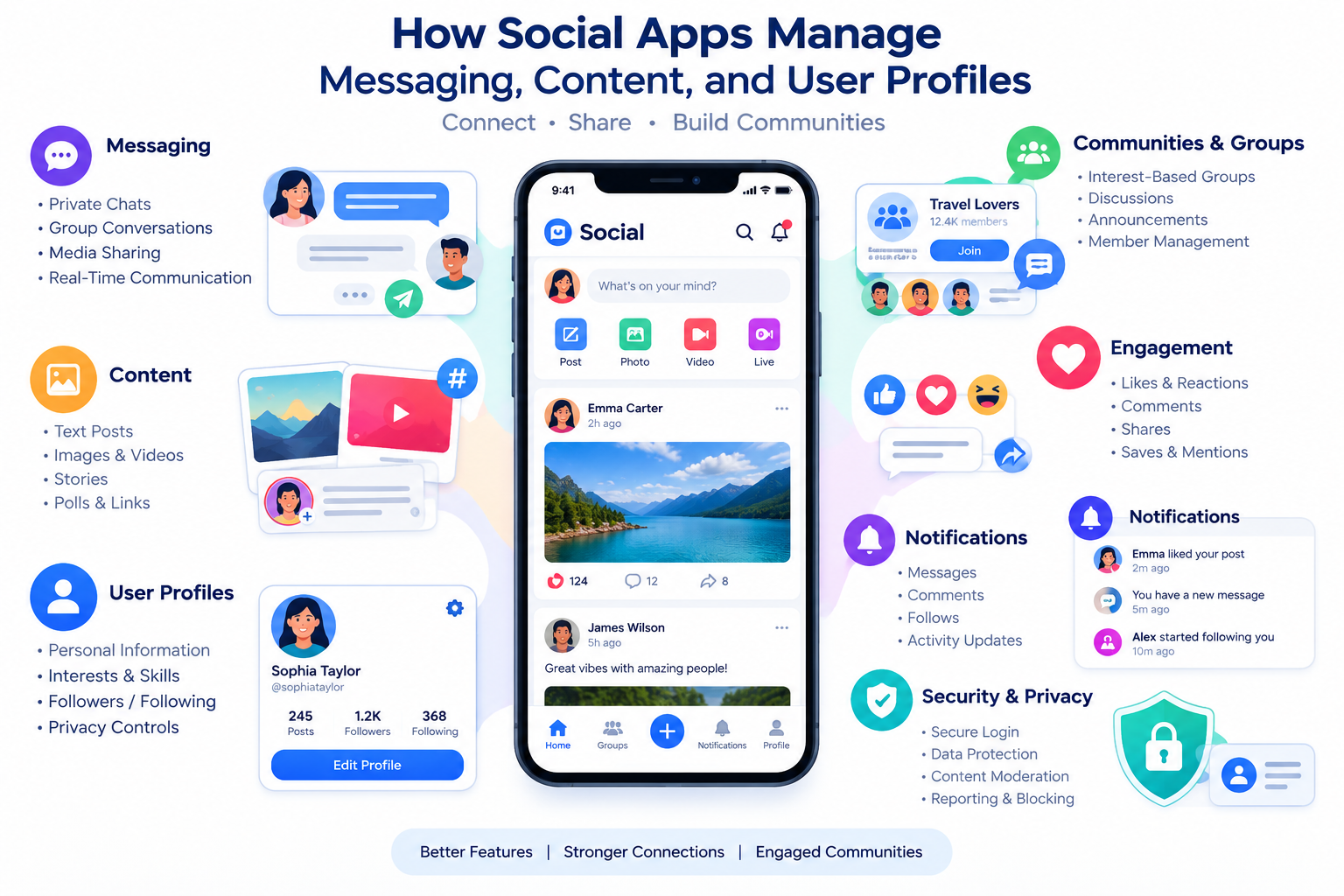
Social platforms have changed how people communicate, share information, build communities, and interact with brands. From photo-sharing platforms to professional networks and interest-based communities, different types of social applications serve different audiences. For businesses planning to create their own platform, social app development involves much more than creating user profiles and adding a news feed. The product needs a clear purpose, suitable features, strong infrastructure, and a plan for long-term growth.
Define the Purpose of the Platform
Every social application needs a clear reason for users to join. A platform could focus on professional networking, local communities, entertainment, hobbies, creators, education, or specific interest groups.
Before development begins, founders should identify the audience and the type of interactions they want to encourage. This decision influences almost every other part of the application, including profiles, content formats, communication features, groups, and moderation tools.
A focused concept can also help differentiate a new platform from larger general-purpose social networks.
Plan the User Journey
The user experience begins before someone creates their first post. Registration, profile setup, content discovery, following, messaging, and notifications should form a logical journey.
During social app development , designers can create wireframes and prototypes to map these interactions before developers start implementation.
For example, a new user could register, select interests, follow suggested accounts, join communities, and receive a personalized feed. Keeping the initial experience straightforward can help users understand what the platform offers.
Build Flexible User Profiles
Profiles allow users to establish their identity within a social platform. Depending on the application's purpose, profiles can contain photographs, biographies, professional information, interests, links, or other relevant details.
Users may also need options to control who can view their information and interact with them.
A platform focused on professionals might require work experience and skills, while a platform creator could prioritize content portfolios and follower information. The profile structure should therefore reflect the specific community being developed.
Create Multiple Content Formats
Different audiences prefer different forms of content. Some platforms focus on photographs, while others are built around short videos, long-form posts, audio, or live broadcasts.
A social platform can support one or multiple content formats depending on its purpose. Users may be able to add captions, hashtags, locations, mentions, or links to their posts.
Content management also requires suitable storage and delivery systems, especially when users upload large amounts of media.
Add Messaging and Social Interaction
Communication is a major component of many social networks. Users may want to comment on posts, react to content, share posts, follow accounts, or communicate privately.
A platform can include one-to-one messaging, group chats, voice messages, or media sharing. Some products may also require audio or video communication.
A social networking app development company can select suitable technologies for real-time communication based on the application's expected number of users and messaging requirements.
Build Communities and Groups
Groups can give users dedicated spaces for specific interests or discussions. They can be organized around hobbies, locations, industries, events, or other subjects.
Group administrators can receive tools to manage members, approve posts, moderate discussions, and publish announcements.
For a niche social network, community features may become one of the main reasons users continue returning to the platform.
Personalize the Content Feed
A useful content feed can help users find posts that match their interests. The feed may display content from followed accounts, communities, trending topics, or recommended profiles.
As the platform collects interaction data, it can use recommendation systems to organize content according to user behavior.
Artificial intelligence can also be considered for recommendations, content categorization, spam detection, and automated assistance. These functions should be implemented according to the platform's actual needs and privacy requirements.
Include Moderation and Privacy Tools
Social networks require tools for maintaining a safe and organized community. Users should have ways to report posts, accounts, messages, or other content that violates platform rules.
Administrators can receive reports through a management dashboard and take appropriate action according to the platform's policies.
Privacy settings are equally important. Users may need controls over profile visibility, messaging permissions, post audiences, and account activity.
Plan the Business Model
A social platform needs a sustainable way to generate revenue. Businesses can consider advertising, subscriptions, premium accounts, sponsored content, creator programs, virtual products, or paid communities.
The selected monetization model should match the platform's audience. If premium features are planned, the application should support subscription management and payment processing from the beginning.
A clear revenue model can also help determine which administrative and analytics features are required.
Prepare the Platform for Growth
A new social platform may start with a small community but could eventually handle large amounts of content and user activity. The technical architecture should therefore allow the platform to grow.
A social networking app development company can help plan cloud infrastructure, databases, APIs, media storage, content delivery, security, and monitoring systems.
Scalable architecture can also make it easier to introduce new features without rebuilding the complete platform.
Measure User Activity After Launch
Launching the application does not mark the end of development. Businesses should monitor registrations, active users, content creation, session activity, retention, messages, and other relevant metrics.
This information can show which parts of the platform users find useful and where improvements may be needed.
Future updates can then focus on actual user behavior instead of assumptions.
Conclusion
Creating a social platform requires careful planning across product strategy, design, technology, communication, content management, privacy, and business operations. Social app development provides the foundation for building a digital community around a specific audience or purpose.
A social networking app development company can help businesses develop customer applications, backend systems, administration dashboards, real-time communication, content management, and other required components.
With a clearly defined audience, useful social features, practical moderation tools, and infrastructure prepared for growth, businesses can create a platform designed around the needs of its intended community.