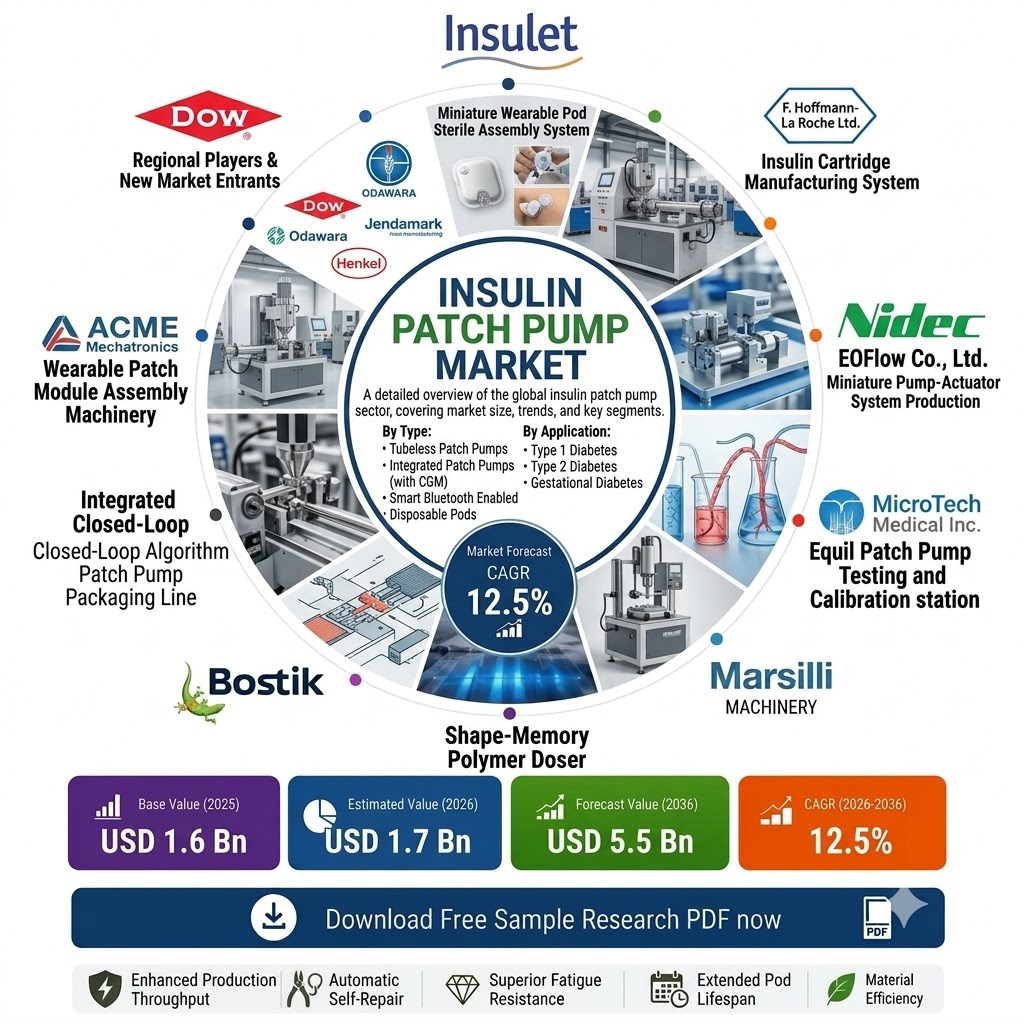
The global insulin patch pump market is projected to expand from USD 1.7 billion in 2026 to nearly USD 5.5 billion by 2036, registering a 12.5% CAGR during the forecast period, according to Fact.MR analysis. The market was valued at USD 1.6 billion in 2025 and is expected to create an additional revenue opportunity of nearly USD 3.8 billion between 2026 and 2036.
Insulin patch pumps are wearable, tubeless devices that deliver insulin through a programmable system without the tubing and external reservoir used in conventional insulin pumps. Their adoption is being supported by a longer-term shift from multiple daily injections toward wearable insulin delivery, particularly among insulin-dependent patients.
Integration with continuous glucose monitoring (CGM) systems is another important factor shaping demand. Connected patch pumps and automated insulin delivery platforms allow insulin delivery to be linked with glucose monitoring and dose-tracking systems. This is supporting wider interest in closed-loop diabetes management across developed healthcare markets.
Get detailed market forecasts, competitive benchmarking, and pricing trends: https://www.factmr.com/connectus/sample?flag=S&rep_id=8044
Reimbursement Becomes a Key Market Driver
Reimbursement coverage is increasingly influencing access to insulin patch pump therapy. Health insurers in Germany and France expanded coverage for patch pump therapy programs during 2024. Similar reimbursement developments across Asia Pacific are creating opportunities for manufacturers seeking wider patient access.
Fact.MR analysis indicates that manufacturers should closely monitor reimbursement approval timelines in markets such as India and South Korea. Faster formulary inclusion can affect patient access and the commercial adoption of wearable insulin delivery systems.
Cost remains a challenge, particularly in price-sensitive healthcare markets. High device costs and limited reimbursement coverage can restrict adoption even as demand for advanced diabetes technologies increases.
Connected Therapy Changes Product Demand
The market is also shifting toward connected insulin delivery. Smart insulin delivery devices account for 44% of the market in 2026, supported by increasing adoption of connected diabetes management and Bluetooth-enabled dose tracking.
CGM-linked patch pump systems are becoming an important part of advanced diabetes care. Closed-loop platforms are designed to improve glucose management while reducing the burden associated with conventional insulin delivery.
By delivery mode, basal and bolus systems hold 48% share in 2026. These systems combine background and mealtime insulin delivery within a single wearable device.
By product type, disposable patch pumps account for 61% share in 2026. Single-use systems can reduce device maintenance requirements and are being adopted for easier outpatient diabetes management.
Retail pharmacies represent another important channel, accounting for 38% share in 2026. Pharmacy networks are increasingly involved in device dispensing, patient onboarding, and access to consumables.
Adult patients hold 57% share in 2026, reflecting the large insulin-dependent adult patient population. At the same time, pediatric diabetes represents a growing area of interest as type 1 diabetes diagnoses among children increase.
Asia Pacific Creates Expansion Opportunities
Asia Pacific is identified as the fastest-growing regional market for insulin patch pumps. Rising diabetes cases, improving insurance coverage, domestic manufacturing, and wider clinical acceptance are supporting regional expansion.
India is projected to grow at a 13.6% CAGR from 2026 to 2036, while China is expected to expand at 13.1% CAGR. South Korea is forecast to record a 12.5% CAGR.
Other major markets are also expected to post sustained growth. The United States is projected to expand at 11.8% CAGR, Germany at 11.2%, and Japan at 10.7% during the forecast period.
In India, private insurance coverage and expansion of wearable diabetes device programs are supporting patient access. In China, domestic production of tubeless insulin delivery systems and reimbursement support are contributing to market development.
Manufacturers Focus on Access and Connected Systems
The competitive environment is being shaped by investment in CGM-integrated and closed-loop insulin delivery platforms. Reimbursement coverage, distribution access, disposable device manufacturing capacity, and pediatric product development are among the strategic factors highlighted by Fact.MR.
The report profiles Insulet Corporation, F. Hoffmann-La Roche Ltd., Terumo Corporation, EOFlow Co., Ltd., and MicroTech Medical Inc.
Manufacturers are also increasing attention to retail pharmacy partnerships and direct-to-patient ordering platforms. These channels can support recurring sales of devices and consumables while improving access outside hospital settings.
Pediatric-focused systems represent another area for product development. Diabetes care centers in India and China continue to face limited availability of wearable devices designed for lower body weight, creating a potential product-development opportunity.
Report Scope
The Fact.MR insulin patch pump market study covers demand across basal, bolus, and basal-and-bolus delivery modes; disposable and reusable products; hospitals, retail pharmacies, private clinics, and online pharmacies; adult, pediatric, and geriatric patients; and smart, connected, and conventional insulin delivery technologies.
The study provides forecasts from 2026 to 2036 across North America, Europe, Asia Pacific, Latin America, and the Middle East and Africa, with country-level analysis covering more than 40 markets.
The research combines OEM device revenue estimates, patient population sizing, primary interviews with endocrinologists and diabetes care specialists, reimbursement records, regulatory data, and company disclosures.
Top Trending Reports:
About Fact.MR
Fact.MR is a market research and consulting firm providing market intelligence, industry analysis, and strategic research across global markets. Its research combines primary research, secondary research, market sizing, forecasting, and industry-specific analysis to support business decision-making.