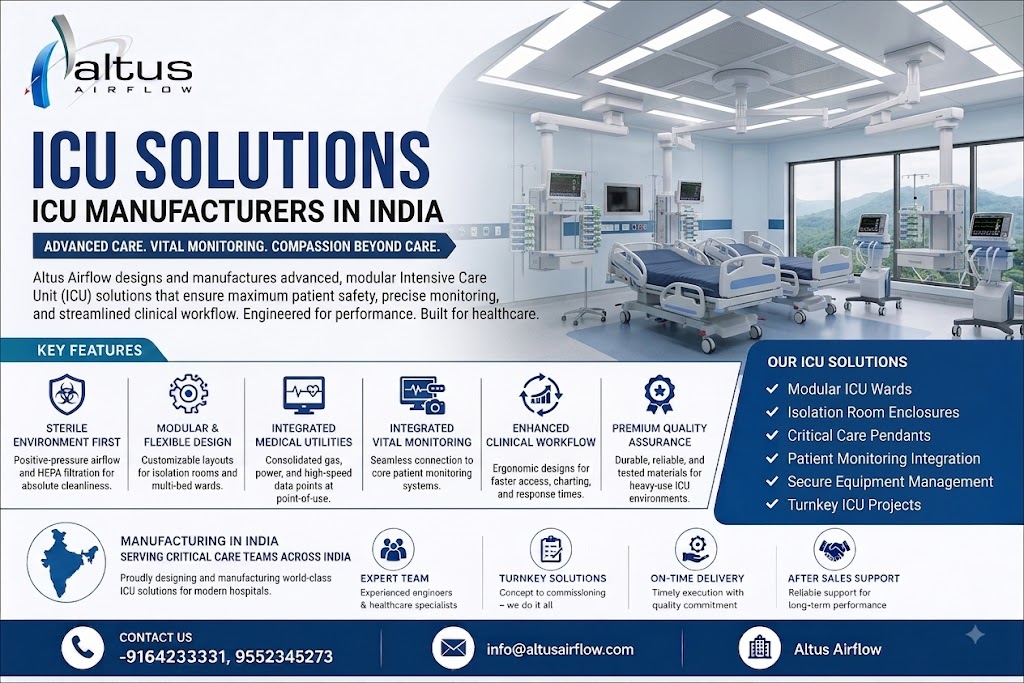
INTRODUCTION
Selecting suitable ICU Manufacturers In India is an important part of developing a modern critical-care facility. An ICU requires coordinated planning of patient spaces, medical equipment, utilities, infection-control measures, emergency access, and staff workflow. NHSRC provides dedicated guidelines for critical-care infrastructure under IPHS 2022, while the Indian Society of Critical Care Medicine maintains guidance on ICU planning and design.
Focus on Modern ICU Planning
Advanced ICU solutions should begin with a clear understanding of the hospital's clinical requirements. Bed capacity, patient categories, available floor space, emergency access, staff movement, and future expansion should all be considered during planning. NHSRC guidance recommends that critical-care infrastructure account for both existing hospital facilities and prospective expansion requirements.
Evaluate Layout and Patient Accessibility
An effective ICU layout should support quick access to patients and essential equipment while maintaining organised movement for clinical teams. NHSRC guidance addresses ICU location, entry and exit flow, bed spacing, isolation facilities, emergency access, and supporting services. These factors can help hospitals assess whether a proposed solution is suitable for their available space and operational needs.
Check Medical Equipment Integration
Advanced critical-care infrastructure needs to work alongside appropriate medical equipment. NHSRC's critical-care hospital block specifications include ICU beds, multiparameter monitors, ICU ventilators, syringe pumps, infusion pumps, defibrillators, suction equipment, crash carts, and other clinical equipment. Hospitals should therefore check whether the proposed infrastructure can accommodate their planned equipment configuration.
Assess Medical Gas and Utility Infrastructure
Critical-care facilities depend on reliable supporting systems such as medical gas pipelines, oxygen supply, air handling, electrical infrastructure, and infection-prevention arrangements. NHSRC's critical-care hospital block guidance specifically identifies medical gas pipeline systems, oxygen supply or generation, air handling units, and infection-prevention mechanisms as components of critical-care infrastructure.
Consider Customisation and Future Expansion
Hospitals have different architectural conditions and clinical requirements. A suitable ICU solution should therefore be adaptable to the available building structure, bed capacity, equipment needs, and workflow. Planning for future expansion can also make it easier to accommodate changing clinical requirements and additional technology.
Review Installation and Commissioning
Hospitals should evaluate the manufacturer's ability to coordinate installation with architects, biomedical engineers, hospital administrators, and other technical teams. Important considerations include infrastructure integration, testing, commissioning, documentation, and staff orientation. A coordinated implementation process can help ensure that different ICU components function together as planned.
Examine Maintenance and Technical Support
Long-term support is another important consideration when evaluating an ICU solution. NHSRC's Biomedical Equipment Management and Maintenance Program includes guidance on equipment maintenance, calibration, and testing and links equipment maintenance with availability and uptime. Hospitals should therefore review the manufacturer's approach to technical support and maintenance before finalising a project.
Conclusion
Hospitals evaluating ICU Manufacturers In India should consider critical-care design expertise, equipment integration, medical gas and utility planning, customisation, installation, future expansion, and technical support. A detailed evaluation can help hospitals develop an ICU environment that is organised around clinical workflows, appropriate infrastructure, patient accessibility, and evolving healthcare requirements.
Frequently Asked Questions
1. What should hospitals consider when evaluating ICU manufacturers?
Hospitals should review design expertise, infrastructure planning, equipment compatibility, customisation, installation capabilities, technical documentation, and maintenance support.
2. What equipment is commonly required in an ICU?
Depending on the facility's requirements, ICU equipment may include patient monitors, ventilators, ICU beds, infusion and syringe pumps, defibrillators, suction systems, crash carts, and other emergency equipment.
3. Why is medical gas infrastructure important in an ICU?
Medical gases and related utility systems support essential critical-care equipment and patient treatment. Proper planning of oxygen, air, suction, and related infrastructure is therefore an important part of ICU development.
4. Can ICU infrastructure be customised?
Yes. ICU planning can be adapted according to available space, bed capacity, equipment requirements, patient categories, workflow, and future expansion needs.
5. Why should hospitals evaluate maintenance support?
Regular maintenance, calibration, and testing can support equipment availability and operational continuity. NHSRC's BEMMP specifically provides guidance covering these maintenance activities.
Read Our Previous Blog-----------> How to Choose Top Recovery Rooms Manufacturers In India?