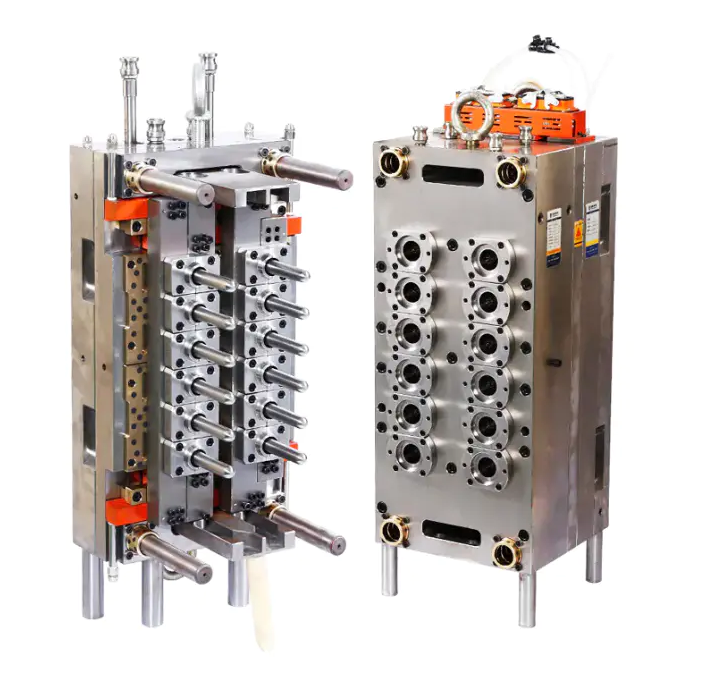
Imagine a tiny plastic tube sitting beside a finished beverage bottle. They look completely different, yet one can be the starting point for the other. That small tube is a preform, and the Preform mould is responsible for giving it its initial shape.
Preforms are commonly produced using injection molding. Plastic material is heated until it becomes fluid and then injected into a mould cavity. Inside the cavity, the material fills the defined space and gradually forms the required structure. After cooling, the preform is ejected and prepared for the next production process.
The interesting part is that a preform is not simply a miniature bottle. Its design is created specifically for later stretching. During bottle formation, the preform is heated and expanded inside another mould. The material stretches both along its length and across its diameter. Because of this, the original preform geometry needs to match the requirements of the finished container.
This makes Preform mould design a detailed engineering task. The neck finish, cavity dimensions, wall distribution, gate position, and cooling arrangement all influence the molded part. Even the way cavities are positioned can affect how a multi-cavity mould performs during production.
Another factor is dimensional consistency. Preforms produced from the same mould need to maintain a stable shape so they can move smoothly into subsequent processes. Consistent neck dimensions are especially important when the finished bottle will later receive a cap or closure.
A Preform mould can also be customized around different container concepts. Short preforms, tall preforms, lightweight designs, and different neck finishes may require distinct mould configurations. This means mould selection should begin with the bottle specification rather than treating the mould as a standalone component.
There is something satisfying about this production process: a carefully engineered mould creates a small object that already contains the basic geometry of a much larger package. The final bottle may look simple, but its shape begins much earlier.
For manufacturers working in plastic packaging, the Preform mould therefore represents an important connection between material, machinery, mould design, and container production. Its role may start with a small preform, but that first shape sets the foundation for everything that follows.