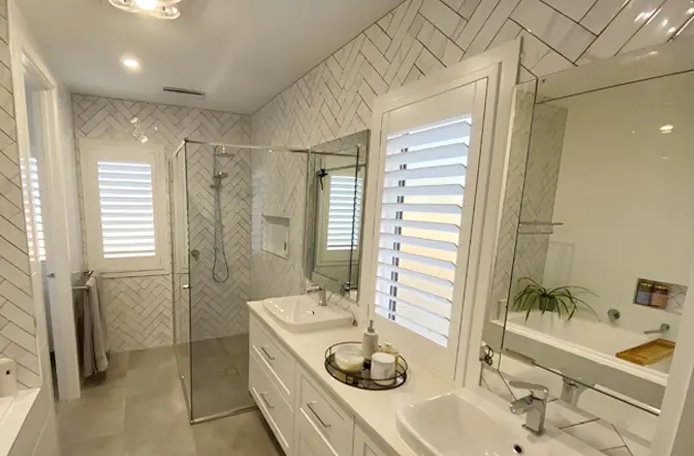
Large window openings often admit light in broad, uncontrolled sweeps that create strong contrasts across interior surfaces. A plantation shutter counters this by breaking the glazed area into a series of adjustable horizontal louvers. Each blade can be tilted independently or in groups, allowing light to be directed upward, downward, or largely excluded according to the needs of the space.
The scale of a plantation shutter distinguishes it from narrower louver systems. Wider blades produce broader bands of illumination when set at intermediate angles, which softens the transition between bright and shaded zones. This characteristic suits rooms where even distribution of daylight supports visual comfort without the need for additional screening layers. The stiles and rails that frame the louvers are proportioned to the overall opening so that the shutter reads as a coherent architectural element rather than a collection of separate parts.
When multiple panels form a plantation shutter installation, the division lines are aligned with existing mullions or architectural features. This alignment preserves the original window rhythm while giving each section its own range of motion. Center stiles may meet with a small overlap or astragal to limit light leakage when the panels are closed. The resulting composition maintains visual order whether the louvers stand fully open, partially tilted, or shut.
Mounting depth and projection also influence the interaction with light. A plantation shutter set inside the window reveal creates a recessed plane that frames the view, while a face-mounted version sits slightly forward and casts its own subtle shadow lines. Both approaches alter the way daylight enters and how the exterior appears from inside. The louver edges themselves can be shaped to reduce glare at certain angles, further refining the quality of light that reaches the interior.
Material thickness contributes to the optical effect. A plantation shutter built with substantial louvers holds its angle under its own weight and resists minor air currents that might otherwise shift the blades. The consistent plane of each louver helps maintain the intended light pattern across the full height of the window. Through these combined geometric and material choices, the plantation shutter becomes a precise instrument for modulating daylight within the architectural volume it serves.