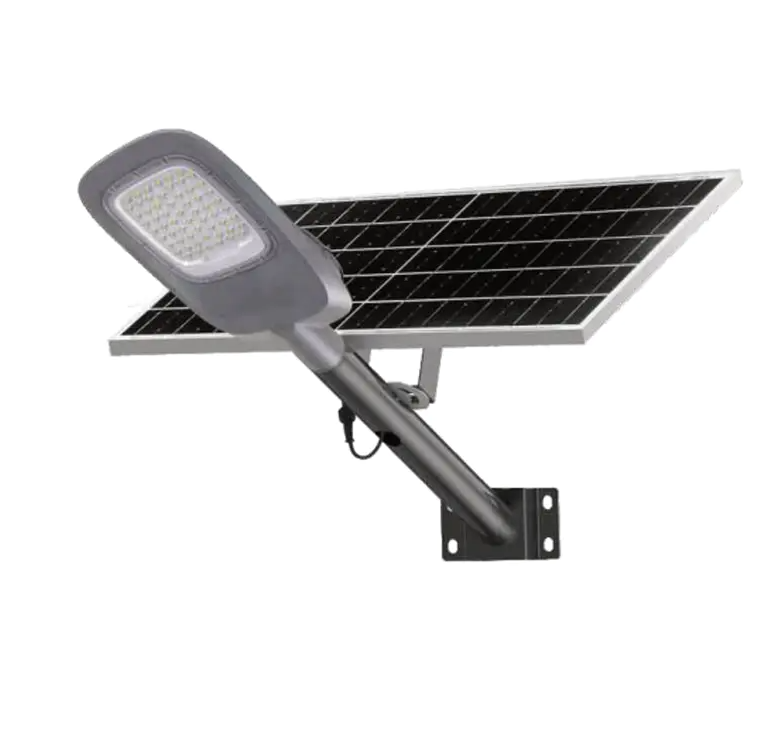
Roadway lighting requires controlled distribution of luminous flux so that pavement, edges, and potential obstacles remain visible without excessive glare. A solar street light achieves this through a combination of LED arrays and secondary optics that shape the emitted beam. The lens or reflector system determines whether the light spreads in a wide lateral pattern or concentrates along the travel path.
Pole height and fixture mounting angle interact with the optical design of a solar street light. Higher placement expands the coverage area but reduces illuminance at the surface unless the beam is correspondingly tightened. Engineers calculate the resulting isolux contours to confirm that the target roadway section receives adequate horizontal and vertical illumination. Cutoff characteristics further limit upward and high-angle light that would otherwise reduce contrast for drivers.
The modular arrangement of LEDs inside a solar street light allows different power densities across the array. Sections facing the road centerline may receive higher drive currents while peripheral zones operate at lower levels, producing a graduated intensity profile. This approach helps maintain uniformity along the length of the illuminated segment and reduces sharp transitions between lit and unlit zones.
Thermal paths within the fixture also influence optical stability. Heat generated by the LEDs must move away from the junction points so that lumen output and color remain consistent during extended night-time operation. A solar street light therefore incorporates heat-spreading surfaces and ventilated housings that keep temperatures within the range specified for the chosen diodes.
When multiple units are spaced along a roadway, the overlap of their individual patterns becomes critical. A solar street light is positioned so that its beam joins the adjacent fixture’s coverage without creating dark bands or excessive cumulative intensity. The resulting continuous ribbon of light supports visual guidance while remaining within practical energy budgets defined by the panel and storage capacity of each unit.