The global cane molasses market is evolving from a traditional sugar-refining byproduct category into a strategically important component of biofuel production, livestock nutrition, industrial fermentation, and specialty food applications. As governments accelerate ethanol blending mandates and agricultural industries seek cost-efficient feed formulations, cane molasses is increasingly being repositioned as a multi-functional industrial feedstock with rising strategic value across global supply chains. Trade concentration, weather-driven sugar cane volatility, and premium product innovation are reshaping procurement behavior, pricing structures, and long-term sourcing strategies across the industry, according to latest insights by future market insights.
Get detailed market forecasts, competitive benchmarking, and pricing trends:
https://www.futuremarketinsights.com/reports/sample/rep-gb-31835
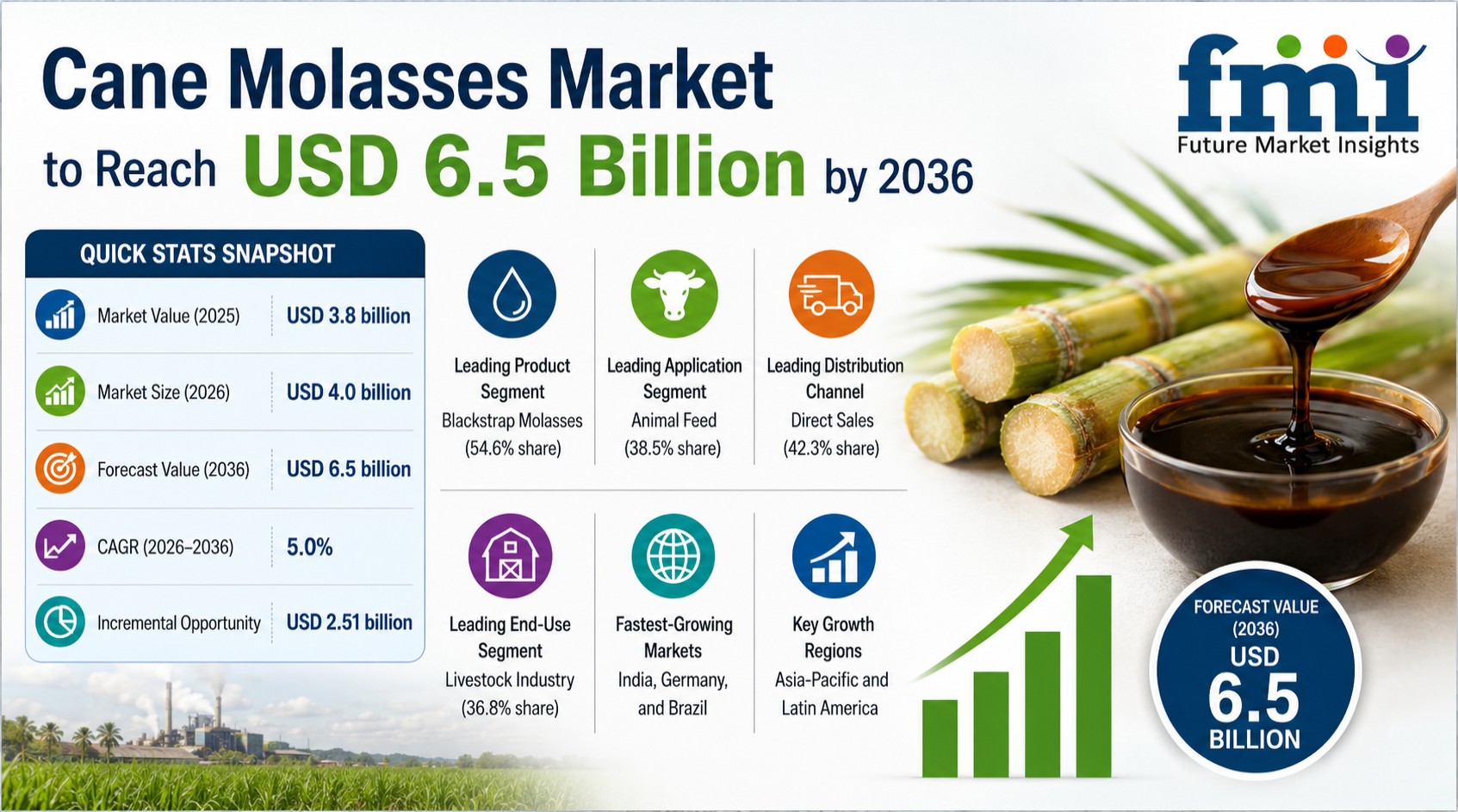
Quick Stats Snapshot
- Market Value (2025): USD 3.8 billion
• Market Size (2026): USD 4.0 billion
• Forecast Value (2036): USD 6.5 billion
• CAGR (2026–2036): 5.0%
• Incremental Opportunity: USD 2.51 billion
• Leading Product Segment: Blackstrap Molasses (54.6% share)
• Leading Application Segment: Animal Feed (38.5% share)
• Leading Distribution Channel: Direct Sales (42.3% share)
• Leading End-Use Segment: Livestock Industry (36.8% share)
• Fastest-Growing Markets: India, Germany, and Brazil
• Key Growth Regions: Asia-Pacific and Latin America
Market Size and Forecast: Ethanol Expansion and Feed Applications Drive Structural Demand Growth
The cane molasses market is projected to grow from USD 4.0 billion in 2026 to USD 6.5 billion by 2036, registering a CAGR of 5.0% during the forecast period. Unlike earlier market cycles driven primarily by commodity sugar processing economics, the industry is increasingly being influenced by biofuel policies, livestock feed integration, industrial fermentation demand, and specialty ingredient innovation.
Key Growth Drivers: Ethanol Mandates, Feed Integration, and Premium Fermentation Applications
- Expansion of Ethanol Blending Programs
Government-backed ethanol policies are significantly reshaping molasses demand allocation worldwide. India’s E20 ethanol blending initiative, Brazil’s RenovaBio program, and Thailand’s ethanol expansion policies are increasing demand for fermentation feedstocks and tightening supply availability for alternative applications.
- Rising Integration in Livestock Feed Formulations
Molasses continues gaining adoption in animal feed applications because of its role as an energy source, feed binder, and palatability enhancer. Large-scale dairy, poultry, and swine production systems increasingly utilize molasses in feed optimization strategies.
- Growth in Industrial Fermentation and Bioindustrial Applications
Industrial fermentation industries including yeast production, bioethanol manufacturing, and industrial alcohol production are expanding procurement volumes due to the cost-efficiency and functional consistency of cane molasses feedstocks.
Market Challenges: Weather Volatility, Trade Concentration, and Feedstock Competition
Despite favorable long-term demand fundamentals, the cane molasses market continues to face several operational and structural challenges:
- Weather-related sugar cane production disruptions impacting raw material supply
• Export controls and domestic allocation restrictions during ethanol shortages
• Rising competition between biofuel producers and feed manufacturers
• Price volatility linked to sugar production cycles and regional harvest conditions
• Infrastructure limitations in storage and bulk transportation systems
• Margin pressure on smaller regional suppliers competing against integrated commodity traders
Emerging Opportunities: Specialty Molasses, Storage Infrastructure, and Sustainable Bioindustrial Growth
Several emerging opportunities are expected to redefine long-term industry value creation:
- Premium blackstrap molasses for craft spirits and specialty fermentation
• Organic and non-GMO molasses for clean-label food markets
• Investment in bulk storage and port blending infrastructure
• Expanded molasses utilization in renewable energy and bioindustrial applications
• Digital procurement systems supporting direct industrial contracts
• Multi-origin sourcing strategies improving supply resilience
Segmentation Insights: Blackstrap Molasses and Animal Feed Continue to Anchor Demand
By Product
Blackstrap Molasses is projected to account for 54.6% of the product segment in 2026 due to established buyer familiarity, competitive cost-performance advantages, and strong suitability across feed, fermentation, and industrial processing applications.
By Application
Animal Feed is expected to hold 38.5% of application demand in 2026 as livestock producers continue utilizing molasses across cattle, poultry, swine, and aquaculture feed formulations.
By Distribution Channel
Direct Sales are projected to account for 42.3% of distribution demand because large industrial buyers increasingly prefer long-term procurement agreements and bulk purchasing structures.
By End Use
The Livestock Industry is expected to maintain 36.8% market share due to expanding commercial dairy and poultry production across emerging economies.
Regional Analysis: Asia-Pacific Leads Volume Growth While Europe Expands Through Premium Applications
High-Growth Markets
- India (17.01% CAGR): Ethanol blending mandates, large cattle-feed demand, and strong domestic sugar cane output continue supporting rapid market expansion.
• Germany (15.65% CAGR): Industrial fermentation and yeast-production demand are driving premium market growth across Europe.
• Brazil (14.29% CAGR): RenovaBio policies and export-oriented sugar cane processing strengthen molasses utilization across biofuel applications.
• United States (12.93% CAGR): Strong livestock feed demand and growth in craft rum distilleries continue supporting market expansion.
• United Kingdom (11.56% CAGR): Industrial fermentation and specialty distilled spirits applications are sustaining premium demand growth.
Emerging Market Dynamics
- China continues expanding through large-scale livestock feed demand and industrial fermentation activity
• Southeast Asia is benefiting from rising poultry production and ethanol policy support
• Middle East markets are witnessing early-stage growth through hospitality, food processing, and organized retail expansion
Regional market priorities increasingly differ:
- Asia-Pacific emphasizes ethanol expansion and livestock feed integration
• Latin America focuses on sugar cane processing and export-linked biofuel economics
• Europe prioritizes premium fermentation and specialty ingredient applications
• North America balances feed demand with craft distillery growth and specialty distribution channels
Full Report for Detailed Insights: https://www.futuremarketinsights.com/reports/cane-molasses-market
Competitive Landscape: Scale, Logistics Infrastructure, and Premium Positioning Shape Market Leadership
The competitive landscape is increasingly defined by sourcing access, logistics capability, bulk trading scale, and product diversification strategies.
Leading companies including Bunge Limited, Cargill Incorporated, Louis Dreyfus Company, ED and F Man Holdings Ltd, and Wilmar International are strengthening their molasses operations through integrated sourcing systems, trading infrastructure, and long-term industrial contracts.
Recent market developments indicate that competitive differentiation is increasingly shaped by:
- Multi-origin sourcing capability and supply continuity
• Bulk logistics and storage infrastructure
• Specialty and premium-grade molasses innovation
• Direct procurement relationships with industrial buyers
• Regulatory compliance and certified product offerings
Future Outlook: From Sugar Byproduct to Strategic Multi-Industry Feedstock
Over the next decade, cane molasses is expected to evolve beyond its historical role as a secondary sugar-processing byproduct into a strategically important component of renewable fuel systems, livestock nutrition, industrial fermentation, and premium food manufacturing.
Executive Takeaways
- The cane molasses market is projected to reach USD 6.5 billion by 2036
• Ethanol blending mandates are significantly reshaping global molasses allocation and pricing structures
• Blackstrap Molasses remains the dominant product category with 54.6% share
• Animal Feed continues leading application demand due to expanding livestock production systems
Explore More Related Studies Published by FMI Research
Canned Tuna Market Share Analysis : https://www.futuremarketinsights.com/reports/canned-tuna-market-share-analysis
Caramel Food Colors Market : https://www.futuremarketinsights.com/reports/caramel-food-colors-market
Bulk Food Ingredients Market : https://www.futuremarketinsights.com/reports/bulk-food-ingredients-market
About Future Market Insights (FMI)
Future Market Insights, Inc. is an ESOMAR-certified, ISO 9001:2015 market research and consulting organization trusted by Fortune 500 companies. With a global presence across the U.S., UK, India, and Dubai, FMI delivers data-driven insights across 30+ industries and 1200 markets worldwide.
Contact Us
Future Market Insights Inc.
Christiana Corporate, 200 Continental Drive,
Suite 401, Newark, Delaware – 19713, USA
T: +1-347-918-3531
For Sales Enquiries: sales@futuremarketinsights.com
Website: https://www.futuremarketinsights.com