Market Overview
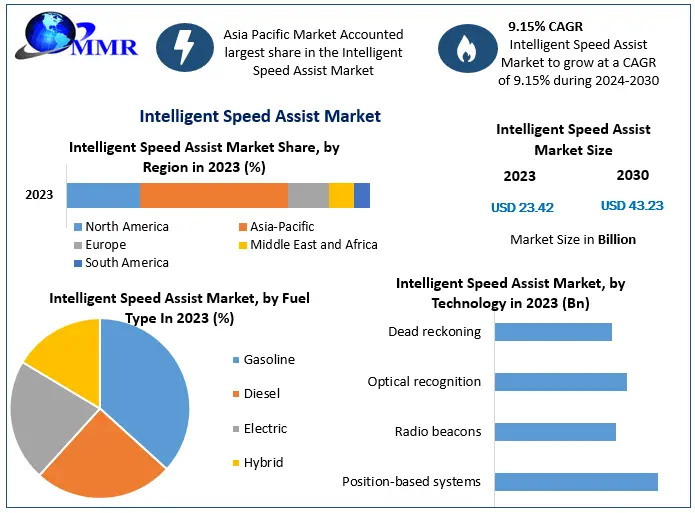
The Intelligent Speed Assist Market is witnessing strong expansion as automakers, governments, and technology suppliers increasingly prioritize road safety, driver assistance, and intelligent vehicle technologies. According to Maximize Market Research, the global Intelligent Speed Assist Market was valued at approximately USD 23.42 billion in 2023 and is projected to reach USD 43.23 billion by 2030, registering a CAGR of 9.15% during 2024–2030.
Intelligent Speed Assist systems use information from cameras, positioning systems, maps, and other vehicle sensors to identify applicable speed limits and notify drivers or assist with speed control. Growing awareness of road safety, increasing adoption of advanced driver assistance systems (ADAS), rising premium and connected vehicle production, and government initiatives aimed at reducing speeding-related accidents are important market growth drivers. The technology is also benefiting from improvements in traffic-sign recognition, digital mapping, connected vehicle platforms, artificial intelligence, and real-time road information.
A major opportunity exists in integrating ISA with adaptive cruise control, navigation, connected-map services, autonomous driving platforms, and centralized vehicle computing. Bosch, for example, is developing connected speed-limit information capable of providing continuously updated speed-limit data, improving the operation of ISA and adaptive cruise control. The transition toward software-defined vehicles could further create opportunities for software-based ISA functions that can be updated over the air rather than being dependent entirely on fixed hardware.
US Market Trends and Investment in 2025
The United States is increasingly evaluating Intelligent Speed Assist as a practical road-safety technology for public and commercial fleets. A significant 2025 development was the evaluation of New York City's Intelligent Speed Assistance pilot involving municipal fleet vehicles. The U.S. Department of Transportation's ITS Joint Program Office reported in April 2025 that the pilot reduced the amount of time participating vehicles spent above speed limits by 64.18%. New York City operates more than 28,700 municipal fleet vehicles, making the program an important large-scale demonstration of ISA technology in the U.S. public sector. At the broader federal level, U.S. vehicle-safety policy continues to emphasize advanced driver assistance technologies. NHTSA's 2024 final rule requiring automatic emergency braking on new light vehicles, with compliance beginning in 2029, also contributes to a regulatory environment supportive of wider ADAS adoption. These developments can encourage technology suppliers and fleet operators to invest in connected cameras, digital maps, vehicle-control software, and sensor-based safety systems.
Request To Free Sample of This Strategic Report ➤ https://www.maximizemarketresearch.com/request-sample/76086/
Market Segmentation – Largest Segment
By Vehicle Type, Passenger Vehicles held the leading position in the Intelligent Speed Assist Market. The passenger vehicle segment benefits from increasing consumer demand for advanced safety features, growing penetration of ADAS in new vehicles, and the integration of ISA with navigation, adaptive cruise control, traffic-sign recognition, and other electronic safety systems. MMR identifies passenger vehicles as the major growth segment within the vehicle-type classification.
Competitive Analysis
The Intelligent Speed Assist market is characterized by competition among major automotive technology suppliers that combine sensing, vehicle electronics, software, mapping, and ADAS capabilities.
Continental AG is a major supplier of automotive safety and ADAS technologies. Its technology portfolio spans sensors, vehicle electronics, and intelligent driving functions, supporting the integration of speed assistance with broader safety systems.
Delphi Automotive LLP participates in vehicle electronics and advanced safety technologies, supporting the integration of sensing and electronic control systems required for intelligent vehicle functions.
DENSO Corporation is strengthening ADAS as a strategic growth area. In its 2025 reporting, DENSO identified electrification and ADAS as major priorities and stated that it is developing next-generation products while expanding collaboration involving HMI and infrastructure. The company has also targeted substantial long-term growth in its ADAS business. In April 2025, DENSO and Horizon Robotics announced a strategic partnership to develop assisted-driving solutions tailored to Chinese road conditions.
Magna International Inc. expanded its ADAS technology strategy in 2025 through collaboration with NVIDIA. Magna announced integration of NVIDIA DRIVE AGX, based on the DRIVE Thor platform, for next-generation vehicle intelligence and AI-powered ADAS. The companies planned development and testing of L2+ through L4 active-safety solutions, providing a technology pathway for increasingly sophisticated intelligent driving functions.
Robert Bosch GmbH is developing connected speed-limit technology that combines continuously updated information with vehicle assistance systems. Its connected speed-limit information is specifically designed to improve the performance of ISA and adaptive cruise control by addressing outdated map information and dynamic speed-limit changes.
Regional Analysis
United States: The U.S. represents an important opportunity because of its large vehicle fleet, advanced automotive technology industry, and increasing fleet-level experimentation with ISA. The 2025 New York City pilot demonstrated measurable reductions in speeding exposure.
United Kingdom: ISA adoption is supported by road-safety initiatives and proposed vehicle type-approval changes. UK government documentation identifies ISA as a technology capable of warning drivers or controlling speed when speed limits are exceeded, using optical recognition and map or real-time data.
Germany: Germany is a major automotive manufacturing center and benefits from European Union vehicle-safety requirements. Since July 2024, new vehicles registered in the EU have been required to include several driver-assistance technologies, including intelligent speed assistance.
France: France benefits from the same EU regulatory framework requiring ISA on new vehicles. European regulatory standardization supports deployment by creating a common technology and vehicle-approval environment across member states.
Japan: Japan's strong automotive manufacturing base, emphasis on vehicle safety, and development of advanced driver assistance technologies provide opportunities for ISA suppliers. Companies such as DENSO are increasing their focus on ADAS, software, sensing, and infrastructure-linked safety technologies.
China: China represents a significant growth opportunity because of its rapidly expanding intelligent-vehicle ecosystem, large passenger vehicle market, and development of domestic ADAS technologies. The 2025 DENSO-Horizon Robotics partnership specifically targeted assisted-driving solutions adapted to China's road environment.
MMR identifies Asia Pacific as the largest regional market in 2023. However, the published MMR report does not provide individual global-market percentage shares for the six specified countries; therefore, country-level percentages are not estimated here.
Request To Free Sample of This Strategic Report ➤ https://www.maximizemarketresearch.com/request-sample/76086/
Key Players
Key companies identified in the MMR Intelligent Speed Assist Market include Continental AG, Delphi Automotive LLP, DENSO Corporation, Magna International Inc., Robert Bosch GmbH, AISIN SEIKI Co., Ltd., Hyundai Mobis, Texas Instruments Incorporated, HELLA KGaA Hueck & Co., Volvo, Jeep, Jaguar, Land Rover, Peugeot, and Renault.
Conclusion
The Intelligent Speed Assist Market is positioned for sustained growth as vehicle safety regulations, connected mobility, ADAS adoption, and software-defined vehicle architectures converge. The market's projected expansion from USD 23.42 billion in 2023 to USD 43.23 billion by 2030 highlights the increasing commercial importance of intelligent speed-control technologies.
The major growth opportunity lies in combining real-time speed-limit data, computer vision, high-accuracy digital maps, AI-based perception, connected vehicles, and centralized computing platforms. Regulatory mandates in Europe, fleet pilots in the United States, and accelerating ADAS development in Asia create multiple pathways for market expansion. Future innovation is likely to focus on improving speed-limit recognition accuracy, reducing false alerts, integrating dynamic road information, lowering system costs, and enabling software updates throughout a vehicle's lifecycle.
About Maximize Market Research
Maximize Market Research Pvt. Ltd. (MMR) is a global market research and consulting company that provides reliable, data-focused, and practical business insights. The firm serves a wide range of industries, including healthcare, pharmaceuticals, technology, automotive, electronics, chemicals, personal care, and consumer goods. Through market forecasts, competitive analysis, strategic consulting, and industry impact assessments, MMR helps organizations understand changing market conditions, identify growth opportunities, and make informed business decisions for long-term success.
Contact Us
2nd Floor, Navale IT Park Phase 3
Pune Banglore Highway, Narhe
Pune, Maharashtra 411041, India
+91 9607365656
sales@maximizemarketresearch.com