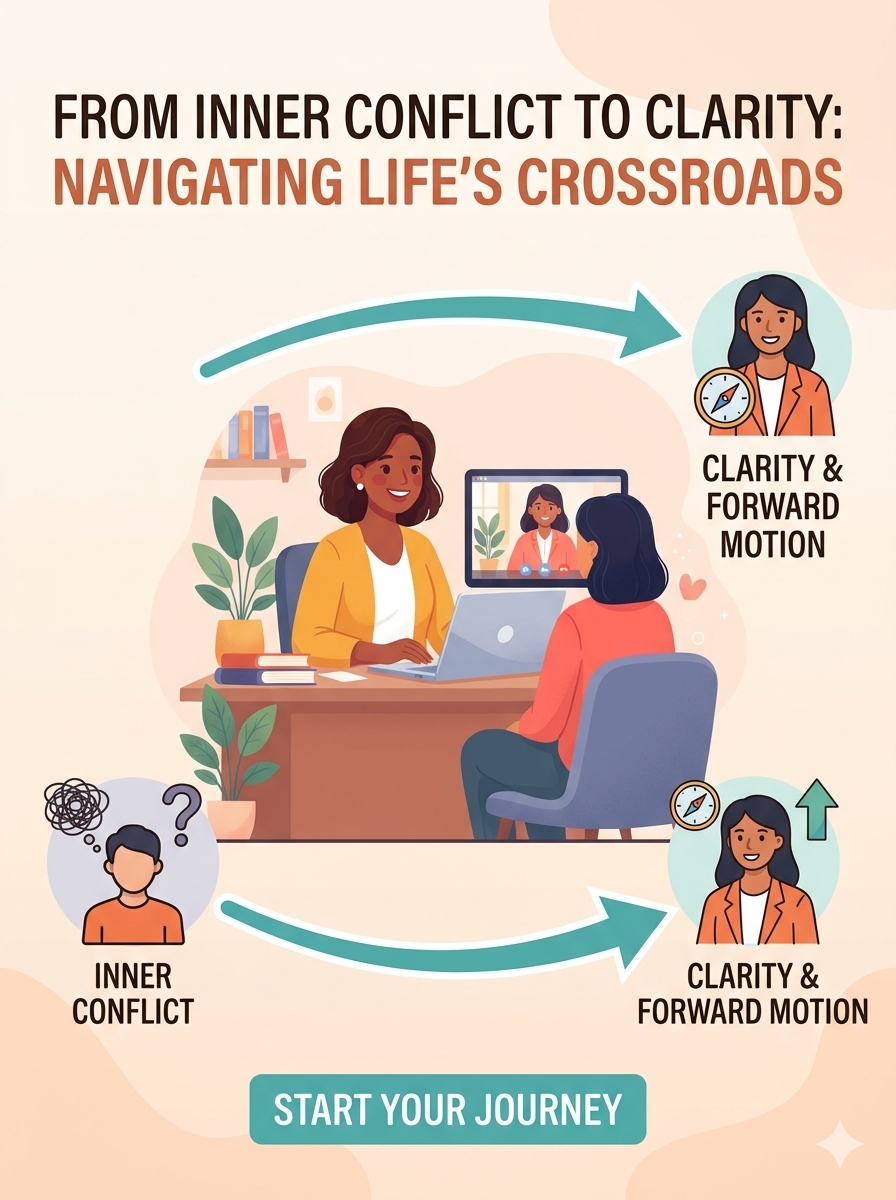
Life does not always give us clear answers. Sometimes, we reach a point where we know that something needs to change, but we are not sure what that change should be. You may be deciding whether to continue in a particular career, move to a new city, stay in a relationship and focus on Building Healthy Emotional Connections, start something new, or simply figure out what you want from life. On the outside, everything may appear normal, but internally, you may feel confused and pulled in different directions.
This is what an inner conflict can feel like. Your mind may tell you to choose the practical option, while your heart may want something completely different. You may want to make yourself happy but also worry about disappointing your family. You may want stability but crave change at the same time.
These moments can leave you overthinking, emotionally exhausted, and unsure about your next step. While it may be tempting to keep analysing every possible outcome, sometimes what we need is not another opinion but a safe space to understand ourselves. This is where an online counsellor can help.
Understanding Inner Conflict
Inner conflict happens when different thoughts, emotions, needs, or values within us do not seem to agree. It is not necessarily a sign that something is wrong with you. In fact, it often happens when a decision is connected to something important in your life.
Imagine someone who has a stable job but no longer feels fulfilled. One part of them says, “I should stay because the job is secure,” while another says, “I want to explore something that makes me happier.” Neither thought is necessarily wrong. The difficulty comes from trying to decide which need should take priority.
Similar conflicts can happen in relationships. You may care deeply about someone while still questioning whether the relationship meets your emotional needs. You may want independence while also wanting closeness. You may want to follow your own dreams while feeling responsible for your family's expectations. When these different needs remain unresolved, they can create a constant feeling of being stuck.
Why Do Life's Crossroads Feel So Overwhelming?
Major life decisions often come with uncertainty, and our minds naturally want certainty before taking action. We may spend hours imagining different outcomes, asking others what they would do, searching for answers online, or repeatedly changing our minds. The problem is that more thinking does not always lead to more clarity.
Sometimes, overthinking actually makes the situation more confusing. Every possible choice starts to come with a list of risks and “what ifs.” You may become so focused on avoiding a mistake that you stop thinking about what you genuinely want. Another challenge is the influence of other people's expectations. Family, friends, colleagues, and society can all have ideas about what a successful or acceptable life should look like. Their advice may come from care and experience, but it can still make it difficult to hear your own voice.
This is especially true when you are at a stage of life where everyone seems to be moving forward. Seeing friends getting married, changing careers, buying homes, travelling, or achieving professional goals can make you question whether you are falling behind. But there is no single timeline for life.
When Confusion Starts Affecting Everyday Life
A difficult decision is normal. However, when uncertainty continues for a long time, it can begin affecting your emotional wellbeing.
You may find yourself constantly thinking about the same issue without reaching a conclusion. You may have trouble concentrating at work, feel anxious about the future, become irritable, or lose interest in things you normally enjoy. Some people may also start avoiding decisions altogether because making no decision feels easier than facing the uncertainty.
You might hear yourself saying, "I just don't know what I want anymore." Sometimes, this confusion can also be connected to deeper concerns such as Managing Worry And Unease, low self-confidence, Coping With Social Isolation, Handling Pressure And Tension, Managing Persistent Low Mood, fear of failure, people-pleasing, relationship difficulties, or past trauma that has influenced the way you make decisions. Understanding these underlying factors can be more helpful than simply forcing yourself to "choose."
Moving From Confusion Towards Clarity
Clarity does not always arrive as one sudden realisation. More often, it develops gradually when you give yourself the opportunity to understand your thoughts and feelings. One useful starting point is to separate what you want from what you think you are supposed to want.
Ask yourself: If I did not have to worry about anyone else's opinion, what would matter to me?
This does not mean ignoring the people you care about. It simply gives your own needs a place in the decision. It can also help to identify your values. Think about what matters most to you at this stage of life. Is it stability, independence, family, personal growth, meaningful work, creativity, financial security, peace, or connection? Once you understand your priorities, decisions can become easier to look at because you have a clearer idea of what you are trying to protect or build.
Another important step is accepting that there may not be a completely risk-free choice. Every meaningful decision involves some uncertainty. Instead of asking yourself, “Which choice guarantees that everything will be perfect?”, consider asking, “Which choice is more aligned with what matters to me right now?” This change in perspective can reduce some of the pressure.
How Can an Online Counsellor Help?
When you are caught in your own thoughts, it can be difficult to see the situation clearly. Speaking with an online counsellor can give you a neutral and supportive space to slow down and explore what you are experiencing.
Counselling is not about someone telling you what decision to make. Your counsellor's role is not to choose your career, relationship, or future for you. Instead, online counselling can help you understand your emotions, recognise patterns, explore your values, and look at your situation from different perspectives. For example, you may initially believe that you are confused about your career, but through conversation, you may realise that your bigger concern is fear of disappointing your family. Someone else may think they are uncertain about a relationship when they are actually struggling with trust because of previous experiences.
Understanding what is underneath the confusion can make the situation feel more manageable. Online therapy can also make professional support easier to access for people with busy schedules, limited local options, or a preference for talking from a familiar environment. Platforms such as TalktoAngel provide access to professional counselling from the best psychologists in India, and mental-health support, allowing individuals to seek guidance without necessarily having to travel to a counselling centre.
You Do Not Have to Figure Out Your Entire Future Today
One of the biggest pressures we place on ourselves is the belief that we need to have everything figured out. Sometimes, you only need to understand your next step. If you are uncertain about your career, perhaps the next step is researching another field rather than immediately resigning. If you are struggling with a relationship decision, perhaps the first step is having an honest conversation. If you feel disconnected from yourself, perhaps the next step is simply giving yourself time to reflect on what you have been feeling. Small steps can create movement without requiring you to have all the answers.
Conclusion
Standing at a crossroads can be uncomfortable because the future is uncertain. You may wish for someone to simply tell you which direction to take, but meaningful decisions often require understanding your own needs, values, emotions, and priorities. Feeling conflicted does not mean that you are incapable of making a decision. It may simply mean that there are several important parts of your life asking for your attention at the same time. TalktoAngel, an online platform for counseling, can provide a supportive space to explore these thoughts, gain clarity, and better understand the factors influencing your decisions.
Instead of rushing yourself towards an answer, give yourself permission to pause and understand what is really happening within you. And if your thoughts feel too tangled to sort through alone, speaking with an online counsellor can provide a safe space to explore them. You may not be able to know exactly where every road will lead. But with greater self-understanding, you can begin making choices that feel more meaningful and more aligned with the person you want to be.Sometimes, finding clarity is not about finding the perfect answer. It is about finally being able to hear your own voice clearly.
Frequently Asked Questions
1. What is inner conflict?
Inner conflict is the struggle we experience when different thoughts, feelings, needs, or values pull us in different directions. It often occurs when we are faced with an important decision or life change.
2. Why do I feel confused about a decision even after thinking about it so much?
Overthinking can sometimes increase confusion because you keep focusing on every possible outcome and trying to eliminate all uncertainty. Understanding your emotions and priorities can be more helpful than repeatedly analysing the same decision.
3. Can an online counsellor help with life decisions?
Yes. Counselling can help you explore your thoughts, emotions, values, fears, and patterns around a decision. The counsellor does not make the decision for you but can help you develop greater self-understanding and clarity.
4. Is online counselling suitable for everyone?
Online counselling can be a convenient option for many people, but the most appropriate form of support depends on an individual's needs and circumstances. A qualified professional can help determine what type of support may be appropriate.
5. When should I consider counselling?
Consider speaking with a mental-health professional when confusion, anxiety, or emotional distress continues over time or begins affecting your relationships, work, sleep, concentration, or daily life. You do not have to wait until a problem becomes severe before seeking support.