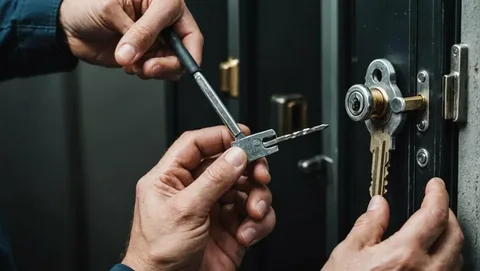
When searching for lock repair near me, it is easy to assume that the lock itself has failed. In some cases, however, the real problem is the door, frame, hinges, or strike plate.
Understanding the difference can help you describe the problem more accurately and avoid replacing a lock that may still be usable.
Test the Lock With the Door Open
One of the simplest checks is to open the door and operate the lock.
Turn the key or handle normally and observe how the mechanism behaves.
If the lock works smoothly while the door is open but becomes difficult when the door is closed, the problem may involve alignment rather than the internal lock mechanism.
This is a useful detail to tell a locksmith.
Check the Door Alignment
A door can shift slightly over time.
Changes in hinges, repeated use, building movement, or loose hardware can affect the position of the door relative to the frame.
Look for signs such as:
-
The door rubbing against the frame
-
A latch that does not line up with the strike plate
-
A bolt that requires pressure to enter the frame
-
Uneven gaps around the door
-
A door that has started dropping or sagging
These issues can place additional pressure on the lock.
Inspect the Strike Plate
The strike plate is the metal section attached to the frame where the latch or bolt enters.
If it has become loose or misaligned, the lock may appear to be faulty even though the locking mechanism is working.
Check whether the screws are loose or whether the latch is hitting the edge of the opening.
Do not make major adjustments without understanding the door's construction.
A professional can determine whether the issue is a simple alignment problem or something more serious.
Pay Attention to the Key
A worn or damaged key can produce symptoms that look like a lock failure.
If you have an authorized spare key, compare how it operates.
A key that is bent, worn, or damaged may not interact correctly with the lock.
Do not continue forcing a key that does not turn normally. It could break inside the cylinder and create an additional problem.
Check the Handle
A loose or spinning handle can indicate a problem with the handle mechanism rather than the lock cylinder itself.
Try operating the handle gently and observe whether the latch moves correctly.
If the handle moves but the latch does not respond, an internal connection may be damaged.
The surrounding door hardware should be inspected before deciding that the complete lock needs replacement.
Look for Signs of Physical Damage
Inspect the lock, handle, door edge, and frame for visible damage.
Look for:
-
Cracks
-
Bent metal
-
Loose screws
-
Corrosion
-
Damaged cylinders
-
Broken handles
-
Signs of forced entry
Physical damage may require more than a simple adjustment.
If the locking mechanism has been badly damaged, replacement may be more practical than repair.
Consider the Type of Door
Different doors can use different locking systems.
A wooden entrance, aluminium door, sliding glass door, and commercial metal door may require different hardware and repair methods.
For aluminium entrances, compatibility is especially important because the lock mechanism needs to fit the existing door profile.
If the issue involves an aluminium entrance, an aluminium door lock should be selected according to the existing configuration rather than appearance alone.
Sliding Doors Need a Different Inspection
A sliding door does not operate like a conventional hinged door.
Its lock works together with the sliding panel, frame, track, and alignment.
If the panel has shifted or the track is damaged, the lock may stop engaging correctly.
In this situation, replacing the lock without addressing the alignment problem may not solve the issue.
A sliding door lock system can be assessed alongside the rest of the sliding mechanism when repair or replacement is required.
When Repair May Be Enough
Repair may be possible when the lock has a minor mechanical issue or the surrounding door hardware only needs adjustment.
Examples can include:
-
Loose screws
-
Minor alignment problems
-
A loose strike plate
-
A sticking mechanism
-
A worn handle connection
-
A key that needs replacement
The exact solution depends on the condition of the components.
When Replacement May Be Necessary
A lock may need replacement when the internal mechanism is broken, the cylinder is severely damaged, or corrosion has affected important components.
Replacement may also make sense when the existing lock is no longer compatible with the door or when several parts have failed.
Do not replace the lock simply because the door feels difficult to secure.
First identify what is causing the problem.
Do Not Force a Failing Lock
Repeatedly turning a stuck key or pushing a door against a resistant latch can make the problem worse.
A key may snap, the cylinder may become damaged, or the door frame may suffer additional stress.
If normal operation is no longer possible, stop applying excessive force and arrange an inspection.
Final Thoughts
A difficult lock does not always mean a failed lock.
Before arranging lock repair near me, check whether the mechanism works with the door open, inspect the alignment, look at the strike plate, and consider the condition of the key and handle.
For specialised doors, the surrounding hardware matters just as much as the lock itself.
Identifying the actual source of the problem can help ensure that the right component is repaired or replaced instead of changing a lock that was not the real cause.