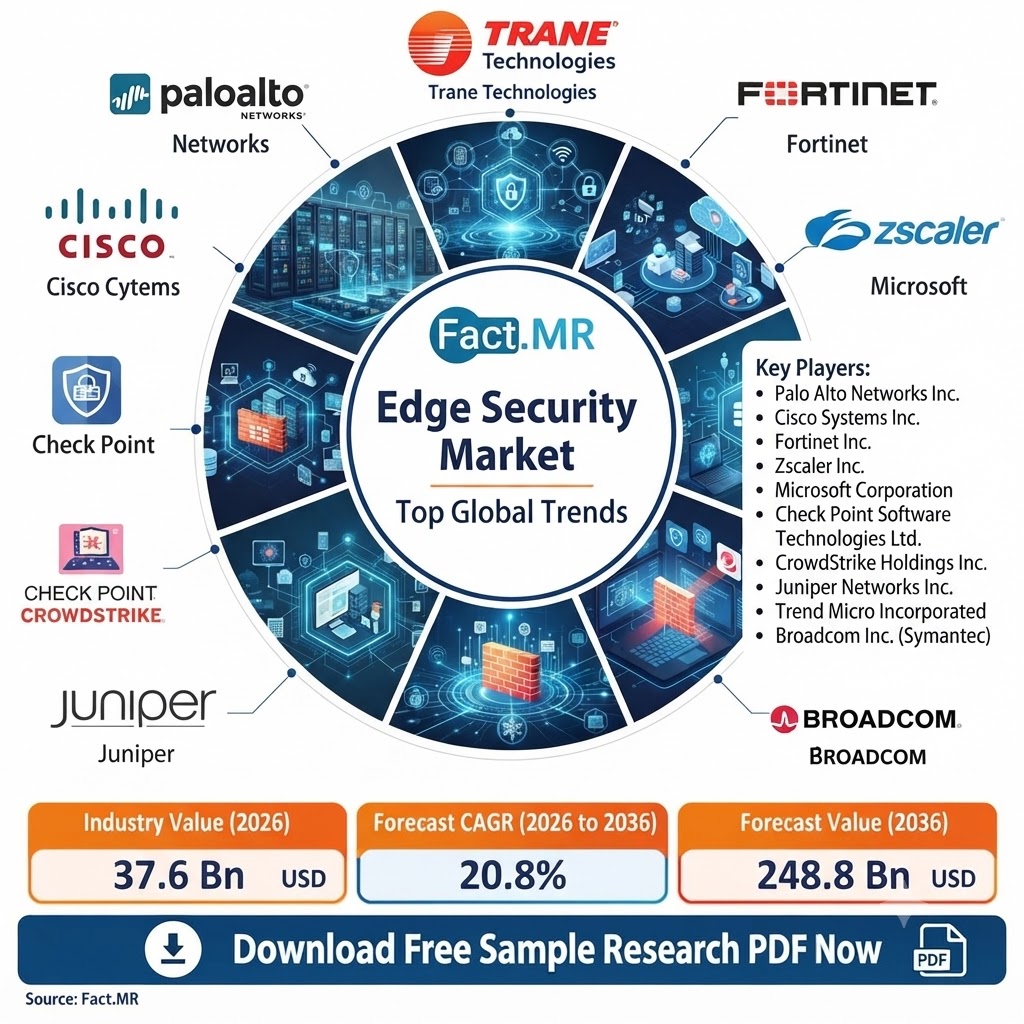
The global edge security market is projected to expand from USD 37.6 billion in 2026 to USD 248.8 billion by 2036, advancing at a CAGR of 20.8% during the forecast period, according to Fact.MR analysis. The market was valued at USD 31.2 billion in 2025, highlighting the rapid expansion of security requirements across distributed network environments. The market is expected to create an absolute dollar opportunity of approximately USD 211.2 billion between 2026 and 2036.
Get detailed market forecasts, competitive benchmarking, and pricing trends: https://www.factmr.com/connectus/sample?flag=S&rep_id=14473
Growth is being supported by the rapid deployment of IoT devices, wider 5G infrastructure, hybrid cloud environments, and increasingly stringent cybersecurity requirements. Connected devices across industrial facilities, smart cities, telecom networks, enterprise branches, and critical infrastructure are expanding the number of network endpoints that require protection. Regulatory measures are also making edge security an increasingly important investment area, with requirements covering zero trust architecture, connected-device security, and protection of critical infrastructure systems.
The solutions segment is expected to account for about 64% of the market in 2026. Software platforms, security gateways, and SASE technologies command a substantial share because enterprises are seeking stronger visibility across distributed environments while supporting zero trust architectures, IoT protection, and operational technology security. On-premise deployment is projected to represent approximately 61% of the market in 2026, supported by data-control requirements and the security needs of regulated industries, defence organizations, and critical infrastructure operators.
Country-level growth remains particularly strong across Asia Pacific and Europe. Korea is projected to record the highest CAGR among the countries covered in the report at 25.0% through 2036. Strong 5G deployment, industrial IoT adoption, and cybersecurity requirements for smart factories are supporting market expansion. Japan follows closely with a 24.9% CAGR, supported by cybersecurity requirements across critical information infrastructure, logistics, healthcare, and other connected sectors. The United Kingdom is forecast to grow at 23.1% CAGR, with connected-device security standards and cybersecurity certification requirements supporting enterprise adoption. Germany is projected to expand at around 22.5% CAGR, driven by industrial cybersecurity requirements and increasing protection needs across industrial control systems.
The United States remains an important market, with demand forecast to rise at a 24.1% CAGR through 2036. Federal cybersecurity requirements, enterprise IoT deployment, and investment in energy, transport, and utilities are contributing to adoption. China is projected to register a 23.5% CAGR, supported by data security requirements and large-scale smart-city and industrial IoT deployments.
Competition in the edge security market includes Palo Alto Networks Inc., Cisco Systems Inc., Fortinet Inc., Zscaler Inc., and Microsoft Corporation. These companies are developing integrated security platforms spanning IoT, OT, branch networks, cloud environments, and zero trust access. Platform consolidation is also influencing purchasing decisions as enterprises seek centralized management across multiple distributed security environments.
Recent industry developments reflect continued investment in specialized edge protection. Palo Alto Networks has expanded Prisma SASE capabilities with IoT security and OT protocol inspection, while Fortinet has introduced ruggedized security appliances for industrial environments. Microsoft is expanding hybrid edge security capabilities through Azure Arc and Defender for IoT, while Cisco is integrating enhanced threat detection capabilities across distributed network infrastructure.
Top Trending Reports:
Military Defense Vehicle Intercom System Market
The outlook for edge security is closely tied to the continued expansion of connected infrastructure and regulatory requirements. Demand is expected to remain concentrated around zero trust access, OT and ICS protection, managed SASE services, private 5G security, and IoT security gateways. Fact.MR's full report provides forecasts through 2036, including component and deployment-mode segmentation, country-level CAGR analysis, competitive assessment, regulatory trends, and strategic opportunities across major regions.