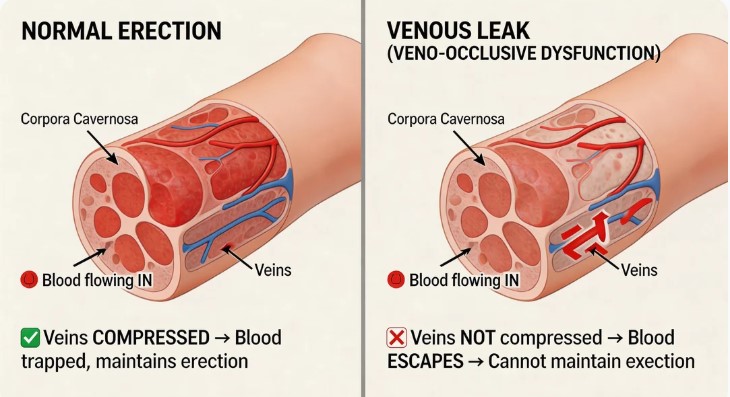
Venous leak is a term commonly used to describe a type of erectile dysfunction (ED) in which a man can achieve an erection but has trouble keeping it firm. The erection may start normally but gradually become softer, making sexual intercourse difficult or unsatisfactory.
The medical term often used for this condition is veno-occlusive erectile dysfunction. A healthy erection depends on sufficient blood entering the penis and being retained inside the erectile tissues. When the blood-retention mechanism does not work properly, maintaining an erection can become difficult.
Venous leak can be associated with vascular health, diabetes, penile or pelvic injury, certain medical conditions, and other factors. However, losing an erection does not automatically mean that a man has venous leak. Several other physical and psychological conditions can cause similar symptoms.
Understanding the possible causes, diagnostic process, and treatment options can help men seek appropriate medical care rather than relying on self-diagnosis.
What Is Venous Leak?
An erection involves a coordinated process between the brain, nerves, hormones, blood vessels, and erectile tissues.
During sexual arousal, the arteries supplying the penis widen and allow more blood to enter the erectile tissues. As these tissues fill with blood, they expand and compress the veins that normally carry blood away from the penis.
This compression helps keep blood inside the penis and maintains the pressure required for firmness.
When this veno-occlusive mechanism does not work effectively, blood may leave the erectile tissues too readily. As a result, the penis may become less firm even though an erection was achieved initially.
This is why men with suspected venous leak often describe their main problem as "I can get an erection, but I cannot keep it."
However, this symptom alone cannot confirm venous leak.
What Are the Symptoms of Venous Leak?
The symptoms can differ between individuals, but difficulty maintaining an erection is the most commonly reported problem.
Possible signs include:
-
Achieving an erection but losing firmness soon afterward
-
An erection becoming softer during intercourse
-
Difficulty maintaining an erection without continuous stimulation
-
Losing an erection when sexual stimulation decreases
-
Being unable to maintain sufficient firmness for intercourse
-
Repeated frustration during sexual activity
-
Anxiety or reduced confidence related to erection problems
Some men may experience normal erections at certain times but have difficulty during sexual activity with a partner.
This difference can be important because psychological factors, stress, and performance anxiety can sometimes produce symptoms similar to those associated with vascular erectile dysfunction.
What Causes Venous Leak?
Venous leak does not have one universal cause. Different health and physical factors can contribute to problems with erection maintenance.
Diabetes
Diabetes can affect both blood vessels and nerves involved in erectile function. Long-term high blood sugar can damage the vascular and nervous systems and increase the risk of ED.
Cardiovascular Disease
The penis contains a network of blood vessels that must function properly for an erection to occur. Cardiovascular conditions can interfere with healthy blood flow and contribute to erectile problems.
High Blood Pressure
Persistent high blood pressure can damage blood vessels over time and may contribute to erectile dysfunction.
Smoking
Smoking can negatively affect blood-vessel health and circulation. It is an important risk factor for erectile dysfunction.
Penile Injury
Injury to the penis may affect the tissues involved in achieving or maintaining an erection.
Pelvic Injury or Surgery
Certain pelvic injuries or surgical procedures can affect nerves, blood vessels, and other structures involved in sexual function.
Penile Structural Problems
Conditions that change the structure of the penis can sometimes be associated with erectile difficulties.
For example, Peyronie's disease can cause scar tissue and penile curvature and may occur alongside erectile dysfunction.
Aging
Changes in blood vessels and erectile tissues become more common with age. Nevertheless, persistent erectile dysfunction should not simply be dismissed as an unavoidable part of aging.
Other Medical Conditions
Obesity, metabolic disorders, neurological conditions, hormonal abnormalities, and certain medications can also contribute to erectile dysfunction.
Is Venous Leak the Same as Erectile Dysfunction?
No.
Erectile dysfunction is a broad medical condition, while venous leak is one possible mechanism associated with difficulty maintaining an erection.
ED may result from:
-
Reduced blood flow into the penis
-
Blood-vessel disease
-
Nerve damage
-
Diabetes
-
Hormonal abnormalities
-
Certain medications
-
Psychological factors
-
Stress and anxiety
-
Cardiovascular disease
-
Lifestyle factors
A man may also have several of these factors at the same time.
This is why diagnosing the underlying cause is more useful than assuming that every erection-maintenance problem is a venous leak.
Can Stress Cause Symptoms Similar to Venous Leak?
Yes.
Stress and anxiety can have a significant effect on sexual performance.
When a man becomes worried about maintaining an erection, this anxiety can interfere with the body's normal sexual response. The result may be an erection that becomes weaker or disappears.
Performance anxiety can create a cycle:
Erection problem → worry about performance → increased anxiety → difficulty maintaining erection → more worry.
Because psychological and physical factors can overlap, a healthcare professional may consider both when evaluating erectile dysfunction.
How Is Venous Leak Diagnosed?
There is no reliable home test that can confirm venous leak.
A doctor generally begins by discussing the patient's medical and sexual history.
The doctor may ask:
-
When did the problem begin?
-
Can you achieve an erection?
-
How long can you maintain it?
-
Do you have morning erections?
-
Do erections occur during masturbation?
-
Do you have diabetes or high blood pressure?
-
Do you smoke?
-
What medications are you taking?
-
Have you experienced penile or pelvic trauma?
-
Are stress or relationship problems affecting sexual activity?
A physical examination may also be performed.
Depending on the findings, the doctor may recommend blood tests or specialized vascular testing.
Penile Doppler Ultrasound for Venous Leak
A penile duplex Doppler ultrasound may be used when a vascular cause of erectile dysfunction is suspected.
During the examination, a medication may be used to produce an erection. Ultrasound is then used to evaluate blood flow through the penile vessels.
The test can help assess:
-
Arterial blood flow
-
Blood entering the erectile tissues
-
The veno-occlusive mechanism
-
Possible vascular causes of ED
Doppler testing should be interpreted by an experienced clinician because several factors can influence the findings, including the degree of erection, medication response, timing, and technical factors.
Blood Tests for Erectile Dysfunction
Blood tests may be recommended based on a person's symptoms and health history.
A doctor may evaluate:
-
Blood glucose
-
HbA1c
-
Cholesterol
-
Testosterone
-
Thyroid function
-
Other hormones or metabolic markers when appropriate
The exact tests depend on the individual patient.
Venous Leak Treatment Options
Treatment depends on the underlying cause, severity of erectile dysfunction, overall health, and previous treatment response.
There is no single treatment that is appropriate for every patient.
1. Lifestyle Changes
Improving general health can support healthy blood vessels and erectile function.
Important lifestyle measures include:
-
Stop smoking
-
Exercise regularly
-
Maintain a healthy weight
-
Manage diabetes
-
Control blood pressure
-
Manage cholesterol
-
Limit excessive alcohol
-
Get adequate sleep
-
Reduce chronic stress
Lifestyle changes may improve erectile health, although they should not be presented as a guaranteed cure for a confirmed structural vascular problem.
2. Oral Erectile Dysfunction Medicines
PDE5 inhibitor medicines are commonly used to treat erectile dysfunction.
Common examples include:
-
Sildenafil
-
Tadalafil
-
Vardenafil
-
Avanafil
These medicines enhance the natural blood-flow process involved in erections and may help some men achieve and maintain better erections.
They do not necessarily correct an underlying veno-occlusive abnormality.
Important Safety Information
PDE5 inhibitors are not suitable for everyone. They can interact dangerously with nitrate medications, potentially causing a serious drop in blood pressure.
Anyone considering ED medication should discuss their medical history and current medicines with a healthcare professional.
3. Vacuum Erection Devices
A vacuum erection device uses controlled negative pressure to draw blood into the penis.
A constriction ring can then be used to help maintain the erection.
For some men, vacuum therapy provides a non-surgical way to manage erection difficulties.
Proper instructions are important because incorrect use can cause pain, bruising, or other problems.
4. Injection Therapy
Intracavernosal injection therapy involves injecting prescribed medication directly into the erectile tissue.
The medication can increase blood flow and produce an erection.
This treatment can be effective for some men, but it should only be used according to a healthcare professional's instructions.
An incorrect dose can cause priapism, a prolonged erection that requires urgent medical treatment.
5. Counseling and Sex Therapy
Not every case of erectile dysfunction is caused by a physical vascular problem.
Performance anxiety, stress, depression, relationship difficulties, and other psychological factors can affect erection quality.
Counseling or sex therapy may help address these issues.
For men with both physical and psychological contributors, psychological treatment can be combined with medical treatment.
6. Penile Implant Surgery
For men with severe erectile dysfunction who do not achieve satisfactory results from other appropriate treatments, a penile implant may be considered.
A penile prosthesis is surgically placed inside the penis and allows the patient to create an erection when desired.
Common types include:
-
Inflatable penile implants
-
Malleable or semirigid implants
Penile implant surgery is a significant procedure and has potential complications, so it requires careful discussion with a qualified urologist.
Can Venous Leak Be Cured?
There is no universal answer because the outcome depends on the underlying cause.
If erectile dysfunction is associated with factors such as smoking, diabetes, medication, cardiovascular disease, or psychological problems, addressing those factors may improve sexual function.
Some men may need ongoing treatment to manage their symptoms.
Therefore, it is important to be cautious about claims that a particular treatment can permanently cure every case of venous leak.
The first goal should be to establish an accurate diagnosis.
Can Venous Leak Be Treated Without Surgery?
Yes.
Many men with erectile dysfunction can receive non-surgical treatment.
Depending on the diagnosis, options may include:
-
Lifestyle improvements
-
Oral ED medications
-
Vacuum erection devices
-
Injection therapy
-
Counseling
-
Sex therapy
-
Treatment of underlying medical conditions
Surgery is generally considered only in selected circumstances.
Can Exercise Help With Erectile Function?
Regular exercise can support cardiovascular health and may improve overall erectile function.
Activities such as walking, swimming, running, cycling, and resistance training can contribute to better physical fitness.
Exercise does not guarantee correction of a structural venous problem, but maintaining good cardiovascular health is an important part of protecting erectile function.
Can Diet Improve Erectile Health?
A balanced diet can support blood-vessel and metabolic health.
A healthy eating pattern may include:
-
Vegetables
-
Fruits
-
Whole grains
-
Beans and legumes
-
Nuts and seeds
-
Fish
-
Lean proteins
-
Healthy fats
It is also helpful to limit excessive processed foods, added sugars, and unhealthy fats.
A healthy diet should be considered part of an overall approach to sexual health rather than a guaranteed treatment for venous leak.
Does Masturbation Cause Venous Leak?
Normal masturbation is not established as a cause of structural venous leak.
It is also normal for an erection to disappear after ejaculation or when sexual stimulation ends.
If you consistently experience difficulty achieving or maintaining erections, it is better to have the problem evaluated rather than assuming masturbation is the cause.
Does Pornography Cause Venous Leak?
Pornography does not physically create a leak in the penile veins.
However, psychological factors, sexual expectations, anxiety, and individual sexual habits may affect sexual performance in some people.
These factors should not be confused with medically diagnosed veno-occlusive erectile dysfunction.
Venous Leak and Infertility
Venous leak and infertility are different medical conditions.
A man can have erectile dysfunction while having normal sperm production and fertility.
Likewise, fertility problems can occur in men who have no difficulty achieving erections.
If both erectile and fertility concerns are present, each issue should be appropriately evaluated.
Venous Leak and Age
Erectile dysfunction becomes more common as men age because health conditions associated with ED also become more common.
These include:
-
Diabetes
-
High blood pressure
-
Cardiovascular disease
-
Obesity
-
Vascular disease
-
Hormonal changes
However, persistent erection problems should not simply be ignored as a normal consequence of aging.
How to Support Healthy Erectile Function
Although not every case of ED can be prevented, several habits can support sexual and cardiovascular health.
Quit Smoking
Smoking can damage blood vessels and impair circulation.
Stay Physically Active
Regular exercise supports cardiovascular fitness and overall health.
Maintain a Healthy Weight
A healthy weight can reduce the risk of several conditions associated with erectile dysfunction.
Manage Diabetes
Good blood-sugar control can help protect blood vessels and nerves.
Control Blood Pressure
Regular monitoring and appropriate treatment can help protect cardiovascular health.
Manage Cholesterol
Healthy cholesterol levels can support vascular health.
Limit Alcohol
Excessive alcohol consumption can interfere with erections and overall health.
Manage Stress
Chronic stress can contribute to sexual difficulties.
Get Enough Sleep
Good-quality sleep supports overall physical and hormonal health.
When Should You See a Doctor?
Occasional erection difficulties can happen to many men. However, persistent or recurring problems deserve professional attention.
Consider consulting a doctor if you:
-
Frequently lose erections
-
Cannot maintain an erection during intercourse
-
Have experienced persistent ED for several weeks
-
Notice a sudden change in erectile function
-
Have diabetes or cardiovascular risk factors
-
Take medicines that may affect sexual function
-
Experience significant distress because of erection problems
A urologist or sexual-medicine specialist can evaluate your symptoms and determine whether further testing is necessary.
Frequently Asked Questions About Venous Leak
What is venous leak in men?
Venous leak is a commonly used term for veno-occlusive erectile dysfunction, where the penis has difficulty retaining enough blood to maintain a firm erection.
What are the main symptoms?
The most common symptom is difficulty maintaining an erection after initially becoming erect.
How can venous leak be confirmed?
A doctor may use a medical history, physical examination, blood tests, and penile duplex Doppler ultrasound when appropriate.
Can venous leak be treated?
Yes. Treatment depends on the underlying cause and may include lifestyle changes, oral medication, vacuum therapy, injection therapy, counseling, or penile implant surgery in selected cases.
Can Viagra treat venous leak?
Sildenafil and other PDE5 inhibitors may improve erectile function in some men. They do not necessarily correct an underlying structural veno-occlusive problem.
Is venous leak permanent?
Not necessarily. The outlook depends on the underlying cause and response to treatment.
Can venous leak cause infertility?
Venous leak and infertility are separate conditions. Erectile dysfunction does not automatically mean that a man is infertile.
Which doctor treats venous leak?
A urologist, particularly one specializing in male sexual medicine, can evaluate suspected venous leak and other causes of erectile dysfunction.
Does masturbation cause venous leak?
Normal masturbation is not established as a cause of structural venous leak.
Conclusion
Venous leak, medically described as veno-occlusive erectile dysfunction, is associated with difficulty maintaining a firm erection. A man may be able to achieve an erection but lose firmness during sexual activity.
However, erection loss alone does not establish a diagnosis of venous leak. Diabetes, cardiovascular disease, medications, hormonal problems, nerve-related conditions, stress, anxiety, and other forms of erectile dysfunction can cause similar symptoms.
A proper evaluation can help determine the underlying cause. Depending on the diagnosis, treatment may involve lifestyle changes, oral medications, vacuum erection devices, injection therapy, counseling, or penile implants in selected cases.
If you are experiencing persistent difficulty maintaining an erection, speaking with a qualified urologist or sexual-medicine specialist can help identify the cause and determine which treatment options may be appropriate for you.