INTRODUCTION
Modern hospitals require carefully planned neonatal care environments to support premature, low-birth-weight, and critically ill newborns. NICU Manufacturers play an important role in developing infrastructure that can integrate clinical equipment, environmental systems, medical gases, electrical services, infection-control provisions, and efficient staff workflows. The Government of India’s Facility Based Newborn Care Operational Guidelines 2025 provide updated guidance covering planning, infrastructure, equipment, human resources, and capacity building for newborn-care services.
Supporting Specialized Newborn Care
A NICU is designed around the specific needs of newborn patients rather than simply adapting a general hospital ward. Modern neonatal care requires appropriate space for patient care, monitoring, procedures, equipment, staff activities, and supporting services.
The National Health Mission identifies facility-based newborn-care services at different levels, including Newborn Care Corners, Newborn Stabilization Units, and Special Newborn Care Units. This demonstrates the importance of appropriately planned infrastructure according to the level and scope of newborn services provided.
Creating an Efficient NICU Layout
The layout should support clinical observation, staff movement, equipment access, and emergency response. Patient-care positions need sufficient surrounding space for healthcare professionals to perform procedures and operate necessary equipment.
Hospitals should also consider the relationship between the NICU and delivery rooms, operating theatres, diagnostic services, laboratories, and other relevant departments. The 2025 FBNC guidelines specifically address infrastructure planning as part of strengthening newborn-care services.
Integrating Neonatal Equipment
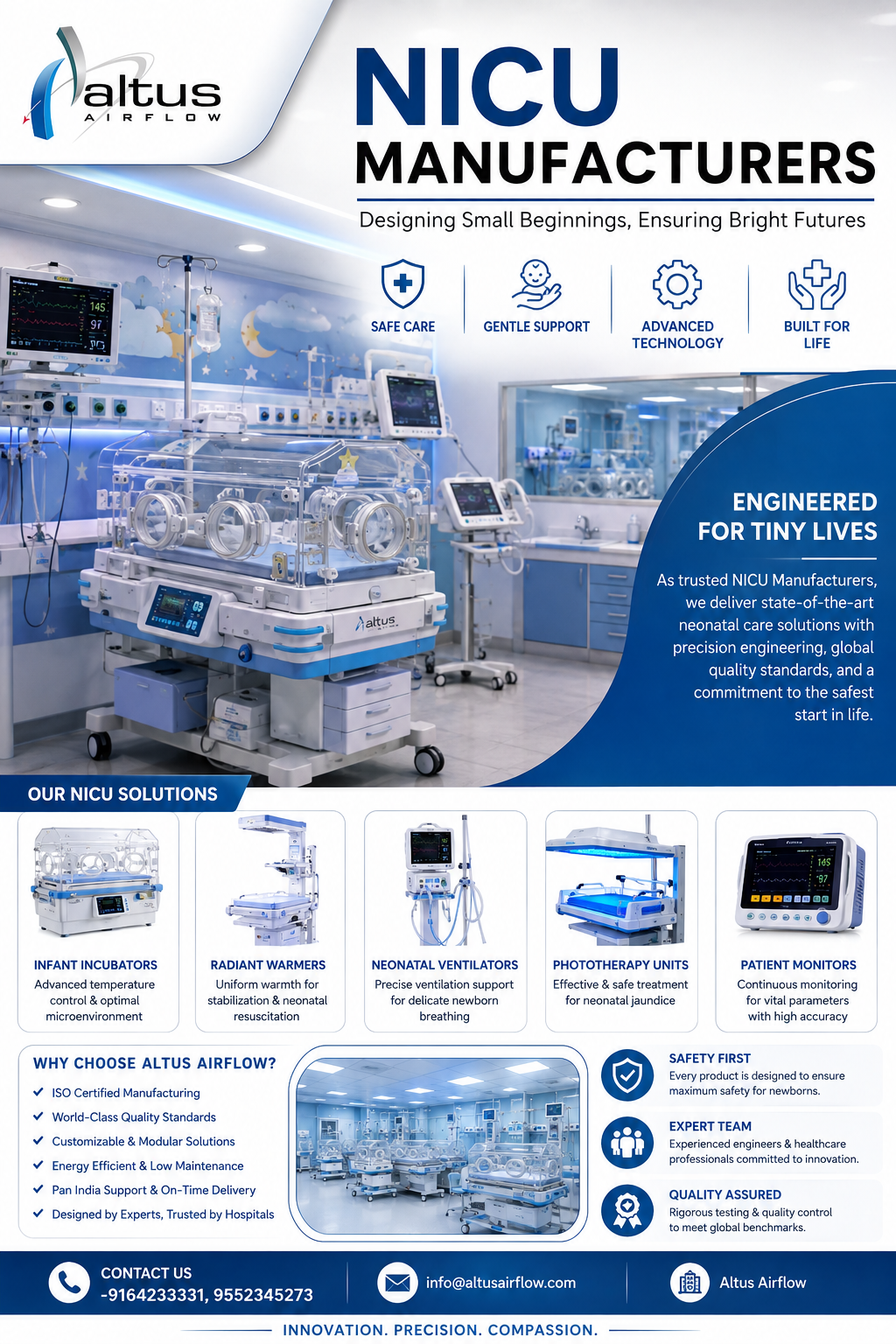
Neonatal care can require specialized equipment such as radiant warmers, incubators, monitors, infusion pumps, respiratory-support equipment, phototherapy systems, and resuscitation equipment.
Infrastructure should therefore be planned around the equipment that clinicians will use. Medical gas connections, electrical outlets, monitoring systems, and equipment positioning should be coordinated so that devices remain accessible without creating unnecessary obstruction around the newborn.
Maintaining Suitable Environmental Conditions
Newborns, particularly premature and low-birth-weight infants, require carefully controlled environments. Temperature, humidity, ventilation, lighting, and air movement should be considered during NICU planning.
The Government of India’s 2025 FBNC guidelines include updated infrastructure and planning guidance for newborn-care facilities, reflecting the need for appropriately designed environments as part of quality newborn services.
Strengthening Infection Prevention
Infection prevention is a major consideration in neonatal environments. The physical design should facilitate cleaning, hand hygiene, equipment management, waste handling, and appropriate separation of patients or activities where required.
Surface finishes, accessibility for cleaning, placement of sinks and hand-hygiene facilities, and workflow planning should be evaluated together rather than independently. A systematic review of neonatal-unit design has also identified environmental and architectural factors such as space, sinks, lighting, clinical areas, staff areas, and family facilities as relevant design considerations.
Planning Medical Gas Services
Neonatal respiratory support and other clinical procedures can require dependable access to medical gases and suction. Gas outlets should be positioned appropriately for the planned patient-care configuration.
Hospitals should assess pipeline routing, outlet accessibility, safety, capacity, and coordination with other building services before installation begins.
Ensuring Reliable Electrical Infrastructure
NICUs can contain numerous electrically powered devices operating simultaneously. Electrical planning should therefore consider current equipment requirements as well as potential future additions.
Adequate outlets, organized cable management, emergency power arrangements, and appropriate backup provisions can help support continuity of essential systems. Electrical services should be coordinated with equipment placement to reduce clutter and preserve safe access around patient-care areas.
Supporting Staff Workflow
NICU staff need efficient access to multiple patients, monitoring systems, equipment, storage areas, and clinical workstations. A well-planned environment can help reduce unnecessary movement and make routine activities easier to organize.
The design should consider nursing stations, preparation areas, storage, utility spaces, staff facilities, and communication systems alongside the patient-care area.
Providing Family-Centred Facilities
Modern newborn-care planning can also incorporate appropriate facilities for parents and families. The National Health Mission promotes Family Participatory Care and Mother Newborn Care Units, with an emphasis on keeping mothers and newborns together where appropriate and supporting parental participation in newborn care.
Consequently, hospitals may need to consider family access, counselling areas, privacy, and spaces that support activities such as Kangaroo Mother Care according to their clinical model.
Improving Emergency Accessibility
Emergency procedures require rapid access to the newborn and essential equipment. Patient positions, doors, corridors, utility connections, and equipment placement should therefore be arranged so that emergency teams can work without unnecessary physical barriers.
The location of the NICU should also be considered in relation to areas such as delivery rooms and operating theatres, particularly where newborns may need rapid transfer for specialized care.
Supporting Future Adaptability
Healthcare technology and hospital requirements can change. A NICU designed only for current requirements may become difficult to modify when additional equipment, beds, monitoring systems, or services are introduced.
Flexible infrastructure can make future modifications more manageable. Hospitals should discuss possible expansion, utility capacity, equipment upgrades, and accessibility for maintenance during the initial planning stage.
Coordinating Installation and Commissioning
NICU development involves more than installing individual components. Architectural planning, HVAC, electrical services, medical gases, equipment, infection-control requirements, and clinical workflows need to work together.
Hospitals should therefore assess how effectively the proposed infrastructure can be coordinated with architects, hospital engineers, biomedical teams, clinicians, and other technical professionals. Proper commissioning and documentation can also help ensure that installed systems correspond with the approved design.
Considering Maintenance and Technical Support
Long-term performance depends on regular inspection and maintenance. Hospitals should evaluate maintenance procedures, servicing requirements, calibration, troubleshooting, replacement needs, and technical support before finalizing a project.
The broader critical-care planning literature also emphasizes maintenance, equipment management, and coordination with biomedical engineering teams as important parts of healthcare infrastructure planning.
Building Infrastructure Around Quality Care
The importance of NICU infrastructure extends beyond the physical room. A properly coordinated environment can bring together equipment, clinical workflows, infection-control measures, environmental systems, safety provisions, and family-support requirements.
India’s 2025 Facility Based Newborn Care Operational Guidelines are specifically intended to guide planning, infrastructure, equipment, human resources, and capacity building for newborn-care services.
Conclusion
Modern hospitals need neonatal environments that are carefully planned around the clinical, technical, and operational requirements of newborn care. NICU Manufacturers can contribute to this process by coordinating infrastructure such as layout, equipment integration, medical gases, electrical services, environmental control, infection-prevention features, staff workflows, safety provisions, and future adaptability. Hospitals should evaluate these factors together and align the final design with applicable guidelines and their own clinical requirements. The Government of India’s 2025 FBNC guidelines provide an important reference for planning and strengthening newborn-care infrastructure.
FAQs
1. Why is specialized NICU infrastructure important?
Specialized infrastructure allows hospitals to accommodate neonatal equipment, environmental controls, medical gases, electrical systems, infection-control requirements, and clinical workflows within an appropriately planned care environment.
2. What should hospitals consider when planning a NICU?
Hospitals should evaluate patient capacity, layout, equipment requirements, ventilation, temperature and humidity control, medical gases, electrical systems, infection prevention, staff workflow, family facilities, maintenance, and future expansion.
3. How does NICU design support infection prevention?
Appropriate layout, cleanable surfaces, hand-hygiene facilities, organized equipment placement, and suitable patient and workflow separation can support hospital infection-prevention practices.
4. Why should family facilities be considered in newborn-care planning?
Family participation can be an important component of newborn care. The National Health Mission promotes Family Participatory Care and Mother Newborn Care Units in relevant settings.
5. Why is future adaptability important for NICUs?
Future-ready infrastructure can make it easier for hospitals to accommodate new equipment, revised workflows, additional services, or expansion without requiring extensive redesign.
Read Our Previous Blog-----------> How Do Hospitals Select the Right ICU Manufacturers?