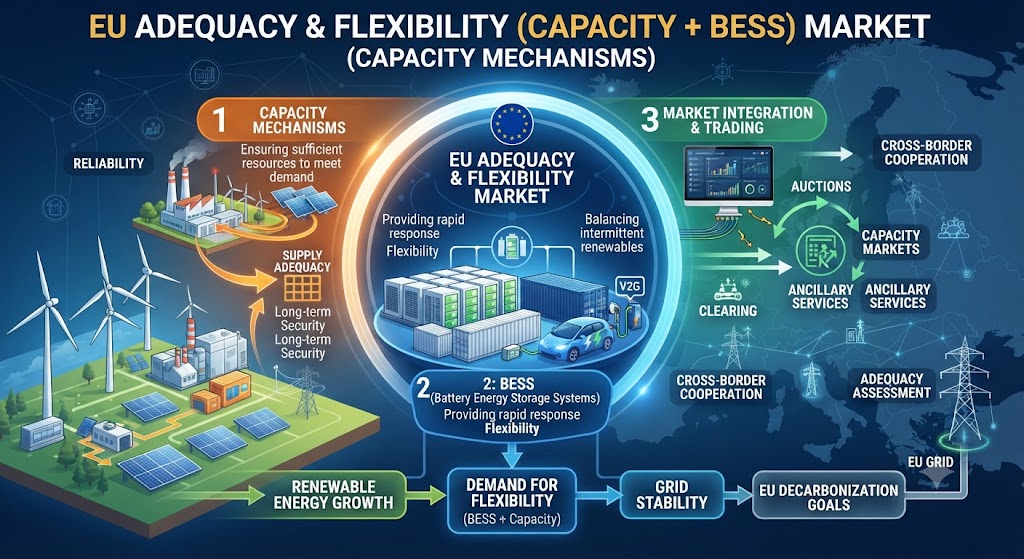
EU Adequacy & Flexibility Market Analysis: Capacity and BESS in a Changing Grid
Europe’s power sector is being reshaped by renewable generation, electrification, and the retirement of conventional assets. These changes are creating a new reliability question: how can electricity systems maintain sufficient supply while also responding rapidly to changing conditions? The answer increasingly involves a combination of capacity arrangements, flexible demand, interconnection, and battery energy storage.
The EU Adequacy & Flexibility (Capacity + BESS) Market Analysis highlights a market structure in which reliability and flexibility are becoming closely connected. Capacity mechanisms can secure resources for periods of system stress, while BESS can deliver rapid balancing and reserve capabilities. Together, these resources can help manage the variability created by higher wind and solar penetration.
Adequacy is traditionally associated with having enough generation capacity to meet peak demand. Yet modern systems require more than sufficient megawatts. They also need resources capable of changing output quickly, shifting consumption, and responding to unexpected events. A system can have adequate installed capacity on paper and still experience operational challenges if available resources cannot respond when required.
BESS is particularly relevant because batteries can react within seconds or faster, depending on technology and controls. This makes them valuable for frequency response, balancing, reserve services, and short-duration peak management. Their ability to participate across multiple markets can become even stronger when software optimizes charging and discharging across several markets.
However, storage economics remain sensitive to market rules. Revenue stacking can improve project viability by combining capacity payments with wholesale arbitrage, ancillary services, and balancing revenues. Restrictions that prevent batteries from participating in multiple services may reduce their system value and weaken investment incentives.
Capacity mechanisms must also evolve as the generation mix changes. Traditional approaches often focus on firm generation availability, but newer frameworks can recognize demand response and storage. Performance requirements can encourage resources to demonstrate actual delivery during scarcity events rather than simply maintaining contractual availability.
The geographic dimension is equally important. Adequacy needs differ between countries and regions because renewable profiles, interconnection capacity, demand patterns, and generation fleets vary. Cross-border electricity trading can provide additional security, but reliance on imports requires careful assessment of whether neighboring systems are likely to experience stress at the same time.
Transmission constraints add another layer. A country may have enough generation nationally while a local area remains exposed to shortages because electricity cannot move efficiently. Batteries located near constrained nodes can sometimes provide targeted flexibility, although their contribution depends on duration, dispatch rules, and network conditions.
Investors are therefore paying closer attention to market design rather than looking only at technology costs. Questions around eligibility, contract length, performance penalties, dispatch rights, degradation treatment, and revenue stacking can materially influence project returns. Developers with strong optimization capabilities may gain an advantage as market participation becomes more sophisticated.
Technology diversity will remain important. Long-duration storage can address extended periods of low renewable output, while short-duration BESS can manage fast fluctuations and daily peaks. Flexible industrial demand can provide another layer of response. Dispatchable generation may continue contributing capacity where economically and environmentally appropriate.
The European reliability framework is consequently moving toward a portfolio model. Rather than relying on a single resource type, policymakers can combine firm capacity, batteries, flexible consumption, interconnection, and operational tools. This approach can improve resilience while supporting decarbonization.
For market participants, understanding how these resources interact will be essential. Future opportunities are likely to emerge where policy reform, grid constraints, renewable growth, and demand electrification create strong requirements for both dependable capacity and rapid flexibility.
As procurement models mature, transparent adequacy assessments and technology-neutral rules can encourage investment in assets that deliver measurable reliability, operational flexibility, and consumer value across changing market conditions.