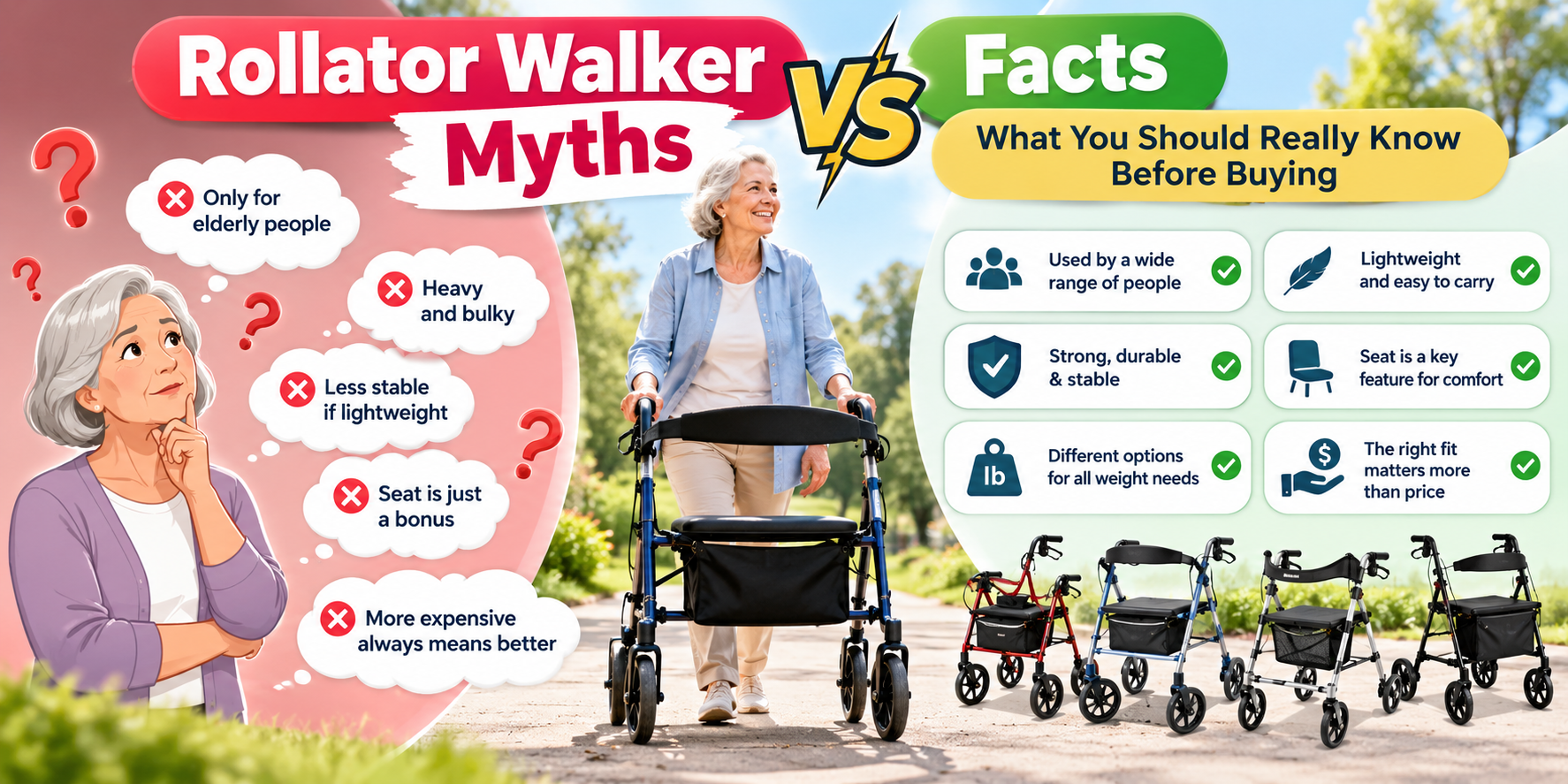
Mobility aids come with more myths than almost any other health product. Some people avoid using a rollator because they believe it makes them "look old." Others assume every rollator is heavy, bulky, and uncomfortable, based on an outdated image from decades ago. These beliefs stop people from getting a device that could genuinely make daily life easier and safer.
In this article, we go through the most common myths about the rollator walker — separating outdated assumptions from how things actually work today. If you or a family member has been hesitating because of something you heard, this guide should help clear things up.
Myth 1: "A Rollator Is Only for Very Old or Very Sick People"
The Fact: Rollators are used by a wide range of people — not just seniors. Younger adults recovering from knee surgery, people managing chronic fatigue conditions, and even athletes recovering from injury use rollators temporarily to stay mobile and active without overexerting themselves.
The real purpose of a rollator isn't age — it's support. Anyone who needs extra stability, a safe place to rest, or help conserving energy while walking can benefit from one, regardless of how old they are. Framing it as a tool for independence, rather than a sign of decline, is closer to how it actually works in practice.
Myth 2: "All Rollators Are Heavy and Hard to Carry"
The Fact: This was true of older walking frames, but it isn't true of modern rollators, especially lightweight rollator models. Many of today's designs use aluminum frames that weigh as little as 13-20 pounds, fold in seconds, and fit easily into a car trunk or a closet.
The confusion usually comes from comparing an old steel-framed hospital walker to a modern rollator. The two are built very differently. A well-made lightweight rollator can be lifted with one hand by most adults, which is a far cry from the heavy, bulky image many people still have in mind.
Myth 3: "A Lighter Rollator Means a Weaker One"
The Fact: Weight and strength are not the same thing. A lightweight rollator achieves its lower weight through better materials and smarter frame engineering — not by using thinner, weaker parts.
Many lightweight models use aircraft-grade aluminum, the same category of material used in demanding engineering applications where strength-to-weight ratio matters most. The frame geometry (how the tubes are shaped and joined) plays a much bigger role in overall stability than how heavy the rollator feels in your hand. In short: light does not mean fragile, as long as the model is well-built.
Myth 4: "A Seat Is Just a Bonus Feature, Not a Necessity"
The Fact: For many users, the seat is one of the most-used parts of the entire device — not an occasional extra. A rollator with seat gives the user a dependable place to rest whenever fatigue sets in, whether that's during a walk around the block, a shopping trip, or a wait at a bus stop.
Caregivers often report that having a seat available changes behavior in a noticeable way: users go out more often and stay out longer, simply because they're no longer worried about where they'll rest if they get tired. Treating the seat as optional often leads to a device that gets used less than it should.
Myth 5: "Any Rollator Will Work, Regardless of Body Weight"
The Fact: Weight capacity is one of the most important safety specifications on a rollator, and it varies significantly between models. A standard rollator is typically rated for up to around 250-300 lbs. For users above this range, a bariatric rollator — built with reinforced frames, wider seats, and stronger wheels — is designed specifically to handle higher weight loads safely.
Using a standard rollator above its rated capacity isn't just uncomfortable, it's risky. Frames under consistent excess load can weaken over time, welds can crack, and brakes may not hold as reliably. Choosing the correct capacity — ideally with some safety margin above the user's actual weight — is a safety decision, not just a comfort one.
Myth 6: "More Expensive Always Means Better"
The Fact: Price does often correlate with build quality, but it isn't the only factor that matters. A mid-range rollator with the right seat size, correct weight capacity, and comfortable handle height can outperform a more expensive model that doesn't actually fit the user well.
Instead of chasing the highest price tag, it makes more sense to match specific features — seat comfort, portability, weight capacity — to the user's actual daily routine. A lower-priced model that fits well will almost always beat an expensive one that doesn't.
Myth 7: "Once You Start Using a Rollator, You'll Always Need One"
The Fact: For many users, a rollator is a temporary tool used during recovery from surgery, injury, or a health setback. As strength and balance improve, some people transition back to a cane or no walking aid at all.
For others, especially those managing long-term conditions, a rollator becomes a permanent part of daily life — and that's just as valid an outcome. Either way, using a rollator doesn't lock someone into a particular path. It simply provides support for as long as support is needed.
Myth 8: "A Rollator Will Make Walking Slower and More Difficult"
The Fact: In most cases, the opposite is true. Because a rollator rolls smoothly instead of needing to be lifted with each step (like a standard walker), many users find they can actually walk more naturally, with less effort and less risk of losing balance mid-step.
The brakes also add a layer of control that isn't available with a cane or standard walker, allowing the user to stop confidently on a slope or when navigating around obstacles. For many people, a rollator doesn't slow them down — it lets them keep moving for longer distances with less fatigue.
Myth 9: "Three Wheels Are Always Better Because They're More Compact"
The Fact: Three-wheel rollators are indeed more compact and easier to maneuver in tight indoor spaces, but that compactness comes with trade-offs. Most 3-wheel models don't support a seat, since the triangular base isn't stable enough for safe sitting.
Four-wheel rollators, while slightly wider, offer more stability overall and are the standard choice when a seat is needed or when the rollator will be used outdoors. Neither type is universally "better" — it depends entirely on where and how the rollator will be used.
Myth 10: "Any Wheels Will Work Fine, Indoors or Outdoors"
The Fact: Wheel size and material make a real difference depending on the surface. Smaller wheels (around 5-6 inches) work well on smooth indoor flooring but can struggle with outdoor cracks, gravel, or uneven pavement. Larger wheels (8 inches or more), especially with air-filled or semi-pneumatic tires, handle outdoor terrain far more smoothly.
Choosing a rollator based only on indoor testing in a store, without considering outdoor use, is a common reason people end up disappointed with stability once they take it outside.
Myth 11: "Maintenance Isn't Necessary for a Rollator"
The Fact: Like any mechanical device, a rollator benefits from regular, simple maintenance. Brakes should be checked monthly to confirm they engage and release properly. Wheels should be inspected for wear, especially with frequent outdoor use. Loose bolts, particularly around folding joints and the seat frame, should be tightened as needed.
Skipping maintenance doesn't cause immediate problems, but over months and years, small issues compound — a brake that's gradually loosening, a wheel that's slowly wearing unevenly — until they eventually become safety concerns. A few minutes of care each month prevents most of these issues entirely.
Myth 12: "Handle Height Doesn't Matter Much, Just Pick Something Comfortable"
The Fact: Handle height has a bigger impact on long-term comfort than most people expect. Handles set too low force the user to hunch forward, while handles set too high create strain in the shoulders and wrists. Over weeks of regular use, incorrect handle height can contribute to new aches that weren't there before.
The correct setup allows the user to stand upright with a slight, natural bend in the elbows while holding the handles. This is worth checking carefully and adjusting properly, rather than leaving it at a default setting.
Myth 13: "A Rollator Is a Replacement for Physical Therapy or Exercise"
The Fact: A rollator is a support tool, not a substitute for staying active or following a prescribed therapy plan. In fact, many physical therapists recommend rollators specifically because they make it easier for patients to keep moving safely while recovering strength and balance.
Relying on a rollator without any accompanying movement or exercise, when a doctor has recommended both, can slow recovery. The two work best together: the rollator provides safety and confidence, while therapy or guided exercise helps rebuild strength over time.
Myth 14: "If It Folds, It Must Be Easy to Fold"
The Fact: Almost every rollator on the market is technically "foldable," but that doesn't mean the process is quick or easy in daily life. Some folding mechanisms require two hands, a fair amount of force, or an awkward motion that's difficult for users with limited grip strength or arthritis.
Before assuming a model will be convenient, it's worth testing the folding mechanism directly — ideally one-handed, the way it will actually be used getting in and out of a car or storing it at home. A rollator that's technically foldable but practically difficult to fold often ends up left open and in the way, rather than being folded away when not needed.
Myth 15: "Storage Baskets Are All the Same"
The Fact: Storage baskets vary quite a bit in size, depth, and how securely they attach to the frame. Some are barely large enough for a phone and a set of keys, while others comfortably hold a small bag of groceries or a water bottle and a folded jacket.
For users who value independence — running small errands without needing a second person to carry things — a properly sized, secure basket can make a meaningful difference in how often the rollator gets used for actual outings, not just short walks near home.
Real Scenarios Where Myths Caused Real Problems
The caregiver who assumed any rollator would do. A family bought the cheapest available model for their father without checking the weight rating closely, believing "a rollator is a rollator." Within a few months, the frame became noticeably wobbly, and they had to replace it with a properly rated bariatric model — spending more overall than if they had chosen correctly the first time.
The traveler who avoided rollators entirely. A frequent flyer assumed all rollators were too bulky and heavy to bring on trips, so she avoided using one altogether, even though her doctor had recommended it after a knee procedure. She later discovered lightweight folding models designed specifically for travel, and wished she had looked into it sooner instead of struggling through trips without support.
The patient who skipped the seat to save money. Trying to stick to a tighter budget, a patient chose a basic rollator without a seat, assuming it was an unnecessary extra. Within weeks, she was cutting walks short and avoiding outings because there was nowhere to rest. Upgrading to a model with a proper seat noticeably increased how often and how far she was willing to walk.
Each of these situations shows how an outdated or incorrect assumption — not a lack of options — led to a less effective choice the first time around.
A Quick Myth-vs-Fact Summary Table
| Myth | Reality |
| Only for very old or sick people | Used by a wide range of ages and recovery situations |
| All rollators are heavy | Modern lightweight models weigh as little as 13-20 lbs |
| Lighter means weaker | Strength comes from engineering, not just material weight |
| Seat is just a bonus | Often the most-used feature of the entire device |
| Any rollator works for any weight | Weight capacity is a critical safety specification |
| More expensive always means better | Fit and correct features matter more than price alone |
| Once you start, you'll always need one | Many users use it temporarily during recovery |
| Rollators slow you down | Often allow for easier, longer-distance walking |
| 3-wheel is always better | Depends on whether a seat or outdoor stability is needed |
| Any wheels work indoors and outdoors | Wheel size and material should match the main use case |
| Maintenance isn't necessary | Regular checks prevent long-term safety issues |
| Handle height doesn't matter much | Incorrect height can cause new aches over time |
How to Make a Confident, Myth-Free Decision
Now that the common misconceptions are out of the way, here's a simple approach to choosing the right rollator with confidence:
- Think about the real daily routine — not just how the rollator looks in a photo, but how it will actually be used day to day.
- Prioritize a seat if rest breaks are a regular need, rather than treating it as optional.
- Choose a lightweight model if transport, stairs, or frequent folding is part of the routine.
- Match the weight capacity carefully, with a safety margin above the user's actual weight, especially for larger users who may need a bariatric rollator.
- Test the brakes and handle height in person whenever possible, rather than relying only on a spec sheet.
- Plan for simple monthly maintenance to keep the rollator safe and reliable for years.
For a side-by-side look at different models that fit these priorities, it helps to browse a dedicated walkers and rollators collection, where options are grouped together for easier comparison.
Where These Myths Usually Come From
It helps to understand why these misconceptions are so common in the first place. Many people's mental image of a "walker" comes from older hospital equipment — heavy steel frames with no seat, no brakes, and a boxy, institutional look. That image has stuck around in popular culture for decades, even though the products themselves have changed dramatically.
Modern rollators are designed with input from physical therapists, occupational therapists, and real users, focusing on comfort, portability, and everyday usability rather than just basic function. The gap between the outdated mental image and the current reality is exactly where most of these myths take root.
Social circles and word-of-mouth also play a role. A family member's experience with an old, poorly-fitted walker from years ago often gets generalized into "all rollators are like that," even though a properly chosen modern model would likely have solved the original problem entirely.
Tips for Talking to a Hesitant Family Member About These Myths
If a parent, spouse, or relative is resisting the idea of a rollator because of one of these outdated beliefs, a few approaches tend to help:
- Share the facts calmly, not as a correction. Instead of saying "that's not true," try "actually, newer models are a lot different from what you might be picturing."
- Offer a trial period. Suggesting a short trial, rather than a permanent commitment, often lowers resistance significantly.
- Focus on specific benefits relevant to them. If they love gardening, mention the storage basket for tools. If they enjoy visiting grandchildren, mention how lightweight models make travel easier.
- Let them see a modern model in person. Photos and descriptions only go so far — seeing and touching a current, well-designed rollator often does more to dispel myths than any amount of explanation.
Frequently Asked Questions
Q1. Is it true that rollators are only for elderly people?
No. Rollators are used across a wide age range, including younger adults recovering from surgery or injury, and anyone who needs extra walking support or a safe place to rest.
Q2. Are lightweight rollators actually safe for daily use?
Yes, when well-built. Quality lightweight rollators use strong materials like aircraft-grade aluminum and are engineered to stay stable and durable despite their lower weight.
Q3. Do I really need a rollator with a seat, or is it optional?
For most users who tire during walks, a seat significantly improves how often and how comfortably the rollator gets used. It's generally worth prioritizing rather than treating as optional.
Q4. How do I know if I need a bariatric rollator instead of a standard model?
If the user's weight is close to or above the standard rollator's typical capacity (usually around 250-300 lbs), a bariatric model offers a safer margin and sturdier long-term support.
Q5. Does using a rollator mean I'll need one forever?
Not necessarily. Many people use a rollator temporarily during recovery and transition to less support as they improve, while others continue using one long-term — both are completely normal outcomes.
Q6. Is a more expensive rollator always a better choice?
Not always. A mid-range model that properly fits the user's weight, seat needs, and routine often works better than a pricier model that doesn't match their actual daily use.
Final Thoughts
Many of the hesitations people have about rollators come from outdated assumptions rather than how these devices actually work today. Modern rollators — whether it's a rollator with seat for comfort, a lightweight rollator for easy daily handling, or a bariatric rollator for extra strength — are designed to support real, active daily life, not replace it.
Separating myth from fact makes it much easier to choose confidently, rather than hesitating based on outdated ideas. Take the time to match the features to the actual routine, test what you can in person, and choose a rollator that will genuinely get used every day.
Compare the full range here: Walkers & Rollators Collection