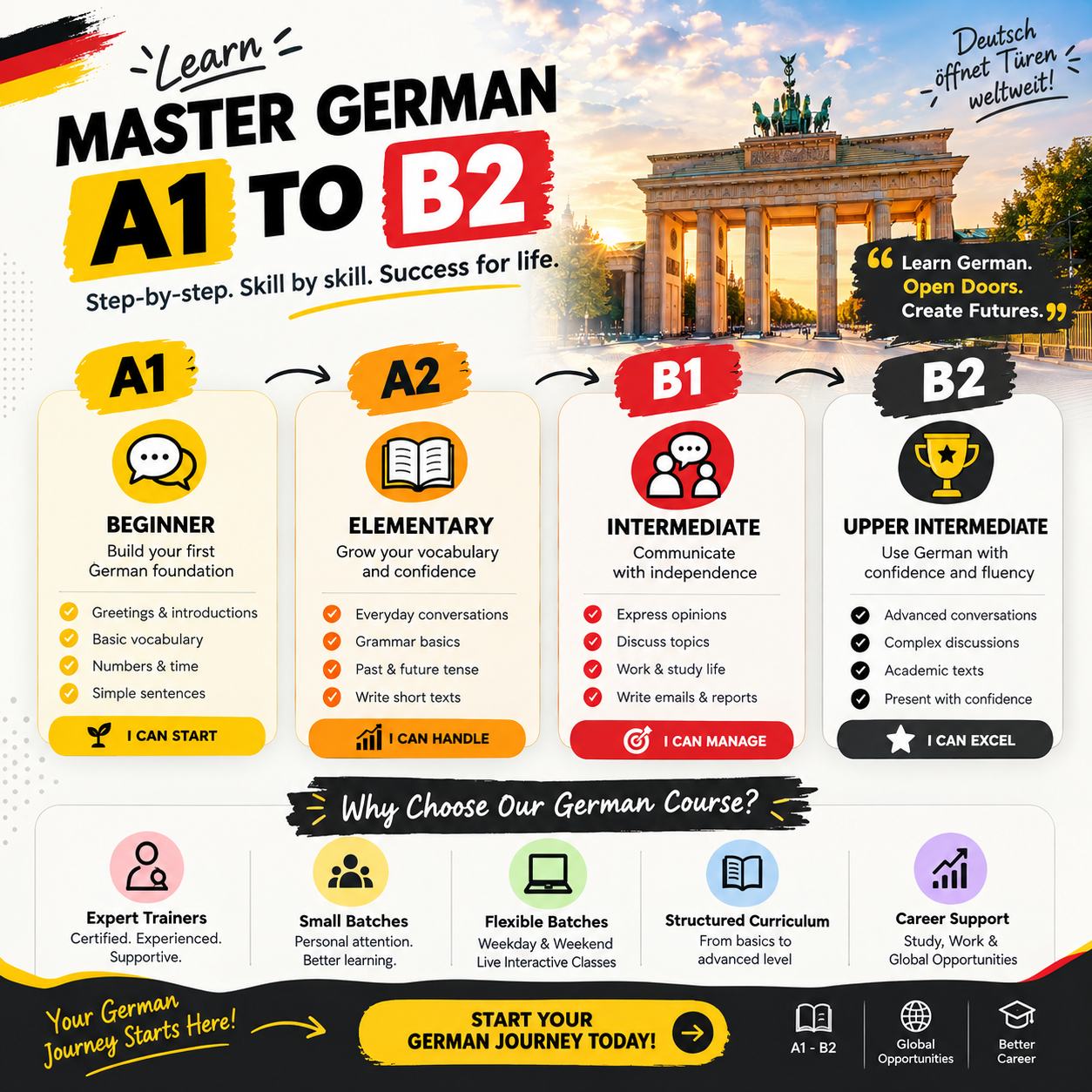
Reaching B2 in German is a different challenge from learning a few everyday phrases or understanding basic vocabulary. A German language course and self-study through apps, YouTube videos, and books are both common starting points, but they do not lead to the same outcome. Self-study can be useful for building vocabulary and developing familiarity with the language. However, B2 requires more than memorizing words or completing lessons on a screen. It requires independent communication, accurate grammar, regular speaking practice, feedback, and preparation for formal assessment. For learners aiming to use German in education or workplace settings, the learning method becomes especially important as the level increases.
What Self-Study Is Actually Good For
Self-study can be a practical way to begin learning German. Apps, videos, books, and online exercises make it possible to study whenever time is available. They can also help learners become comfortable with common vocabulary and basic sentence patterns before joining formal classes.
A learner can use self-study effectively for:
- Building basic German vocabulary
- Revising grammar rules independently
- Practising common phrases and expressions
- Improving reading comprehension
- Reviewing lessons between classes
- Becoming familiar with German pronunciation
Self-study is particularly useful at the early stages. A learner can practise A1 and A2 concepts repeatedly and move through familiar topics at a personal pace.
However, the benefits become less complete as the learner moves toward B1 and B2. Higher levels demand active communication rather than recognition of words and sentences.
Where Self-Study Usually Breaks Down
The biggest limitation of self-study is not access to information. There is plenty of German learning material available online. The problem is having a structured system that develops all four language skills consistently.
Common difficulties include:
- Limited opportunities for live speaking
- No teacher feedback on recurring mistakes
- Difficulty measuring actual language progress
- No clear progression from A1 through B2
- Limited exam-focused practice
- Difficulty developing spontaneous communication
A learner may understand a grammar explanation but still struggle to speak for several minutes about education, work, travel, or personal opinions. This gap between understanding and using the language becomes more noticeable at B1 and B2.
Self-study can therefore support the learning process, but it may not provide everything required to become an independent B2-level communicator.
What a Structured German Language Course Adds That Apps Cannot
A structured German language course provides a defined progression through A1, A2, B1, and B2. Instead of selecting unrelated lessons from different sources, learners follow a planned sequence that develops vocabulary, grammar, reading, listening, writing, and speaking together.
Speaking practice is particularly important. Live classes give learners opportunities to form sentences, answer questions, participate in conversations, and receive corrections. This type of interaction is difficult to reproduce through vocabulary apps or recorded videos alone.
Structured learning also provides a clearer route toward examinations. Course preparation typically includes Goethe-Zertifikat or OSD exam preparation, mock tests, and speaking practice. This helps learners understand not only the language but also the type of performance expected during certification.
For learners who need flexibility, an online German language course with certificate can combine structured instruction with the convenience of studying from home. Live online classes remove the need to travel while retaining interaction with instructors and other learners.
Self-Study vs a Structured Course: Side-by-Side Comparison
| Area | Self-Study | Structured German Language Course |
| Structure | Learner chooses materials and sequence | Planned progression from A1 to B2 |
| Speaking Practice | Often limited or irregular | Regular live speaking practice |
| Feedback | Usually self-correction | Instructor feedback and corrections |
| Exam Preparation | Must be arranged independently | Includes mock tests and exam-focused practice |
| Certification | No course completion certificate by itself | Completion certificate after each level |
| Time to Reach B2 | Varies significantly by learner and routine | Defined progression of about 10 months including exam preparation |
The comparison does not mean self-study has no value. It means that the two approaches serve different purposes. Self-study works well as a supporting method, while structured learning provides a complete framework for progressing toward B2.
Why B1 and B2 Specifically Are Hard to Reach Through Self-Study Alone
A1 and A2 mainly establish the foundation of German. At these stages, learners work with everyday vocabulary, basic grammar, simple conversations, and familiar situations.
B1 and B2 introduce a different requirement. Learners need to communicate independently in education or workplace settings, express opinions, explain ideas, understand more complex information, and respond without depending entirely on memorized sentences.
This is where regular speaking practice becomes essential. A learner may know the correct grammar but hesitate when forming an answer in real time. Without feedback, the same pronunciation, grammar, or sentence-structure mistakes can continue unnoticed.
A structured German language course creates repeated opportunities to practise these skills. The four-level progression covers A1 and A2 in about two months each, followed by approximately three months for B1 and three months for B2. The full journey is roughly 10 months, including exam preparation.
What an Online German Language Course with Certificate Actually Proves
A completion certificate from an online German language course with certificate generally confirms that the learner has completed a particular level of the course. It is different from an internationally recognized language examination certificate.
This distinction matters. A course completion certificate shows participation and completion at a specific level, while Goethe-Zertifikat or OSD certification assesses language ability through a formal examination.
A German language course online with certificate can therefore be useful as part of a broader learning and certification pathway. Live online classes provide structured instruction, while mock tests and speaking practice help learners prepare for the relevant examination.
The course progression covers A1, A2, B1, and B2. A completion certificate is awarded after each level, while exam preparation can help learners work toward formal Goethe or OSD certification.
Why German Language in India Is Increasingly Tied to Certification, Not Just Conversation
Learning German language in India can support several career and education pathways, but conversational ability alone may not always demonstrate the required level. Formal certification provides documented evidence of language proficiency when an institution, employer, or visa process requires it.
Goethe or OSD certification is internationally recognized and is often required for German university admissions and certain work visa categories. This makes examination preparation an important part of the learning journey for learners with academic or professional goals.
The career relevance of German also extends beyond studying in Germany. In India, potential career paths after learning German include German BPO or KPO Executive, Translator, Language Trainer, Customer Support, and Content Writer.
For these reasons, German language in India is increasingly approached as a skill that needs both practical communication ability and, where required, formal certification.
Learners in Other Cities: Chennai and Pune
The same self-study versus structured-learning comparison applies regardless of location. A learner searching for a German Language Course In Chennai may have access to online classes that make location less restrictive. The learner can attend live sessions while studying from home and continue independent revision between classes.
The same applies to someone considering a German Language Course In Pune. Online delivery can provide a structured learning schedule without requiring daily travel to a physical classroom.
For both Chennai and Pune learners, the important question is not simply where the course is delivered. The stronger question is whether the learning method provides progression, speaking practice, feedback, exam preparation, and a clear route from A1 to B2.
This makes online structured learning particularly practical for learners who need flexibility but still want regular interaction and guided progression.
Conclusion
Self-study can build vocabulary, reinforce grammar, and support regular revision. However, reaching B2 requires much more than completing app lessons or watching videos. Learners need structured progression, speaking practice, feedback, and exam preparation, particularly at B1 and B2.
The honest answer is that a German language course is more likely to provide the complete framework needed to reach B2, while self-study works best as a supporting tool. The strongest approach is structured learning combined with independent practice, followed by appropriate exam preparation.
For learners targeting B2, the next step is simple: choose a structured A1-to-B2 learning path and use self-study to strengthen the skills developed in class.