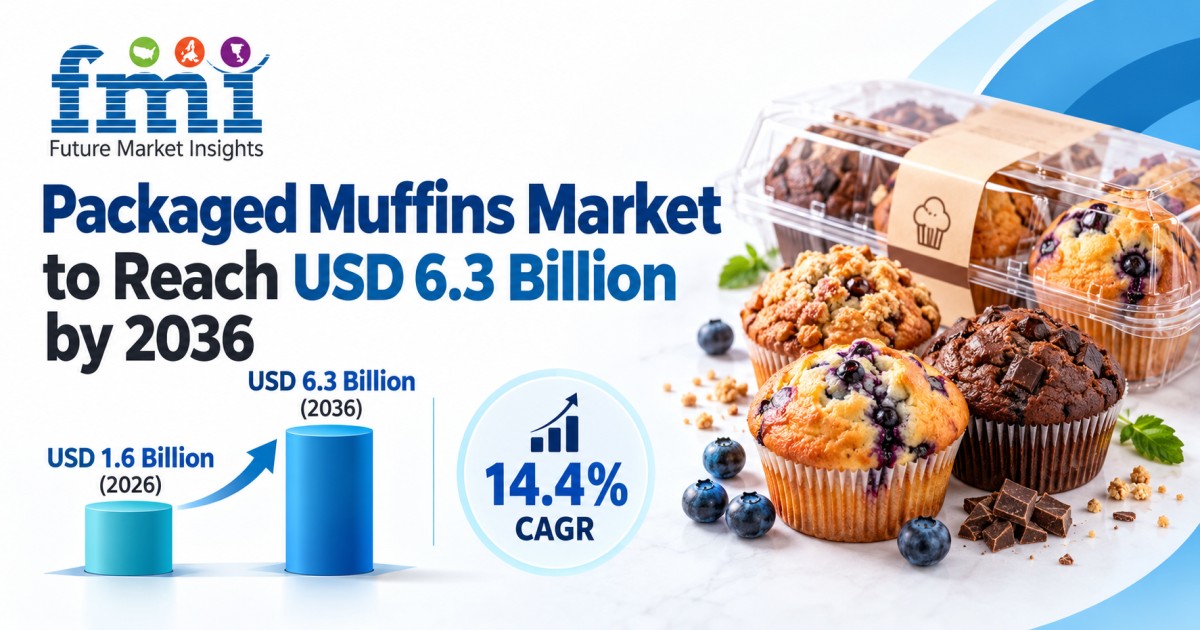
The global packaged muffins market is forecast to increase from USD 1.6 billion in 2026 to USD 6.3 billion by 2036, expanding at a 14.4% CAGR during the 2026–2036 forecast period, according to Future Market Insights. The market stood at USD 1.4 billion in 2025. Growth is being supported by the role of muffins as portable breakfast and snack products across retail and foodservice channels. Retail multipacks and foodservice formats provide suppliers with multiple routes to market, while fresh, frozen, and ambient formats help buyers manage different shelf-life and handling requirements.
Get detailed market forecasts, competitive benchmarking, and pricing trends:
https://www.futuremarketinsights.com/reports/sample/rep-gb-35635
Regional Segment Leaders
As this is a global packaged muffins market report, the segment analysis reflects demand across product type, claim / nature, format, packaging format, and sales channel categories.
- Blueberry & fruit — 32.0% of Product Type demand in 2026: Familiar fruit flavors work across breakfast, snack, full-size, and mini muffin occasions while fitting branded and private-label assortments.
- Conventional — 55.0% of Claim / Nature demand in 2026: Conventional recipes provide flexibility for balancing sweetness and moisture at mainstream price points and support high-volume retail and foodservice production.
- Fresh — 34.0% of Format demand in 2026: Fresh muffins benefit from immediate softness and freshness cues, while frozen and ambient formats compete through longer inventory windows and easier storage.
- Multipack — 32.0% of Packaging Format demand in 2026: Multipacks provide several portions at a clear unit price and support lunchboxes, household snacking, and repeat purchases.
- Supermarkets & hypermarkets — 38.0% of Sales Channel sales in 2026: Large-format grocery offers broad assortment visibility across fresh, frozen, and ambient muffins and supports planned breakfast, snacking, and take-home purchases.
Country-Level Performance
The report profiles eight countries, with a 2.2 percentage-point spread between the highest and lowest forecast CAGR.
- UAE | CAGR 15.6% (2026–2036) | Key drivers: Strong tourism and hotel demand increase opportunities for portable breakfast and foodservice bakery formats, while frozen and thaw-and-serve products help operators manage variable occupancy.
- Saudi Arabia | CAGR 15.3% (2026–2036) | Key drivers: Rapid growth in licensed hospitality facilities expands the institutional and hotel buyer base, creating opportunities for centrally purchased frozen muffin formats.
- South Korea | CAGR 15.0% (2026–2036) | Key drivers: High online and mobile food-shopping activity increases the importance of protective packaging, pack integrity, and e-commerce-ready muffin assortments.
- USA | CAGR 14.7% (2026–2036) | Key drivers: A large food-away-from-home economy supports both retail multipacks and frozen or ambient foodservice formats.
- Germany | CAGR 14.3% (2026–2036) | Key drivers: Established household spending on bread and cereal products creates a familiar bakery environment, while fruit and chocolate flavors can reduce trial barriers.
- UK | CAGR 14.0% (2026–2036) | Key drivers: Promotion restrictions for qualifying less-healthy products increase the importance of nutrition profiles, reformulation, pack formats, and merchandising strategy.
- France | CAGR 13.7% (2026–2036) | Key drivers: Take-home and hospitality demand provide opportunities, although value sensitivity makes visible product quality important for premium fruit and specialty formats.
- Japan | CAGR 13.4% (2026–2036) | Key drivers: Convenience-store growth supports single-portion muffin availability, while limited shelf space makes sales velocity, pack design, and freshness perception critical.
Regional Context
Packaged muffins benefit from their portability across breakfast, snack, retail, and foodservice occasions. The market provides suppliers with multiple routes to consumers through supermarkets, convenience stores, online channels, specialty bakeries, and foodservice distributors.
The product category is increasingly shaped by the balance between indulgent formulation, shelf life, pack economics, and nutrition-related merchandising restrictions. Fresh muffins appeal through soft texture and visible freshness, while frozen and ambient products provide longer holding periods and greater flexibility for foodservice operators.
Large-format retail remains important because supermarkets and hypermarkets can merchandise fresh, frozen, and ambient muffins together while allowing consumers to compare flavors, pack counts, and prices. Foodservice provides another growth route, particularly as operators seek ready-to-serve and thaw-and-serve products that reduce preparation requirements.
Nutrition-related regulation creates a key execution challenge. England's restrictions on promotions of qualifying less-healthy products can affect pack promotions and reformulation decisions. Suppliers therefore need to balance nutrition improvements with the softness, taste, shelf life, and price expected by consumers.
Competitive Landscape
The competitive landscape includes direct packaged muffin platforms, broader sweet-bakery businesses, and international bakery portfolios.
- Direct Packaged Muffin Platforms: Rich Products, Sara Lee Frozen Bakery, Mademoiselle Desserts, Finsbury Food Group, McKee Foods, and Hostess (The J.M. Smucker Co.) have direct muffin products or packaged muffin capabilities.
- Broader Sweet Bakery and Dessert Platforms: Dessert Holdings and Premier Foods bring wider sweet-bakery and dessert capabilities to the competitive landscape.
- International Sweet-Bakery Portfolios: Bauli and Dr. Oetker operate broader bakery portfolios across international markets.
Sara Lee Frozen Bakery scores highly across packaged muffin format breadth, retail and foodservice coverage, and nutrition/claim capability in the report's competitive benchmark.
Notable developments include Finsbury Food Group's February 2026 analysis of the out-of-home breakfast market, highlighting ready-to-serve bakery solutions and mini formats for time-pressed operators. In May 2026, Premier Foods introduced further Mr Kipling innovation, including selected four-pack formats, while Sara Lee Frozen Bakery expanded its Sweet Moments range with new single-serve desserts in September 2026.
Get the Complete Story — Read More About Our Latest Report
https://www.futuremarketinsights.com/reports/packaged-muffins-market
Analyst Perspective
“Soft texture and dependable shelf life will decide repeat purchases. Retailers need packs that protect margins while foodservice buyers need muffins that keep their quality after storage and handling.” — Nandini Roy Choudhury, Principal Consultant, Future Market Insights
About Future Market Insights (FMI)
Future Market Insights, Inc. (FMI) is an ESOMAR-certified, ISO 9001:2015 market research and consulting organization, trusted by Fortune 500 clients and global enterprises. With operations in the U.S., UK, India, and Dubai, FMI provides data-backed insights and strategic intelligence across 30+ industries and 1200 markets worldwide.
For Press & Corporate Inquiries
Rahul Singh AVP - Marketing and Growth Strategy
Future Market Insights, Inc.
+91 8600020075
For Sales: sales@futuremarketinsights.com
For Media: Rahul.singh@futuremarketinsights.com
For Web: https://www.futuremarketinsights.com/