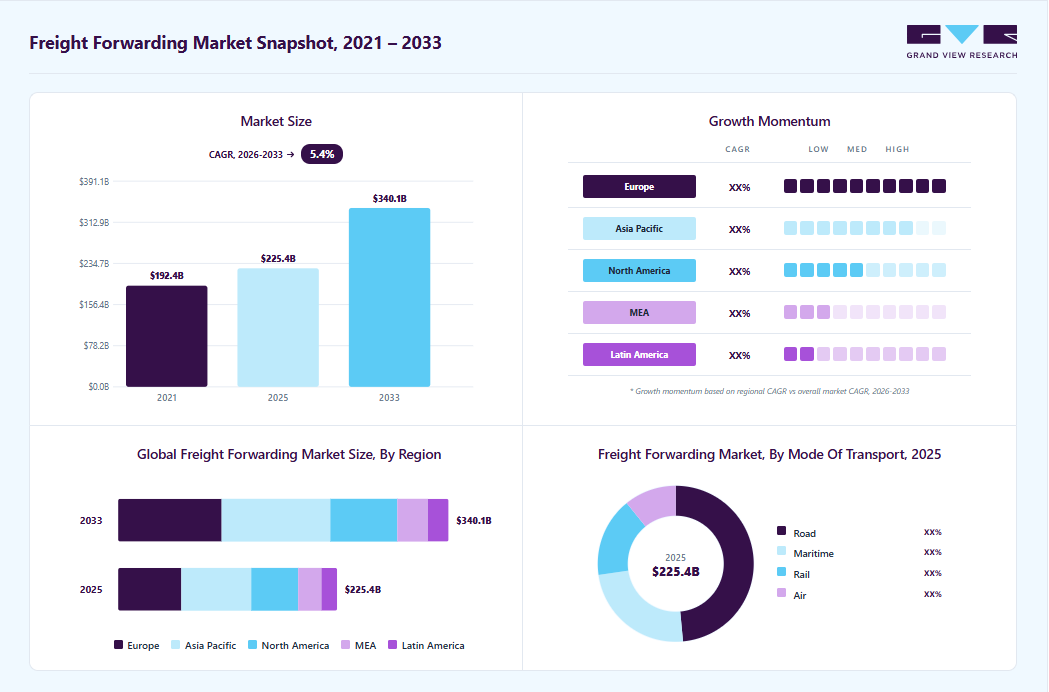
The movement of goods across increasingly complex supply chains is creating stronger demand for specialized logistics coordination. The freight forwarding market was valued at USD 225.4 billion in 2025 and is estimated to reach USD 235.2 billion in 2026. The market is projected to reach USD 340.1 billion by 2033, expanding at a CAGR of 5.4% from 2026 to 2033. Expanding international trade, e-commerce, specialized pharmaceutical logistics, and the adoption of digital freight management technologies are contributing to continued market development.
E-Commerce Is Increasing the Need for Flexible Freight Management
The rapid expansion of online retail has significantly changed freight forwarding requirements. E-commerce businesses source products from manufacturers across different countries and must coordinate transportation, customs procedures, warehousing, and delivery to customers.
Freight forwarders help businesses select appropriate transportation modes, manage cross-border documentation, and coordinate shipments from manufacturing facilities to distribution centers and final delivery points. Increasing expectations for faster fulfillment are also encouraging logistics providers to strengthen last-mile capabilities and develop more responsive supply chain networks.
Road Transport Maintains Its Strong Market Position
Road transportation accounted for 48.5% of market revenue in 2025, making it the leading mode of transport. Its accessibility and flexibility allow freight to reach a broad range of destinations, including locations that may be difficult to serve through other transportation modes.
Cost efficiency is another important factor supporting road freight, particularly for short- and medium-distance shipments. The mode is widely used for regional distribution and local deliveries where reliability and delivery speed are important.
Air freight, meanwhile, is expected to register the fastest growth, with a 6.2% CAGR during the forecast period. Its speed makes it particularly suitable for high-value, time-sensitive products and e-commerce shipments requiring rapid delivery.
B2B Logistics Remains Central While B2C Demand Expands
The B2B segment is expected to dominate the market in 2025 as businesses increasingly seek technology-enabled logistics solutions. Transportation management systems, real-time shipment tracking, and advanced analytics are helping companies improve visibility, optimize routes, and manage costs.
At the same time, the B2C segment is projected to grow at a 5.8% CAGR from 2026 to 2033. Demand for same-day and next-day delivery, combined with urbanization and the development of micro-fulfillment centers, is encouraging freight forwarding providers to adapt their services to individual consumers.
Digital Freight Platforms Are Transforming Service Delivery
Technology is becoming one of the defining elements of modern freight forwarding. Cloud-based platforms, artificial intelligence, Internet of Things connectivity, predictive analytics, blockchain-based documentation, and real-time tracking are helping logistics providers improve transparency and operational efficiency.
The value-added services segment is expected to record the fastest CAGR from 2026 to 2033. These services increasingly include customized logistics, temperature-controlled transportation, product assembly, kitting, predictive analytics, and enhanced shipment visibility.
Digital trade facilitation and electronic documentation are also creating opportunities by reducing administrative complexity and helping cargo move through customs processes more efficiently.
Pharmaceutical Logistics Is Creating Specialized Demand
The increasing movement of pharmaceuticals, biologics, and vaccines is creating demand for specialized freight forwarding capabilities. These products require controlled transportation environments, precise temperature management, regulatory compliance, and reliable multimodal coordination.
The experience of large-scale vaccine distribution reinforced the importance of cold-chain logistics and time-sensitive transportation. As pharmaceutical supply chains become more complex, freight forwarders with specialized handling and compliance expertise can play an increasingly important role in healthcare logistics.
Manufacturing and Retail Are Important Growth Engines
Industrial and manufacturing applications dominated the market in 2025. Manufacturers depend on freight forwarders to coordinate raw-material procurement, production-related shipments, and finished-product distribution. Just-in-Time manufacturing further increases the importance of punctual and reliable transportation.
Retail and e-commerce, however, are expected to experience the fastest application growth during the forecast period. Increasing online shopping is creating greater demand for adaptable freight networks, technology-enabled last-mile delivery, and logistics partnerships capable of handling fluctuating order volumes.
Infrastructure Disruptions Remain a Major Challenge
Freight forwarding providers remain exposed to port congestion, rail terminal bottlenecks, trucking constraints, labor shortages, modal imbalances, fluctuating freight rates, and broader transportation disruptions. These conditions can increase costs and create uncertainty around delivery schedules.
Such challenges are encouraging companies to diversify transportation routes, improve supply chain visibility, strengthen multimodal capabilities, and invest in technologies that support faster decision-making.
Competition Is Moving Toward Digital and Integrated Logistics
Companies are investing in digital freight platforms, automated documentation, real-time visibility, AI-enabled route optimization, cloud logistics systems, and expanded transportation networks. Recent developments, including expanded air freight capacity, new cargo facilities, consolidation services, and healthcare logistics acquisitions, demonstrate how providers are positioning themselves for increasingly specialized and technology-driven freight requirements.
FAQs
What is driving the growth of the freight forwarding market?
E-commerce expansion, international trade, pharmaceutical logistics, demand for faster delivery, digital freight platforms, supply chain visibility, and specialized transportation requirements are key factors supporting market growth.
Which transportation mode leads the freight forwarding market?
Road transportation led the market with a 48.5% revenue share in 2025, while air transportation is expected to grow at the fastest rate, with a 6.2% CAGR during the forecast period.
Key Freight Forwarding Companies:
- Kuehne+Nagel
- Deutsche Post AG
- DB Schenker
- Expeditors International of Washington, Inc.
About us:
Grand View Research, a market research and consulting company, provides syndicated research reports, customized research reports, and consulting services. Grand View Research database is used by the world's renowned academic institutions and Fortune 500 companies to understand the global and regional business environment. Our database features thousands of statistics and in-depth analysis on 46 industries in 25 major countries worldwide.