Grid Congestion Is Creating New Opportunities for European Flexibility Platforms
Grid congestion has become an important consideration in Europe's energy transition. Renewable generation projects, electric vehicle charging infrastructure, industrial electrification, and distributed batteries are increasing demand for network capacity. Yet electricity infrastructure cannot always expand quickly enough to accommodate every connection and changing power flow.
Flexibility platforms offer an additional approach to managing these pressures. By coordinating available energy resources, they can help operators respond to localized constraints, improve network utilization, and potentially reduce the need for immediate reinforcement in suitable locations.
Understanding the Congestion Challenge
Electricity networks have physical limits determined by factors such as conductor capacity, voltage conditions, transformer ratings, and operational security requirements. When electricity generation or demand approaches these limits, operators must take corrective action.
Renewable generation can create congestion when production exceeds the capacity available to transport electricity from a particular location. Electrification can produce similar challenges when electric vehicle charging, heat pumps, or industrial loads increase demand within constrained distribution networks.
Network reinforcement remains essential in many circumstances. However, construction can require extensive planning, permitting, equipment procurement, and investment. Flexibility can provide another tool for addressing selected constraints while longer-term infrastructure projects progress.
How DERMS and VPP Platforms Help
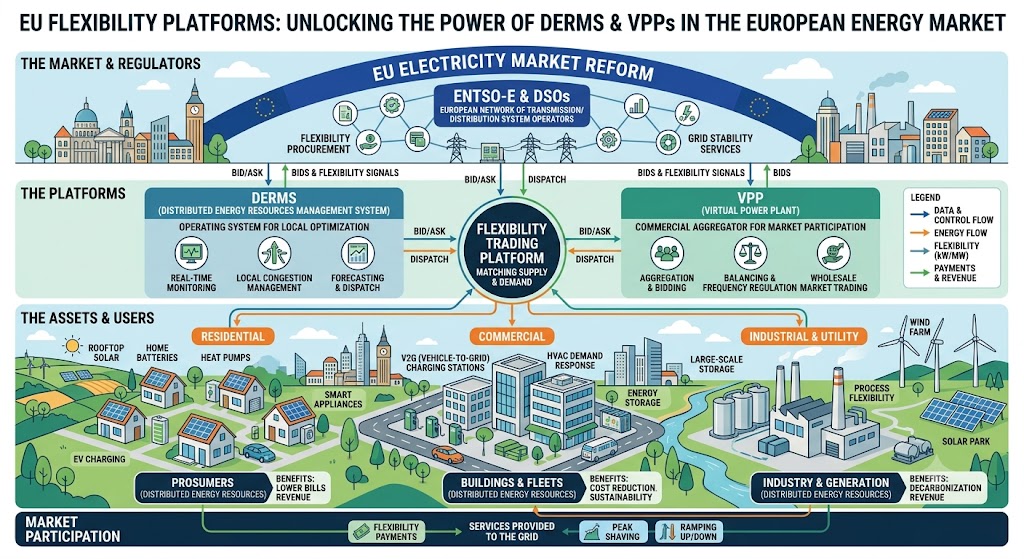
DERMS platforms can combine network information with distributed asset data to identify available flexibility and support distribution system operations.
When a local constraint emerges, eligible batteries may change charging schedules, controllable demand may be shifted, or distributed generation may be adjusted within applicable limits. The appropriate response depends on network conditions, asset availability, customer agreements, and regulatory requirements.
VPP platforms can aggregate resources across multiple locations and coordinate their participation in commercial flexibility programs. Their role may include forecasting availability, communicating dispatch instructions, and measuring delivered performance.
Effective coordination requires accurate network information and clear communication between distribution operators, aggregators, and participating asset owners.
Commercial Opportunities and Emerging Business Models
Congestion management creates opportunities for flexibility service providers, energy software companies, aggregators, battery developers, and engineering firms.
Potential commercial models include flexibility procurement contracts, demand response arrangements, software subscriptions, managed optimization, and payments for eligible services. The availability and profitability of these mechanisms differ between countries and market structures.
For businesses examining EU Flexibility Platforms (DERMS/VPP) Market Report, understanding local market design is essential. A technically capable platform cannot generate attractive returns unless its services can be procured, compensated, or translated into identifiable customer savings.
Providers must also evaluate the cost of recruiting participants, integrating assets, verifying performance, and maintaining reliable operations.
Investment Considerations and Implementation Risks
Investors should assess whether a flexibility provider has access to suitable resources in locations where network constraints create meaningful demand. Portfolio size alone may not determine commercial value because flexibility is often location specific.
Other considerations include contract duration, asset availability, dispatch accuracy, customer retention, regulatory exposure, and software integration costs.
Distribution operators may be cautious about relying on third-party flexibility without robust verification and contingency arrangements. Providers therefore need transparent measurement systems, dependable communications, and clear operational responsibilities.
Data quality and interoperability also influence implementation economics. Standardized interfaces can simplify integration, while fragmented systems may increase deployment costs and slow expansion.
Future Outlook for Congestion Management
Europe's transition toward electrified transport, heating, and industry is expected to increase the importance of efficient network management. The combination of distributed generation and growing electricity demand will require coordinated investment in physical infrastructure and digital capabilities.
Flexibility platforms can contribute by helping operators identify available resources and manage certain constraints more dynamically. They will not replace necessary grid upgrades, but can complement reinforcement by improving the use of existing capacity.
Market development will depend on regulatory frameworks, procurement mechanisms, customer participation, and demonstrated operational benefits.
Companies that combine location-aware optimization, strong asset aggregation, reliable delivery, and transparent commercial arrangements may be positioned to serve this emerging requirement. As distribution networks become more complex, flexibility could become an increasingly valuable resource for supporting Europe's energy transition.