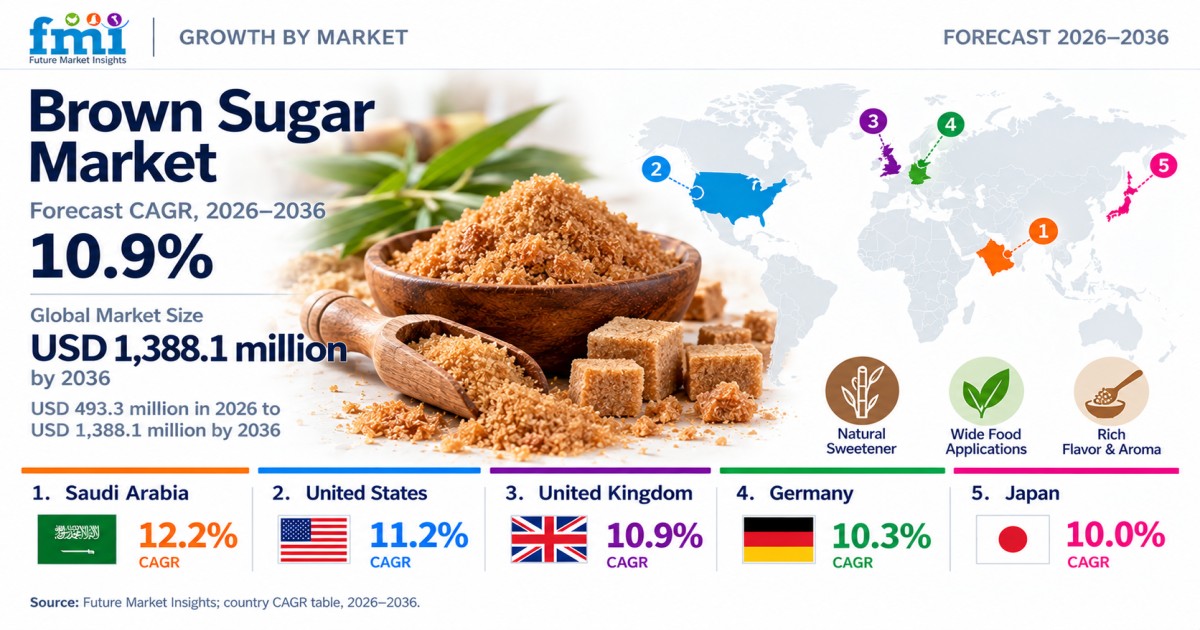
The global brown sugar market is projected to grow from USD 493.3 million in 2026 to USD 1,388.1 million by 2036, registering a compound annual growth rate (CAGR) of 10.9%, according to Future Market Insights (FMI). The market is forecast to add USD 894.8 million in revenue over the decade.
Get detailed market forecasts, competitive benchmarking, and pricing trends:
https://www.futuremarketinsights.com/reports/sample/rep-gb-35796
Industrial bakeries remain an important source of demand because brown sugar contributes color, moisture and molasses flavor to baked products. Fine grades, powder and dry formats, and bread and rolls account for substantial portions of their respective market segments. At the same time, café beverages are creating additional opportunities for suppliers of brown sugar syrups.
Bakery recipes support repeat purchasing
Brown sugar's functional properties help maintain demand from commercial bakeries. Ragus Sugars reported in August 2024 that dark soft brown sugar retains more moisture than white granulated sugar. Ingredion also noted in November 2025 that sugar contributes bulk, browning and moisture retention in baked products.
These properties matter to manufacturers working with approved recipes and established production processes. Changing the sugar grade can require adjustments to dough, batter, texture and finished-product performance. As a result, bakeries have an incentive to maintain consistent specifications when ordering ingredients for recurring production runs.
Where growth is fastest
FMI's country-level forecasts indicate that Saudi Arabia will record the fastest growth among the five profiled markets between 2026 and 2036.
- Saudi Arabia — 12.2% CAGR: Café openings are creating opportunities for brown sugar syrups and bakery ingredients. The Ministry of Commerce had issued more than 61,000 café business licences by August 2025, according to the source cited by FMI.
- United States — 11.2% CAGR: Established cane-refining operations and demand from large bakery groups support market expansion. Refiners must also account for raw sugar import requirements and changing product-labeling expectations.
- United Kingdom — 10.9% CAGR: A smaller domestic sugar beet crop is increasing the importance of imported sugar supplies. FMI reports that the 2025 UK beet crop fell 7.1% to 7.3 million tonnes.
- Germany — 10.3% CAGR: Craft bakeries and efforts to improve beet-processing efficiency support demand. Suppliers must balance ingredient quality with the cost requirements of bakery customers.
- Japan — 10.0% CAGR: Imported sugar remains important to domestic supply. FMI reports that Japan imported 1.144 million tonnes of sugar in sugar year 2025, compared with domestic output of 648,000 tonnes.
What leads the market
FMI identifies five leading segments across the brown sugar market's product and sales classifications for 2026.
- Fine grades — 40% of type sales: Smaller crystals can mix evenly into dough and batter, supporting their use in industrial bakery production.
- Powder and dry formats — 51% of form revenue: Established bag and silo handling systems make dry formats practical for bakeries that weigh sugar alongside other ingredients.
- Bread and rolls — 29% of application revenue: Recurring production schedules and established recipes support repeat purchasing from commercial bread manufacturers.
- Conventional brown sugar — 49% of claim sales: Many bakery buyers prioritize grade specifications, supply consistency and delivered price.
- Direct supply to industrial bakeries — 50% of channel sales: Large production facilities often purchase through direct contracts covering volume, specifications and delivery schedules.
The hurdle: sugar-reduction policies and raw material costs
Brown sugar suppliers face two related pressures: managing the cost of raw materials and responding to policies that encourage lower sugar consumption.
Saudi Arabia introduced a tiered excise structure for sweetened drinks effective January 1, 2026. Under the reported rules, drinks containing 5 to 7.99 grams of sugar per 100 millilitres are subject to SAR 0.79 per litre, while drinks containing at least 8 grams are subject to SAR 1.09 per litre. These thresholds create an incentive for beverage manufacturers to review sugar content per serving.
In England, restrictions on volume promotions for foods high in fat, salt or sugar took effect on October 1, 2025, for businesses covered by the rules. Such measures can influence how food manufacturers promote products and manage recipes.
Recent developments and industry investment
Developments in sugar refining and processing highlight efforts to improve operational efficiency and maintain supply capacity.
- August 14, 2026: Nordzucker announced a new extraction tower at its Schladen factory in Germany, designed to improve sugar-production efficiency. The facility handles approximately 10,500 tonnes of sugar beet per day.
- October 27, 2025: Südzucker announced the groundbreaking for a Bio Energy Hub at Zeitz, Germany, planned to use beet pulp from autumn 2027.
- June 20, 2025: ASR Group announced changes to its US operational network, including continuous operations at its Chalmette and Baltimore refineries and the planned closure of its Yonkers refinery by the end of 2025.
These developments concern broader sugar production and refining capabilities. They should not be interpreted as evidence of a specific change in brown sugar market share.
FMI profiles the following companies in the market: Südzucker, Nordzucker, ASR Group, Ragus Sugars, Cargill, Archer Daniels Midland Company (ADM), Tate & Lyle, Ingredion, Roquette and BENEO.
Analyst perspective
“Bakeries will keep buying brown sugar from refiners that deliver the same color and moisture in every load. Over the next ten years, suppliers serving both bread plants and café syrup makers from secure raw sugar will take most of the new bakery and café contracts.” — Nandini Roy Choudhury, Principal Consultant, Future Market Insights.
What this means for food manufacturers and ingredient buyers
- Standardize specifications for recurring bakery orders. Establish clear requirements for crystal size, moisture, sucrose content and product consistency. Test any proposed grade change against the existing recipe before making a full-scale switch.
- Evaluate suppliers on supply reliability as well as price. Compare raw sugar sourcing, refining capacity, delivery schedules and contingency arrangements. These factors matter when production depends on uninterrupted access to a specified grade.
- Assess opportunities beyond traditional bakery applications. Café syrups and foodservice formats can create additional routes to market. Suppliers should evaluate pack sizes, handling requirements and customer demand before investing in new liquid or syrup formats.
For detailed forecasts, segment shares, country-level growth rates and competitive analysis, read Future Market Insights' Brown Sugar Market Report: https://www.futuremarketinsights.com/reports/brown-sugar-market
About Future Market Insights (FMI)
Future Market Insights, Inc. (FMI) is an ESOMAR-certified, ISO 9001:2015 market research and consulting organization, trusted by Fortune 500 clients and global enterprises. With operations in the U.S., UK, India, and Dubai, FMI provides data-backed insights and strategic intelligence across 30+ industries and 1200 markets worldwide.
For Press & Corporate Inquiries
Rahul Singh AVP - Marketing and Growth Strategy
Future Market Insights, Inc.
+91 8600020075
For Sales: sales@futuremarketinsights.com
For Media: Rahul.singh@futuremarketinsights.com
For Web: https://www.futuremarketinsights.com/