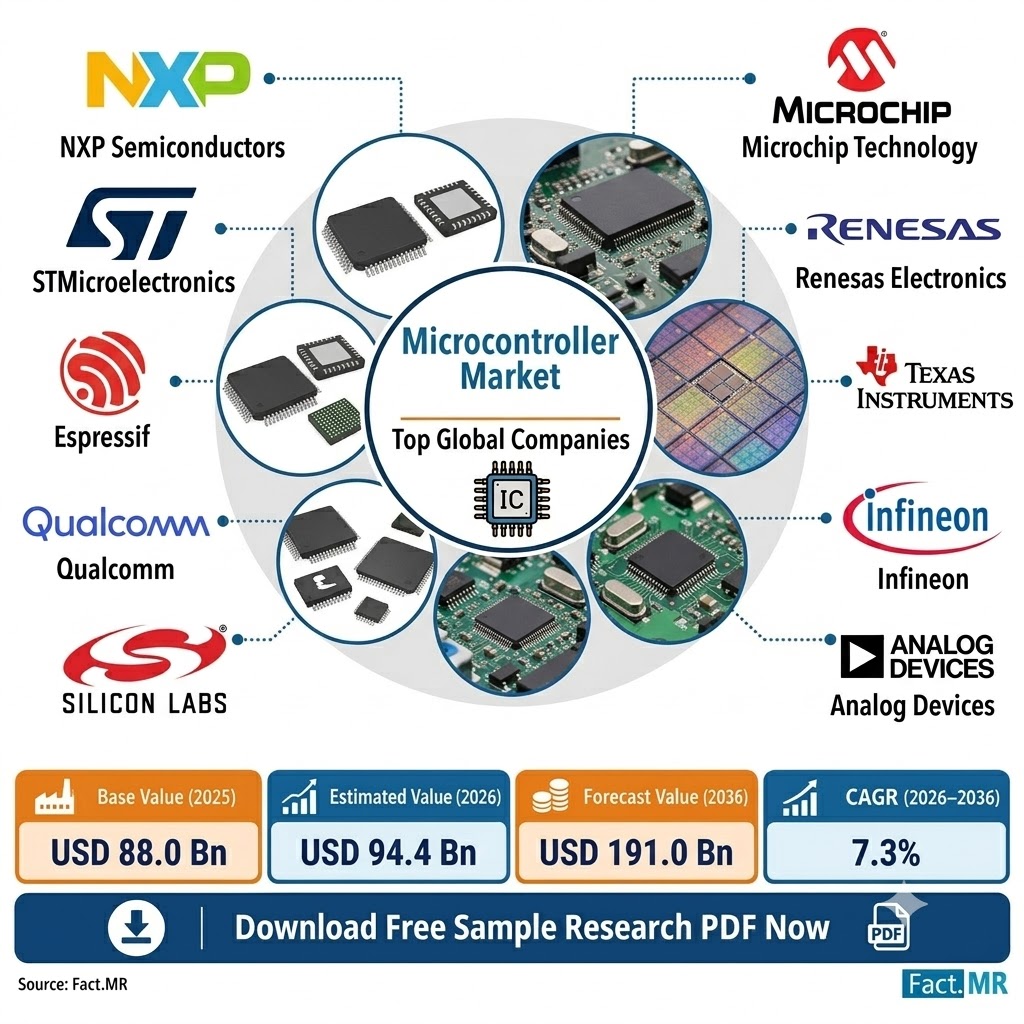
The global microcontroller market is projected to grow from USD 94.4 billion in 2026 to USD 191.0 billion by 2036, expanding at a compound annual growth rate (CAGR) of 7.3%, according to Fact.MR. The market is expected to create an incremental opportunity of USD 96.6 billion over the 2026–2036 forecast period, supported by rising electronic content in electric vehicles, industrial automation and connected devices.
Automotive electrification is a major source of additional demand. Electric vehicle platforms require three to five times more microcontroller content per vehicle than conventional internal combustion engine vehicles, according to Fact.MR. Powertrain control units, battery management systems, advanced driver assistance systems and body electronics all require dedicated microcontrollers. At the same time, manufacturers of connected products are seeking components that combine energy efficiency, connectivity and security.
Get detailed market forecasts, competitive benchmarking, and pricing trends: https://www.factmr.com/connectus/sample?flag=S&rep_id=4556
The market is also responding to procurement concerns following semiconductor supply disruptions between 2021 and 2023. Buyers are placing greater emphasis on supply availability, product qualification and sourcing resilience. For suppliers, these requirements create opportunities in automotive-grade components, secure connected devices and microcontrollers capable of running machine-learning workloads locally.
Where growth is fastest
Fact.MR's country-level forecasts identify North America as an important source of demand growth, while automotive and industrial applications support opportunities across Europe.
- USA — CAGR 8.5%: The fastest-growing country in the study. Electric vehicle production, industrial automation, Internet of Things (IoT) deployments and defense electronics support demand. Investment associated with the CHIPS Act is also identified as a factor supporting domestic semiconductor manufacturing capacity.
- Mexico — CAGR 8.2%: Nearshoring of electronics and automotive manufacturing, expanding electric vehicle component production and domestic electronics assembly support market growth. Its position in North American manufacturing and USMCA trade dynamics adds to the opportunity.
- Germany — CAGR 7.5%: Automotive electrification, Industrie 4.0 initiatives and industrial automation support demand for automotive-grade and industrial microcontrollers.
- France — CAGR 7.1%: Automotive electronics, aerospace and defense applications, and industrial modernization support demand for higher-specification components. Fact.MR also identifies STMicroelectronics' domestic manufacturing presence as a regional factor.
- United Kingdom — CAGR 6.9%: IoT development, automotive electronics and industrial automation are expected to support consumption, alongside the country's semiconductor design ecosystem.
What leads the market
Three established product characteristics account for substantial shares of the market in 2026, according to Fact.MR.
- 32-bit microcontrollers — 54.8% of product share: The leading product category, supported by demand across automotive, industrial and consumer applications.
- RISC architecture — 61.3% of architecture share: The largest architecture segment in the forecast's base year, reflecting its established position across major end-use applications.
- Embedded flash memory microcontrollers — 68.7% of memory share: The leading memory category, serving applications that require program storage within the microcontroller.
Low-power microcontrollers are also identified as an important technology category for medium-term growth as application requirements evolve. In connected devices, demand for hardware security features—including secure boot, cryptographic accelerators and hardware security modules—is creating further opportunities.
The hurdle
Price competition and supply-chain uncertainty remain important constraints for microcontroller manufacturers. Cost-sensitive customers can put pressure on margins in entry-level segments, while concentrated supply chains and material availability can complicate procurement. Regional compliance requirements and differences in product specifications may also raise market-entry costs.
For buyers, the challenge is to balance component price with long-term availability, qualification requirements, security features and total cost of ownership. For suppliers, the report points to opportunities beyond commodity products, particularly where application-specific performance, connectivity or security can differentiate a design.
Recent developments and industry investment
Fact.MR identifies the following developments in its report:
- NXP Semiconductors — 2025: The report describes a product launch involving automotive-grade microcontrollers with integrated neural processing units for in-vehicle edge AI applications, targeting advanced driver assistance, cabin monitoring and predictive maintenance.
- STMicroelectronics — 2025: The report describes an expansion of European microcontroller fabrication capacity within the European Chips Act investment framework, intended to support automotive and industrial demand.
- Renesas Electronics — 2026: The report describes a technology partnership to develop security-certified microcontrollers for industrial IoT applications, integrating hardware security modules with IEC 62443 compliance.
The report profiles NXP Semiconductors, STMicroelectronics, Microchip Technology, Renesas Electronics, Texas Instruments, Infineon, Analog Devices, Silicon Labs, Qualcomm and Espressif. Competition is shaped by product portfolio breadth, software ecosystems, application engineering support and design-in relationships established early in product development.
Analyst opinion
Shambhu Nath Jha, Principal Consultant at Fact.MR, says:
“The microcontroller market is undergoing a structural demand expansion driven by automotive electrification, IoT proliferation, and edge computing requirements that will more than double the market by 2036. The competitive landscape is consolidating around vendors that can deliver automotive-grade qualification, integrated security, wireless connectivity, and AI inference capability within a single MCU platform. Companies that invest across these four capability pillars will capture the highest-growth design sockets, while those limited to commodity 8-bit and 16-bit products will see their addressable market steadily contract.”
What this means for electronics manufacturers, OEMs and procurement teams
- Review microcontroller requirements early in product design. Assess processing performance, power consumption, connectivity and security needs before selecting components. Early qualification can help align component choices with the product's expected operating requirements and production plans.
- Build sourcing plans around availability as well as price. Evaluate supplier concentration, product qualification requirements and the availability of suitable alternatives. The supply disruptions experienced between 2021 and 2023 underline the importance of assessing procurement exposure alongside component cost.
- Evaluate opportunities in secure and edge-AI-enabled devices. For connected automotive, industrial and consumer products, compare the benefits of integrated security and local machine-learning inference against cost, power and application constraints. The report identifies these capabilities as potential sources of product differentiation, rather than requirements for every application.
Top Trending Reports:
Autonomous Firefighting Drones Market
About Fact.MR
Fact.MR is a market research and consulting firm that provides market intelligence across industrial goods, automotive, technology, chemicals and materials, consumer goods, healthcare, food and beverage, and other sectors. Its research combines secondary sources, primary interviews, market modelling and validation to assess industry demand, competitive positioning and growth opportunities.