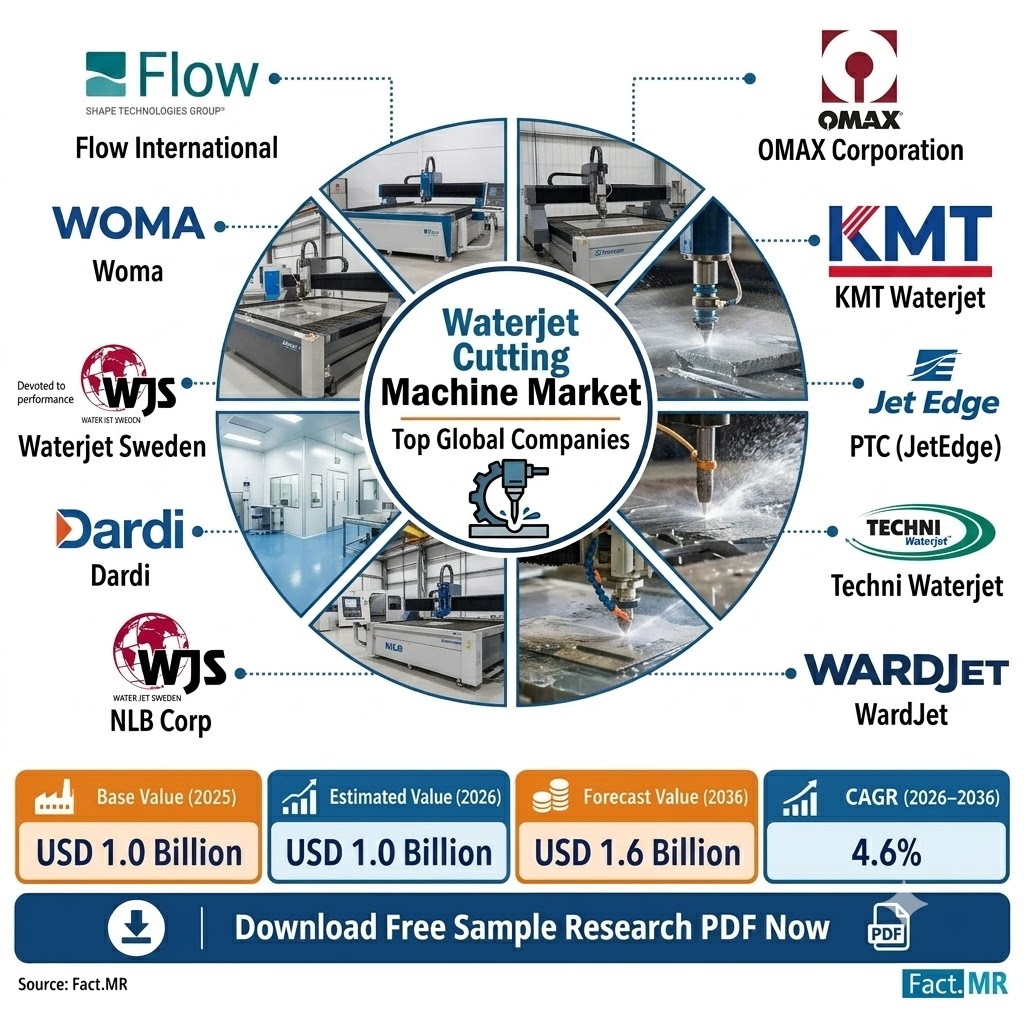
The global waterjet cutting machine market is projected to grow from USD 1.05 billion in 2026 to USD 1.64 billion by 2036, expanding at a compound annual growth rate (CAGR) of 4.6%, according to Fact.MR. The market is expected to generate an incremental opportunity of USD 590 million over the forecast period. Metal cutting will remain the largest application, accounting for 54.2% of the market's application segment in 2026.
Demand is being shaped by manufacturers' need to process metals, composites and other materials with greater precision. Automotive production, aerospace component manufacturing and industrial fabrication are important end-use areas. Equipment buyers are also assessing how cutting machines integrate with computer-aided design and manufacturing software, automated production processes and maintenance systems.
Get detailed market forecasts, competitive benchmarking, and pricing trends: https://www.factmr.com/connectus/sample?flag=S&rep_id=4564
Precision manufacturing is changing equipment requirements
Waterjet cutting equipment is increasingly being positioned as part of an integrated manufacturing system rather than as a standalone machine. Fact.MR identifies computer numerical control (CNC), multi-axis cutting, cutting-path optimization and predictive maintenance as important areas of technological development.
The report notes that computer-aided design and manufacturing (CAD/CAM) integration can reduce setup time by 40% to 60% compared with manual programming. This capability gives fabrication businesses a reason to assess software integration alongside cutting accuracy, machine specifications and operating costs when evaluating new equipment.
Aerospace manufacturing presents another opportunity. Manufacturers use waterjet cutting to process carbon fiber reinforced polymer (CFRP) and titanium components in applications where conventional machining can create delamination or heat-related damage. The report also identifies price pressure in entry-level equipment, supply-chain concentration and differences in regional specifications as constraints on market participants.
Where growth is fastest
Fact.MR's country-level forecasts identify Mexico and Germany as the fastest-growing markets among the five countries profiled. Their growth rates reflect different manufacturing requirements and investment conditions.
- Mexico — CAGR of 4.9% through 2036. Nearshoring in automotive and aerospace manufacturing, expanding metalworking capacity and investment in precision fabrication facilities are expected to support equipment demand.
- Germany — CAGR of 4.6%. Automotive fabrication, aerospace component processing, and stone and glass cutting applications support demand. Buyers also prioritize five-axis capabilities, energy efficiency and automation integration.
- France — CAGR of 4.3%. Aerospace manufacturing, automotive component production and industrial fabrication are expected to sustain demand for precision and multi-axis systems.
- United Kingdom — CAGR of 4.1%. Aerospace component processing, precision engineering and stone cutting for construction and architectural applications support the market.
- South Korea — CAGR of 4.0%. Automotive and electronics manufacturing, along with shipbuilding-related metal fabrication, supports demand for high-speed and high-precision systems.
For suppliers, these forecasts point to different commercial priorities. Mexico's nearshoring-related manufacturing investment creates opportunities to serve expanding production facilities, while Germany and France offer demand linked to established automotive and aerospace manufacturing. In South Korea, equipment specifications must address the requirements of automotive, electronics and heavy-metal fabrication operations.
What leads the market
Three segments account for significant shares of the market in Fact.MR's 2026 estimates.
- Abrasive waterjet cutting machines — 49.5% of product share. This is the leading product category, supported by applications across major manufacturing and fabrication end uses.
- High-pressure pumps — 31.8% of component share. Pump performance and reliability are important considerations for equipment manufacturers and buyers evaluating operating requirements and system specifications.
- Five-axis waterjet cutting — 28.6% of technology share. Multi-axis capabilities support complex cutting requirements and precision fabrication applications.
Metal cutting accounts for 54.2% of the application segment in 2026. The automotive industry represents 29% in the report's end-use analysis, although the supplied market summary does not explicitly identify the denominator for this percentage.
The report also identifies high-pressure systems as an important area as specifications and application requirements evolve. These segment shares describe different parts of the market and should not be added together.
The hurdle: Cost pressure and procurement uncertainty
Equipment suppliers face margin pressure from lower-priced alternatives and cost-sensitive buyers, particularly in entry-level segments. Competition is intensifying as Chinese manufacturers offer competitively priced machines with improving technical specifications.
Supply-chain concentration and material availability can also create procurement uncertainty in selected product categories. Differences in regional specifications and compliance requirements add complexity for manufacturers seeking to expand into new markets.
For buyers, the practical challenge is to compare total cost of ownership rather than purchase price alone. Pump reliability, maintenance requirements, software compatibility, service coverage and expected machine utilization all affect the value of an equipment investment.
Industry investment and recent developments
Fact.MR identifies three company developments relevant to equipment capability, software integration and market access. The report provides years but does not specify the months of these announcements.
- Flow International — Ultra-high-pressure system, 2025. The report states that the company introduced a waterjet system operating above 90,000 PSI for aerospace and advanced-material applications, including precision cutting of composites, titanium and multi-material stacks.
- OMAX Corporation — Intelli-MAX software upgrade, 2025. OMAX released an upgraded version of its Intelli-MAX software platform with enhanced nesting optimization, real-time cutting analytics and predictive maintenance integration.
- Techni Waterjet — European distribution expansion, 2026. The company expanded its European distribution and service network to strengthen coverage in Germany, France and the United Kingdom.
The report profiles the following companies in the global waterjet cutting machine market:
Flow International, OMAX Corporation, KMT Waterjet, PTC (JetEdge), Techni Waterjet, WardJet, NLB Corp, Dardi, Waterjet Sweden and Woma.
Competition spans pump technology, automation, software integration, pricing and service networks. Suppliers offering integrated CAD/CAM capabilities, predictive maintenance and multi-axis cutting systems are positioned to compete for customers with more demanding fabrication requirements. Service availability and access to replacement parts are also relevant considerations for buyers seeking to maintain production uptime.
Analyst perspective
Shambhu Nath Jha, Principal Consultant at Fact.MR, said: “The waterjet cutting machine market is transitioning from a general-purpose cutting tool category into a precision manufacturing platform where software intelligence, multi-axis capability, and total cost management define competitive positioning. Buyers are no longer purchasing waterjet machines as standalone equipment. They are investing in cutting systems that integrate with their digital manufacturing workflows, from CAD design through quality inspection. Vendors that combine reliable hardware with strong software ecosystems and responsive service networks will capture the highest-value fabrication accounts, while hardware-only suppliers face increasing price pressure from Asian competitors.”
What this means for equipment buyers
- Evaluate complete operating costs before purchasing. Compare machine pricing with pump maintenance, abrasive consumption, replacement parts, service access and expected utilization. This is particularly important for buyers in price-sensitive segments, where a lower initial price may not reflect the full cost of operating the system.
- Match machine specifications to production requirements. Automotive, aerospace and general fabrication operations have different material and cutting needs. Buyers should assess whether abrasive or pure waterjet technology, high-pressure configurations and multi-axis capabilities match their planned applications and production volumes.
- Include software and service support in supplier evaluations. Assess CAD/CAM compatibility, nesting optimization, maintenance monitoring and the availability of technical support. For manufacturers expanding production in Mexico or investing in precision fabrication in Europe, these factors can help determine whether a system fits the facility's operational requirements.
Report details
Fact.MR's Waterjet Cutting Machine Market report examines global and regional market size and forecasts from 2026 to 2036. Coverage includes product, component, technology, application, end use, pressure range, regional demand, competitive positioning and key market drivers and constraints.
Top Trending Reports:
Bottled Water Packaging Market
Ultrasound Probe Disinfection Market
About Fact MR
Fact MR is an ESOMAR-certified market research and consulting firm headquartered in Delaware, USA, with offices in the United Kingdom, the United Arab Emirates and India. FMI delivers syndicated and custom research across food and beverage, healthcare, chemicals, technology, packaging, consumer goods and industrial sectors.