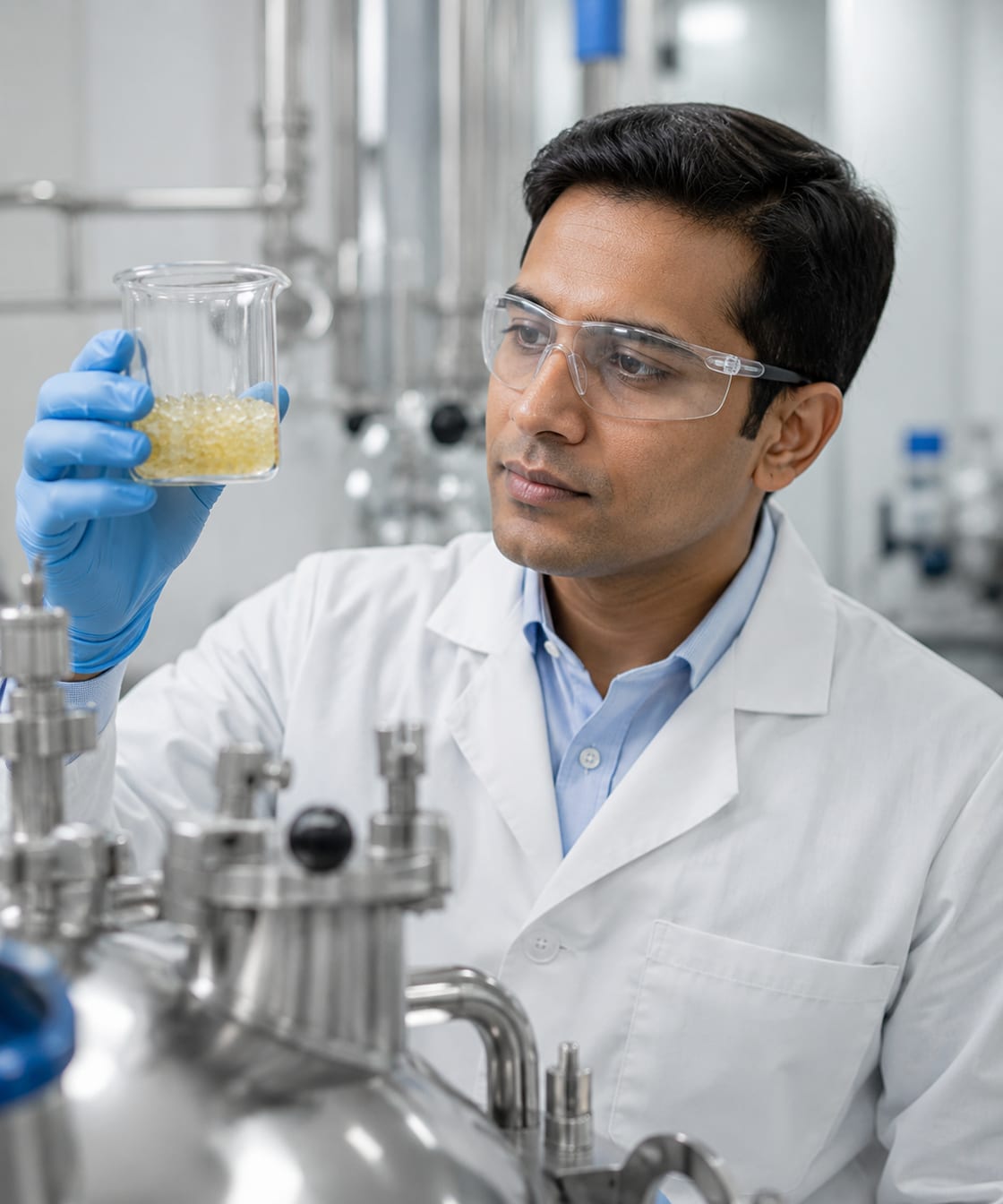
Anion exchange resin helps remove negatively charged contaminants from water, including nitrate, sulfate, and chloride. It is widely used in industrial water treatment, demineralization, and high-purity water production.
However, not every resin removes the same contaminants. Some are designed for general water purification, while others work better for specific applications.
Understanding these differences can help you choose the right resin and avoid unnecessary treatment costs.
What Is Anion Exchange Resin?
Anion exchange resin is a specially designed polymer material used to remove negatively charged ions from water and other liquid solutions.
It usually comes in the form of small beads containing functional groups that exchange ions with the surrounding water.
For example, a suitable resin can capture nitrate ions while releasing chloride ions into the water.
This process helps reduce unwanted contaminants without relying only on conventional filtration.
Anion exchange is commonly used in industrial purification systems where dissolved impurities must be controlled.
How Does Anion Exchange Resin Work?
The process begins when water flows through a tank containing resin beads.
As the water passes through, negatively charged ions are attracted to the resin's exchange sites.
The resin captures selected ions and releases other ions, depending on its chemical form.
For example, a chloride-form resin may exchange chloride for nitrate.
Over time, the resin reaches its working capacity and can no longer remove contaminants effectively.
At this stage, it must be regenerated or replaced.
Proper operation depends on the resin type, water composition, flow rate, and regeneration conditions.
What Are the Different Types of Anion Exchange Resin?
Two main types are commonly used in industrial water treatment.
Strong Base Anion Resin
Strong base anion resin contains permanently charged functional groups that allow it to exchange anions across a wide pH range.
It is commonly used in water demineralization, silica removal, and high-purity water production.
Certain grades can also remove nitrate and other negatively charged contaminants.
Strong base resins are often selected when the treatment system requires low levels of dissolved ions.
Weak Base Anion Resin
Weak base anion resin contains functional groups whose charge depends on the solution's acidity.
It is mainly used to remove strong mineral acids in suitable demineralization systems.
Weak base resins can offer efficient regeneration in certain applications.
However, they are generally not suitable for removing weakly ionized substances such as silica in the same way as strong base resins.
What Contaminants Can Anion Exchange Resin Remove?
The contaminants removed depend on the resin grade and operating conditions.
Nitrate
Specialized anion resins can reduce nitrate concentrations in water. This is useful for certain drinking water and industrial treatment applications.
Sulfate
Anion exchange resins can capture sulfate ions, although competing ions may affect the available treatment capacity.
Chloride
Hydroxide-form strong base anion resins can remove chloride during demineralization.
Silica
Suitable strong base anion resins can remove reactive silica, particularly when used in properly designed demineralization systems.
Other Dissolved Anions
Some specialized resin grades can target contaminants such as chromate or perchlorate. These applications require careful resin selection and testing.
Where Is Anion Exchange Resin Commonly Used?
Industrial Water Purification
Factories use anion exchange technology to control dissolved impurities in process water.
Power Plants
Power generation facilities use demineralization systems to prepare high-quality boiler feedwater.
Electronics Manufacturing
Electronics and semiconductor facilities use high-purity water systems where ion exchange can provide additional purification.
Nitrate Treatment
Specialized resins help remove nitrate from contaminated water sources.
Wastewater Treatment
Selected resins can remove certain negatively charged contaminants from industrial wastewater.
How Can You Maintain Anion Exchange Resin?
Proper maintenance helps preserve resin performance.
Regularly test the treated water to identify changes in contaminant removal.
Follow the manufacturer's recommended regeneration procedure and avoid exposing the resin to unsuitable chemicals.
Organic matter, oxidizing agents, and suspended solids can cause fouling or damage.
Pretreatment may be needed when incoming water contains substances that interfere with resin performance.
How Do You Select the Best Anion Exchange Resin?
Start by identifying which contaminants you need to remove.
A water analysis should include the relevant dissolved ions, pH, and other important water quality measurements.
Next, determine the required treated water quality and daily treatment volume.
Check the resin's operating capacity, chemical compatibility, temperature limits, and regeneration requirements.
For example, a nitrate treatment system may need a selective chloride-form resin, while a demineralization system may require a hydroxide-form strong base resin.
Haitron offers anion exchange resin products for different industrial water treatment requirements. Visit Haitron Resin to explore available options and discuss your application.
Frequently Asked Questions
What is the main purpose of anion exchange resin?
Its main purpose is to remove selected negatively charged ions from water through an ion exchange process.
Does anion exchange resin remove calcium?
No. Calcium is positively charged and is typically removed using cation exchange resin.
Can anion exchange resin remove nitrate?
Yes. Suitable anion exchange resins can capture nitrate, although competing ions can affect performance.
How often should anion exchange resin be regenerated?
Regeneration frequency depends on the contaminant load, resin capacity, water volume, and treatment system operation.
Where can I purchase anion exchange resin?
You can contact Haitron to request product specifications and discuss your water treatment needs.
Conclusion
Anion exchange resin is an important material for industrial water purification, demineralization, and selective contaminant removal.
Strong base and weak base resins work differently, so choosing the correct type is essential.
Understanding your water quality and treatment requirements will help you select a suitable resin and maintain reliable system performance.