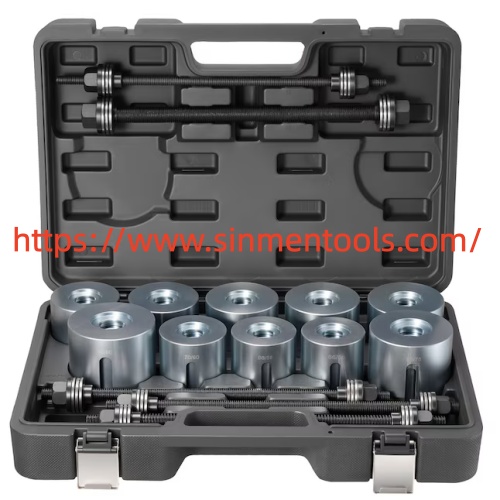
Automotive maintenance often involves components that must be fitted securely without damaging the surrounding assembly. Bushings are commonly used to cushion movement, reduce vibration, and support connections in suspension systems and other mechanical applications. When replacing worn parts, technicians need tools that allow controlled movement and stable alignment. A Bushing Press Kit can support these tasks when its components are appropriate for the assembly being serviced, making material quality, tool compatibility, operating technique, and workshop usability important considerations.
Material selection influences how a tool performs throughout repeated maintenance work. Press adapters, sleeves, threaded components, and supporting pieces may encounter substantial contact forces during installation or removal. Metal components therefore need suitable strength, dimensional consistency, and resistance to wear. The choice of material should reflect the intended application rather than appearance alone. Well-finished surfaces can also help reduce unwanted friction between contacting parts, while sound construction supports reliable handling. Buyers should consider how components are manufactured, inspected, and finished, especially when the tools will be used regularly in busy repair facilities.
Corrosion protection is another practical consideration. Workshop tools may be exposed to moisture, grease, cleaning products, and changing storage conditions. Appropriate surface treatments can help protect exposed metal and make routine cleaning easier. However, coatings do not replace proper maintenance, and damaged finishes should be inspected before continued use. Tool owners should also keep working surfaces free from accumulated dirt and debris, since contamination can affect contact and alignment. A maintenance tool's service life depends not only on its original material but also on how it is stored, cleaned, and used.
Choosing the right set begins with understanding the vehicles and assemblies encountered most frequently. Bushings differ in shape, location, access conditions, and installation requirements, so a tool that suits one application may not fit another. Buyers should review the available adapters, sleeves, support pieces, and connection methods before making a decision. Compatibility information should be checked against the vehicle manufacturer's service guidance or the relevant repair documentation. A broad assortment can be useful, but only when its components match actual workshop needs. Purchasing based solely on the number of included pieces may result in unused accessories or missing parts for common jobs.
The quality of the product information also deserves attention. Clear identification of components, understandable instructions, and accessible guidance can help technicians determine whether a set is suitable for a particular repair. For distributors and automotive equipment buyers, consistency between product descriptions, packaging, and supplied components can make inventory management easier. It is also worth asking about replacement components, packaging options, and after-sales support. These details matter when tools are shared across a workshop or supplied to customers with different maintenance requirements.
Functional design affects how force is transferred during bushing service. A properly selected adapter should contact the intended part without pressing unnecessarily against adjacent surfaces. Stable positioning helps keep the operation aligned, while suitable support pieces can reduce the chance of the tool slipping during use. Threaded mechanisms and connected components should move smoothly and remain in good condition. Technicians must still follow the relevant service procedure, secure the assembly appropriately, and avoid applying force when alignment is uncertain. No tool set eliminates the need for sound judgment or correct repair methods.
Ease of use is especially important when technicians work through varied maintenance tasks. Components that are easy to identify and arrange can reduce time spent searching for the correct piece. A consistent layout also makes it easier to notice missing accessories before a job begins. During operation, accessible working positions and manageable tool handling can help technicians maintain attention on alignment and the condition of the surrounding assembly. These practical details support a more orderly workflow without encouraging rushed work. After each use, cleaning the components and returning them to their assigned locations can help preserve readiness for the next repair.
Appearance and storage design contribute to the overall workshop experience as well. A well-organized case or holder keeps components grouped together, reduces the likelihood of misplaced parts, and makes transport between work areas more convenient. Durable packaging can also help protect metal surfaces during storage and shipping. Clear labels or visual distinctions between component types make identification more straightforward, particularly when several technicians share equipment. Although appearance does not determine mechanical performance, thoughtful organization can communicate care in product development and support a cleaner, more professional working environment.
For tool manufacturers, balancing these considerations requires attention to production consistency, practical feedback, and the needs of different customers. Taizhou Xinming Technology Co., Ltd. manufactures hardware tools and automotive maintenance equipment, with product development and customization supporting varied workshop applications. Buyers evaluating tools for bushing-related work can discuss their intended uses, preferred component arrangements, packaging needs, and compatibility requirements with the company before choosing a suitable solution. Further information about its automotive maintenance tools and manufacturing capabilities is available at https://www.sinmentools.com/.