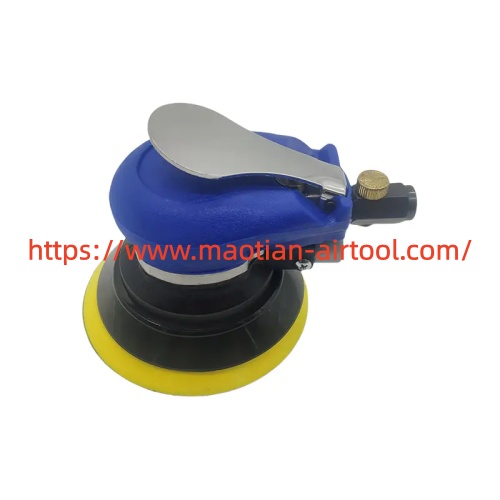
5" Air Random Orbital Sander swirl marks appear when the free spinning motion of the pad is interrupted or when contact conditions prevent the scratch pattern from blending evenly. One frequent source is downward force applied by the operator. The weight of the unit plus a resting hand is normally enough to keep the disc cutting. Adding extra pressure slows the independent rotation of the pad and turns the motion into a more regular circle that leaves clear curved tracks.
Speed of movement across the surface also plays a large role. When the unit travels faster than about two inches per second each point on the workpiece receives fewer overlapping passes. The individual circular scratches do not have time to be crossed by later strokes and remain visible after the finish is applied. Slowing the stroke rate and keeping the path continuous allows successive orbits to erase the previous pattern.
Condition of the backing pad contributes directly to mark formation. Over time the foam or elastomer face can become compressed rounded at the edges or contaminated with adhesive residue. A pad that no longer sits fully flat loses even contact and begins to rock. The resulting imbalance produces a repeating series of arcs rather than a truly mixed pattern. Replacing the pad when the hooks no longer hold the disc firmly or when the face feels uneven restores proper geometry.
Supply pressure measured at the inlet while the unit is running must stay near the rated level usually ninety pounds per square inch. When pressure falls the free speed drops and the pad no longer generates enough independent rotation to randomize the scratches. An undersized hose long runs or multiple tools sharing the same line can all reduce delivery enough to create this condition. Checking the reading under load rather than at the compressor tank confirms whether the unit is receiving what it needs.
Disc condition and grit sequence influence the visibility of any remaining marks. A loaded or worn abrasive generates more heat and friction which again slows free rotation. Jumping from a coarse grit directly to a fine one leaves deep scratches that the finer disc cannot fully remove. Working through intermediate grades and cleaning the surface between changes reduces the chance that earlier tracks survive.
Starting and stopping technique can introduce short curved gouges. Placing a spinning disc onto the work at an angle digs a brief arc before the full face contacts the surface. The reverse happens when the unit is lifted while still under power. Setting the disc flat first then opening the throttle and closing the throttle before lifting keeps the contact controlled.
Dust that builds up between the disc and the workpiece or inside the extraction ports increases friction and can create localized high spots that dig into the material. Keeping the extraction path clear and changing discs before they load heavily limits this secondary source of marks.
When these factors pressure on the pad travel speed pad flatness supply delivery abrasive condition and start stop habits are kept within normal ranges the mixed motion produces an even scratch pattern that disappears under subsequent coatings. Small changes in any one area often eliminate the curved tracks that otherwise show after staining or painting.
Maotian designs finishing equipment with attention to the mechanical details that support consistent pad motion under typical workshop conditions. Checking the available models at https://www.maotian-airtool.com/product/ provides the specifications needed to match the unit to daily surface preparation tasks.