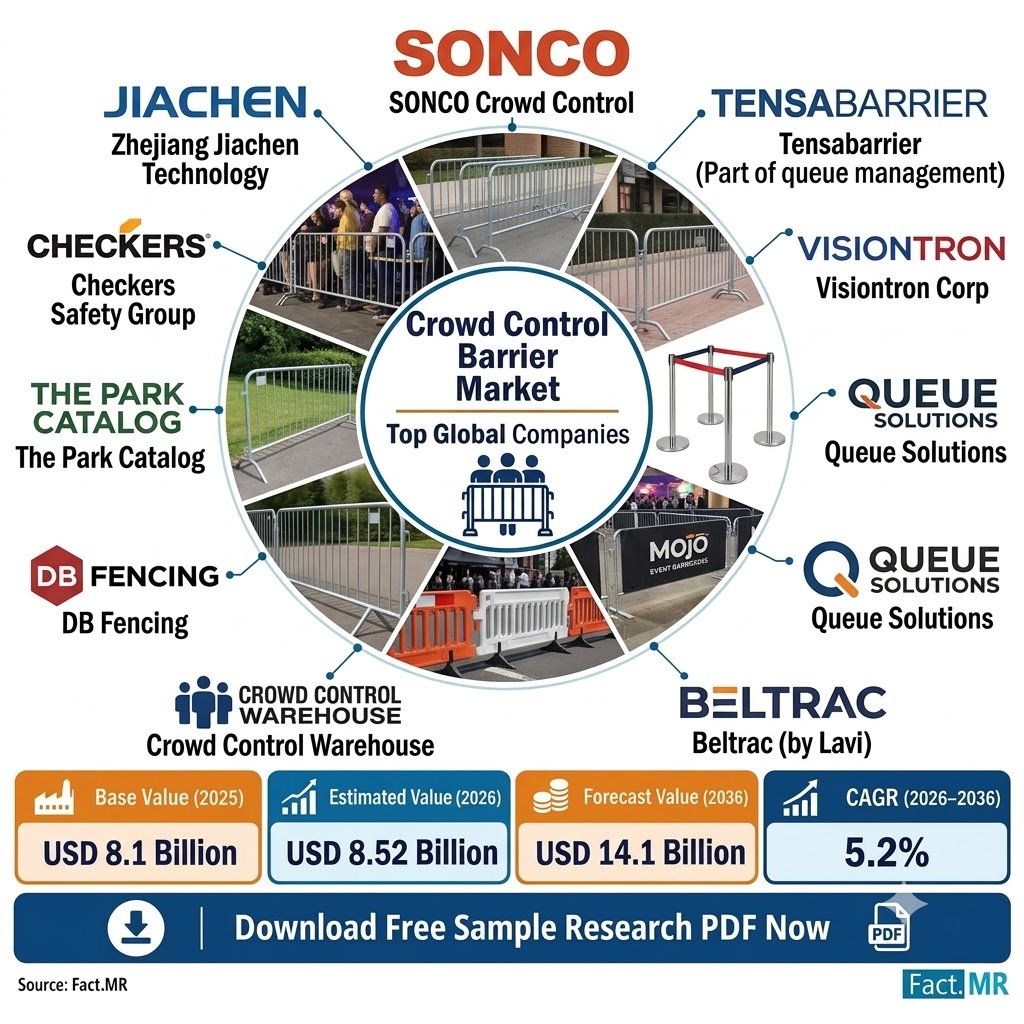
The global crowd control barrier market is projected to reach USD 14.1 billion by 2036, increasing from USD 8.1 billion in 2025 to USD 8.5 billion in 2026, according to Fact.MR. The market is forecast to expand at a compound annual growth rate (CAGR) of 5.2% from 2026 to 2036, generating an absolute dollar opportunity of USD 5.6 billion over the forecast period. Formal crowd-safety planning, growing requirements for pedestrian channelization, and demand for reusable, rapidly deployable barrier systems are shaping purchasing decisions across event venues, transportation hubs and public facilities.
Get detailed market forecasts, competitive benchmarking, and pricing trends:https://www.factmr.com/connectus/sample?flag=S&rep_id=7324
Crowd Control Barrier Market Size and Growth Forecast
- 2025 Market Value: USD 8.1 billion
- 2026 Estimated Market Size: USD 8.5 billion
- 2036 Projected Market Value: USD 14.1 billion
- Forecast CAGR: 5.2% (2026–2036)
- Absolute Dollar Opportunity: USD 5.6 billion
Key Market Segments
By Barrier Type, Material and Function
- Fence Barriers: Expected to account for 65.0% of type demand in 2026. Connectable sections establish continuous boundaries around queues, event perimeters and restricted areas.
- Steel: Projected to capture 45.0% of material demand in 2026, supported by its strength, weldability and suitability for repeated handling.
- Expandable Barriers: Forecast to represent 56.8% of function demand in 2026. Folding and retractable designs support rapid deployment, compact storage and flexible queue configurations.
By Usage, Ownership and Application
- Indoor Usage: Expected to account for 68.0% of usage demand in 2026, supported by recurring queue management and access-control requirements at event venues and commercial facilities.
- Private Ownership: Projected to represent 35.9% of ownership demand in 2026 as frequent-use organizations maintain reusable inventories for routine operations.
- Public Places: Forecast to account for 65.9% of application demand in 2026, reflecting pedestrian-routing and access-management needs across transportation hubs and civic infrastructure.
Major Market Trends and Growth Drivers
Formal crowd-safety planning: Event organizers increasingly treat barriers as part of operational safety infrastructure. The UK Health and Safety Executive recommends considering crowd behavior, visitor numbers, ground conditions, weather and crowd pressure when selecting barriers. The Cybersecurity and Infrastructure Security Agency also incorporates physical security, perimeter protection and crowd management into mass-gathering planning.
Pedestrian channelization and controlled access: Public facilities, temporary traffic-control zones and event sites require clearly defined pedestrian routes. The U.S. Federal Highway Administration recognizes interlocked longitudinal channelizing devices for delineating pedestrian paths in temporary traffic-control settings. These applications extend demand beyond entertainment venues into civic works and public-space management.
Modular systems and lifecycle efficiency: Expandable, folding and retractable products help operators adapt lane configurations without rebuilding fixed boundaries. Reusable barrier fleets also increase the importance of durable frames, stable feet, compatible connectors, corrosion protection and replaceable components. Buyers increasingly need to balance initial purchase costs with transport, storage, inspection and redeployment requirements.
However, heavy barrier fleets can increase transportation and labor costs. Poor product selection or unsafe layouts can create liability exposure, while ropes and cones remain lower-cost alternatives in low-risk environments.
Country-Level Market Growth Through 2036
Fact.MR projects the following country-level CAGRs for the 2026–2036 period:
- USA: 14.5%, supported by mass-gathering security planning and pedestrian channelization.
- Germany: 13.2%, driven by structured event-safety practices and access management.
- UK: 12.9%, reflecting guidance on crowd circulation, queuing and barrier selection.
- Italy: 12.4%, supported by public-event capacity, circulation and safety requirements.
- France: 12.3%, with formal event-security arrangements supporting controlled access and perimeter management.
- South Korea: 11.6%, reflecting organized crowd-safety planning across festivals, transport hubs and high-density locations.
- Japan: 11.2%, supported by coordinated crowd management at festivals, transport approaches and public gatherings.
These forecasts indicate differing rates of market expansion across the profiled countries. Suppliers should align product specifications, distribution capabilities and rental support with local operating requirements.
Competitive Landscape
The crowd control barrier market includes manufacturers, distributors and specialist suppliers competing on structural integrity, portability, connection design, installation speed and product availability. Rental and event-service capabilities also influence competition, particularly where customers need equipment for temporary deployments.
Key companies profiled include:
Tamis Corporation, Viking Fence, PRO-TEK Temporary Fencing, ZND UK Ltd, Seton, SONCO Worldwide, A1 Barriers, Ideal Shield, Fortress Fencing, EventBarriers.com, Calco Metal Works Inc., Otter Fence & Bridge, US Netting Inc., Alpha Crowd Control, Verge Safety Barriers, Sinobc (Shanghai) Supply Chain Management Co., Ltd., World Fence News, Barriers Direct, TrafFix Devices Inc., EMPTEEZY Group, Area Four Industries, Hebei Giant Metal Technology Co., Ltd., Snelder Gruppen AB, Arena Group, Tensator Limited, Hebei Dunqiang Hardware Mesh Co., Ltd., ZND Holding BV, Armorgard Ltd., Mojo Barriers BV, TTFS, North American Safety Products, Inc., Schake GmbH, Anping DB Metal Fences Co., Ltd., and Frontier Polymers Ltd.
Strategic Implications for Manufacturers and Buyers
Manufacturers can strengthen their competitive position by designing systems for repeated setup cycles, standardized connections, compact storage and field-replaceable components. Offering compatible steel, aluminum, plastic and composite options can help address different handling, corrosion and weight requirements.
Venue operators and rental companies should prioritize inspection procedures, connector compatibility and maintenance support. Suppliers must also distinguish pedestrian crowd-control barriers from appropriately rated hostile-vehicle mitigation systems to prevent specification errors and unsafe substitutions.
Analyst Perspective
“Crowd control barrier demand is increasingly shaped by operating discipline rather than simple perimeter creation. Buyers are looking for systems that can be moved, joined, inspected and redeployed without creating pinch points or slowing entry. That puts connection design, fleet durability, handling efficiency and layout flexibility at the center of product selection.”
— Shambhu Nath Jha, Principal Consultant, Fact.MR
Top Trending Reports:
Global Pumps Market Industry Outlook to 2036: Strategic Insights for R&D, Expansion, and Market Development https://www.openpr.com/news/4384268/global-pumps-market-industry-outlook-to-2036-
Next-Generation Vaccine Market Trends 2026-2036: Innovation Catalysts, Regulatory Impact & Revenue Forecasts https://www.openpr.com/news/4384272/2036-global-biomaterials-market-intelligence-report
Global Softgel Capsules Market Size, Share & Forecast: High-Growth Segments, Value Chain Insights & Opportunity Mapping https://www.openpr.com/news/4384250/global-softgel-capsules-market-size-share-forecast
About Fact.MR
Fact.MR is a market research and consulting firm providing industry intelligence, market sizing, competitive analysis and growth forecasts to businesses across global markets. Its research supports strategic planning, investment assessment, product development and commercial decision-making.