EU Battery Storage Industry: Business Models and Future Opportunities
Battery storage is creating new opportunities across Europe’s electricity value chain. Equipment manufacturers, project developers, utilities, software providers, infrastructure investors, and energy traders are exploring ways to participate in a market shaped by renewable deployment and changing power-system requirements. Commercial success depends on understanding not only technology but also how storage assets earn revenue, connect to networks, and operate throughout their lifetimes.
An evolving industry structure
The battery storage value chain extends from cell manufacturing and system integration to project development, financing, trading, maintenance, and recycling. Each segment addresses different customer needs and faces distinct competitive pressures.
Manufacturers compete through product performance, safety, cost, and supply-chain reliability. Integrators coordinate batteries with inverters, controls, thermal management, and protection equipment. Developers identify suitable sites, secure permits, arrange grid connections, and build financing structures.
Software providers support forecasting, asset monitoring, energy management, and automated market participation. Operators use these tools to coordinate physical performance with commercial commitments. Service companies maintain equipment and help owners manage degradation, availability, and component replacement.
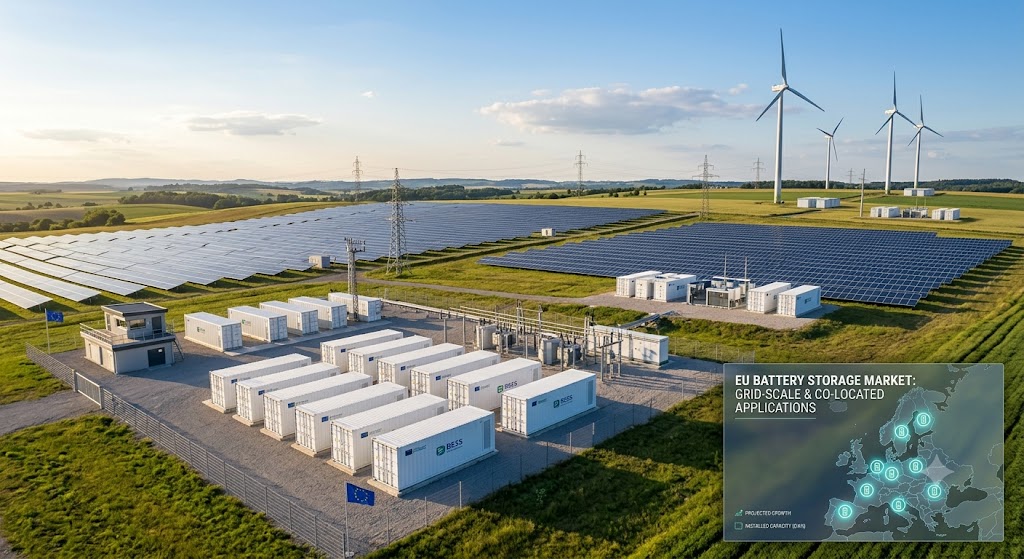
The EU Battery Storage (Grid + Co-located) Industry offers a useful lens for evaluating how these business segments interact and where commercial opportunities may emerge.
Business models and revenue strategies
Standalone batteries often rely on combinations of wholesale electricity trading, balancing services, ancillary services, and contracted capacity arrangements. The available mix depends on location, qualification, market access, and the battery’s technical characteristics.
Co-located batteries operate alongside renewable generation and can help shift output, reduce exposure to unfavourable price periods, or improve the utilisation of shared infrastructure. Their commercial arrangements may involve renewable developers, electricity buyers, asset owners, and specialist traders.
Some projects use tolling agreements, under which a counterparty obtains rights to operate storage capacity under defined contractual conditions. Others combine merchant exposure with minimum revenue guarantees or service contracts. Each structure distributes operational responsibility and market risk differently.
Revenue stacking can improve asset economics, but it requires realistic scheduling assumptions. A battery cannot always provide several services simultaneously, and frequent cycling can increase degradation. Commercial models should include opportunity costs, efficiency losses, and availability limits.
Factors influencing competitiveness
Grid access remains one of the most important project-development considerations. A technically attractive site may prove commercially unviable if connection costs are excessive or export restrictions limit dispatch. Developers must evaluate network capacity, permitting requirements, land arrangements, and construction schedules before committing substantial capital.
Technology procurement also affects competitiveness. Buyers should compare usable energy, power output, efficiency, safety provisions, warranty coverage, degradation assumptions, and service arrangements. Supplier financial strength and replacement-component availability matter over the project lifecycle.
Digital capabilities can influence returns by improving forecasting and dispatch decisions. Software should integrate reliable market data with system constraints and contractual requirements. Clear cybersecurity controls and transparent reporting help asset owners maintain confidence in operations.
Competition is likely to intensify as deployment expands. Falling equipment costs may support new projects, but additional capacity can reduce revenue opportunities in established markets. Companies should avoid relying exclusively on optimistic price forecasts or a single revenue source.
Opportunities for investors and service providers
Investors can pursue development-stage projects, operational assets, portfolio acquisitions, or infrastructure partnerships. Each approach carries different construction, financing, technology, and market risks. Diversifying across countries and revenue models may help reduce exposure, provided that the underlying risks are genuinely distinct.
Utilities can integrate batteries into generation, trading, and customer-supply portfolios. Renewable developers can explore hybrid projects, while specialist operators can provide optimisation services to asset owners lacking internal trading capabilities.
Service providers may find opportunities in maintenance, safety assessments, performance analytics, software integration, and end-of-life management. Recycling and responsible material recovery could become increasingly important as the installed battery fleet matures.
Future outlook
Europe’s battery storage industry is moving toward more integrated business models in which physical assets, software, financing, and market access work together. Growth will depend on grid investment, regulatory clarity, renewable deployment, and commercial structures that appropriately distribute risk.
Companies best positioned for long-term success will combine technical reliability with disciplined project development and realistic financial planning. Rather than competing solely on equipment price or installed capacity, industry participants can differentiate through dependable operations, strong customer relationships, and measurable lifecycle value.
Battery storage will not resolve every electricity-system challenge, but it can become a valuable component of a more flexible European energy infrastructure. Sustainable opportunities will emerge where technology, market design, and customer needs are aligned.